Showing posts with label Oliver Stone. Show all posts

Gary Oldman: The Hollywood Interview

Actor Gary Oldman.


GARY OLDMAN:
WORKING CLASS HERO
By
Alex Simon


Editor’s Note: This article originally appeared in the September 2000 issue of Venice Magazine.

Mel Gibson once said of actor Gary Oldman "He's kind of like Mr. Potato Head. It's like he has this ability to transform himself into something different at will." To the point, no other English-speaking actor since say, Dustin Hoffman, has donned such a wide variety of cinematic masks (including that of director) as the versatile, London-born Oldman. Born the youngest of three children, and the family's only boy, in the tough, blue collar section of South London in 1958, to a welder father and homemaker mother, Oldman endured a near-Dickensinian childhood. After his father left the family when Gary was seven, he managed to survive his formative years at a brutal boys' school, and won a scholarship to the Rose Buford College of Speech and Drama. Oldman's talent was spotted early, and his career on the London stage took off, followed by his film debut in 1986.

An actor of uncompromising intensity, commitment and range, Oldman blasted into the world's collective consciousness in his film debut as doomed punk rocker Sid Vicious in Alex Cox's visceral 1986 film Sid and Nancy. Oldman then played another British working class icon, with his masterful portrait of the flamboyant gay playwright Joe Orton in Prick Up Your Ears(1987). Memorable work followed in films such as Nicolas Roeg's Track 29(1988), Phil Joanu's State of Grace (1990), and Rosencrantz and Guildenstern(1990), but it was Oldman's turn as one of American history's most mysterious figures, Lee Harvey Oswald, in Oliver Stone's controversial JFK (1991) that firmly placed him on the map as one of world's greatest living actors. Blessed with an ability to inhabit the skin of the character he is playing, Oldman's work as Oswald, as well as turns playing such diverse figures as Bram Stoker's Dracula in Francis Coppola's 1992 film, and Beethoven in Immortal Beloved (1994), all give insight into people and/or characters previously thought inaccessible. Oldman's in-depth interpretations made these cultural icons all-too-human.

Other noteworthy performances include scene-stealing work in films like True Romance (1993, as a white, Rastafarian drug dealer), Luc Besson's The Professional (1994, as a drug-addicted crooked cop who listens to classical arias as he shotguns innocent families), and the blockbusters Air Force One (1997, as a terrorist leader),The Fifth Element (1997, as a wonderfully goofy intergalactic baddie who sounds as if he was raised in the bayous of Louisiana), and Lost in Space (1998, as the nefarious Dr. Smith).

Oldman made his writing/directing debut with the searing domestic drama Nil by Mouth (1997), about an abusive familial situation in Oldman's old stomping grounds of South London. The film was released to widespread critical acclaim on both sides of the Atlantic and revealed Oldman to be as gifted an artist behind the camera as he is in front.

Gary Oldman also has the distinction of being one of a handful of great actors for whom an Oscar nomination has proved elusive. That could all change with his latest film, The Contender. The Dream Works release is a riveting political drama, telling the story of Vice-Presidential nominee Laine Hansen (Joan Allen) who is put through a grueling confirmation hearing, led by one Senator Shelly Runyon (Oldman), a veteran politico who is determined that Hansen will not make it to the nation's number two office, especially when his staff uncovers a possible sexual indiscretion during her college years. Oldman's performance as Runyon is a deliciously layered, complex piece of work which the actor pulls off with panache. Oldman just wrapped work on Ridley Scott's Hannibal, the long-awaited sequel to Silence of the Lambs, in which he co-stars with Julianne Moore and Anthony Hopkins.

Just when the Oscar buzz for Oldman seemed like a sure thing, ugly rumors of internal strife on The Contender's set started to surface, highlighted by a controversial Premiere Magazine piece on the subject. What followed was a Rashomon-like series of allegations and accusations with writer-director Rod Lurie on one side, saying that Oldman, whom he calls "a conservative," suffered from "Stockholm Syndrome" and over-identified with his character, feeling that Runyon was the moral hero of the piece. On the other side are Oldman and manager/producing partner Douglas Urbanski, claiming that they were both quoted and interpreted out of context, including (according to the Premiere article) Oldman's accusation that DreamWorks re-cut the film to have a more liberal agenda. Oldman has long had a reputation as a man who speaks his mind and doesn't suffer fools. The actor sat down with Venice Magazine recently in Urbanski's West Hollywood offices to set the record straight, and to shed light on one of the most distinguished acting careers of his generation.

There seems to be a difference of opinion on how things transpired during the making of The Contender. Where should we start?
Gary Oldman: Well, (Rod Lurie) is something of a revisionist, really. All this talk of me suffering from "Stockholm Syndrome" with my character is ludicrous. It's one of Rod's theories that is based on nothing. If he were to get in the ring with me and go toe-to-toe on acting, who do you think knows more? He says these things, just runs off at the mouth. He said them when he was a critic. He said them in his film class. And he said them on the radio. You go 'You don't know what you're talking about.' One gets taken over by a character. Many years ago, Laurence Olivier was playing a character that he really didn't like. He was sort of standing outside the character looking at it, and was being sort of patronizing towards the character. And a good friend of Olivier's said to him "If you don't find something nice about this character, if you don't love this character, you will never be able to play him." If I stand in judgment of the characters I play, where does that leave me? There's a lot that Runyon does, that actually does make sense to me. I find a lot of that "Stockholm Syndrome" stuff really insulting, both to me and to actors in general. He doesn't know what he's talking about. I don't want to sit here and take cheap shots. This feud, this thing that has bubbled up, has become this sandstorm. I don't even know if it's interesting. It is odd that the word "conservative" has become the sort of politically-correct bad word to call someone. We've even had people call here and say "I didn't know Gary was a conservative," like they were saying I was a Communist. It's been really strange. I have never, politically or publically, claimed affiliation with any party. So this is just a story that got out there, maybe based on a few comments I made in the Premiere piece. And these things just have a way of spinning out of control. They talk about movies, and TV, and video games being the new kind of evil towards kids. It's replaced rock and roll, hasn't it? The Internet, I think, is a more insidious weapon, because it's like an expressway to the world. It's not just in one paper, one edition. If I'm misquoted in Premiere magazine, then a bastardized version gets out there, and the Daily Mirror are writing about it in England. Years ago, it was tomorrow's fish and chips paper. Now, it goes into the file. So this sandstorm that's been kicked up, it's all been a bit bemusing, and rather hurtful.

Let's start at the beginning. How did you see The Contender as story. How did you see your character Shelly Runyon, and what drew you to the project as a whole?
It's not only how I saw it. There was a creative team. Two of that team are myself (executive producer) and Doug Urbanski (co-producer). The other half was Rod Lurie and Marc Frydman (also a co-producer). If you're going to make a movie with anyone, you have to meet a lot, talk the thing to death, and you have to be on the same page. We never used the words "bad guys" or "villains" or "heroes." What was very interesting initially about the material was that ambiguity. We discussed with Rod the complexity of Runyon's character and that we had to be careful not to let Shelly Runyon twirl his mustache, so to speak. This indirectly brings us back to Rod's "Stockholm" comment and why I object to it so much. Firstly, an actor doesn't have to suffer from a psychotic disorder to be good. Second, the comment is saying that I'm out of control. Thirdly, I didn't invent any of this. Rod and I discussed Runyon. It was never black and white. Never good guys vs. bad. One could argue that (Jeff Bridges' character, the President) Jackson Evans is an egomaniacal man obsessed with food and ending his term with a controversial bang by appointing a woman. Runyon doesn't invent the sex scandal. If there's a weakness in his character, it's the (way he uses the) scandal. Instead of fighting her on the issues, i.e. abortion, her atheism, her wanting to ban handguns, and wanting a centralized, Orwellian government, he goes for the cheap shot. The turning point for me was the score. That was the big red flag for me. Everytime Runyon appears, there's this dark, sinister music playing. I believed it would contaminate the audience. The movie we discussed allowed the viewer to make up its mind. Now they're being told "This person's good, this person's bad." Music isn't Rod's forte and on viewing Deterrence (Lurie's directing debut) one of our big talking points going into The Contender was the music. We felt the music could be more quirky and witty, a bit like in Rushmore. The music playing at the end of The Contender now, you could put on the end of Hannibal because it's like horror movie music. The other disappointment was the poster and trailer adverting. The line reads "You can assassinate a leader without firing a shot." I thought I'd already made that movie. (laughs) I thought that was an obviously partisan shot, saying isn't that what happened to Clinton?

And you feel that the final product didn't reach the height you originally saw it reaching?
I liked an earlier cut that was more ambiguous and more loyal to what was originally on the page. That was not a four and-a-half hour cut, by the way, which I've also read somewhere. This also wasn't a longer cut with me in it more. (laughs) It was, I thought, an edgier, more ambiguous film.

Was there really as much internal strife happening as the Premiere piece would have you believe?
No, not at all. It was a really nice shoot. It was one of the nicest shoots that we've ever had. The beef with DreamWorks was never about The Contender itself, it was about something else, a contractual issue. There was some bad blood there for a couple of weeks and it got resolved. Let me make it clear that I'm a champion of DreamWorks. They picked up the movie and released it.

As the film is now, the version playing in theaters, how do you feel about it?
I feel good about it! I haven't seen it for a while. They were some changes made to it that I haven't seen. As producers you have two jobs: the first is to sort of chip away at the cut to make the film better and better. The second is to honor the director's vision and his cut. I always said that the notes we gave were suggestions. We never said, we were never in a position, where we were laying down the law. It's not a studio where they say "shoot this ending, or else." That's totally against our philosophy. On the one had we wanted to peck away at the film, on the other we wanted to honor Rod's cut. Making a film is not a democracy. There has to be one voice and one vision.

There's an amazing cast in this film. How was it working with them?
I think back on it with great affection. It was terrific. I loved Richmond, VA. We had a beautiful summer and they were all nice people. I don't have to talk about their work, because it speaks for itself, particularly in this movie. We all got along very well. We had a lot of laughs. We had fun making this film. It was a very nice experience that has, sadly, soured a little.

Let's talk about your background. You grew up in South London.
Yes. I have two older sisters. My mom was a housewife. My dad was a welder.

Were either of your parents artistic?
My mom sang. Still sings, given half the chance. My dad made models, like remote controlled boats and things, from scratch. He was an engineer in the Navy during the war. I have some letters, as well, that he wrote, which are quite beautiful. He was a real poet.

Were you always drawn to things creative?
Well, I was taken to the circus as a small boy and hated it. I remember screaming...and we left. (laughs) Never keen on pantomime, although we have that tradition. I loved movies. I also painted, and drew, and made models, and always off on my own doing something. The thing I do remember is that my mother had this wide white plastic belt like they had in the 60's. I put cigarette packs on it, painted it yellow, and it became my Batman utility belt! (laughs) I did things like that. I was always taking stuff and turning it into something else.

Was there one movie that did it for you?
Well I loved The Beatles. One of my sisters was like 16, 17 when that happened. And the first movie I saw was A Hard Day's Night(1964). She took me to see it in a cinema that is now a supermarket. My sister Jackie liked the movies a lot, and the ones that I could get into, she would sort of drag me along. I loved Hammer horror films when I was a kid, but of course, I was too young to see it. So what my sister would do, she'd go see Dracula with Christopher Lee, and she'd come back, and I'd make her tell me the whole movie! That was a given, that I made her promise she had to do! She'd say "Well, it starts with this belltower, and there's this blood dripping. Then this guy comes in..." and she'd describe it to me.

When did you know you wanted to act?
Well, it's an old story. I saw Malcolm McDowell in a movie called Raging Moon (aka Long Ago Tomorrow, 1970) and that was it. It was like a moment of clarity. 'This is it.' That was lightning bolt. You have to think, is there such a thing as a coincidence, or are things predestined? I knew that to get into drama school, I had to have a Shakespeare monologue and a modern monologue. Having never read any Shakespeare, I went to Fowles bookstore in the West End, to the drama section, and looked for books on speeches. I looked at the binders, and there was a book that said "Audition Speeches for Men." I opened it up, flicked through it, and came across the speech of Sloane, in (Joe Orton's) Entertaining Mister Sloane. And I read the speech, and I thought 'This is good.' Then I sought a guy out called Roger Williams, who was then the artistic director of the Greenwich Young People's Theater. I said 'I wanna go to drama school. I've got the modern speech, but I need a Shakespeare.' So he picked a speech from "Two Gentlemen of Verona."...So I got into to drama school, my education began, and I later played Sloane, and later played Joe Orton. Strange...

You made your film debut in Sid and Nancy (1986). All the characters you play you seem to embody, and seem to learn something about them. What did you learn from Sid Vicious?
If there's anything I learned from Sid, it was not to do heroin.

Did you have access to any of his friends or family for research?
I was able to speak with his mother, who was very helpful. That locket I wear in the film was actually his. She loaned it to me. I believe she committed suicide later. It was wonderful meeting her. It was sort of like being able to play John Cassavetes and having access to Gena Rowlands! (laughs)

Do you think even if he hadn't had access to drugs that he would have been doomed, regardless?
Probably, yeah. It would have been something else.

Do you think some people are born inherently self-destructive? That that's part of their genius?
I think there's a side to us all where some days we just get out of bed and want to smash it all to pieces and start again, full stop. You go to extremes because you just want the body to feel something. Whether it's sex, or booze, or drugs, or running, or weight-lifting. But self-destructive people, I think, are rarely born that way. I think their behavior is more the symptom of an event, or environment. I've been working on my own self for years, and my own self-worth, so I know what it feels like to have that side of Gary that is the self-destructive side. It does surprise me when we are shocked by someone in the entertainment industry breaking the law, or what would appear to be a moment of insanity or craziness. Why should we be shocked by that? Look what we do for a living! My son will take Lego bricks and take his little car and a stick from a lollipop, and create a world. He's at that age now, three, where the whole imagination starts to kick in. That's what I do. I just get paid for it. It's a very strange way of earning one's living: you go into work. You have to summon up emotions, because acting is feeling. I don't speak in absolutes, mind you. In my experience of two decades acting, I am convinced that it is not intellectual. First of all, it's concentration. And it is a sensation. It's a physical thing. You have to plug-in, or connect somewhere to stimulate the required emotion. Then at the end of the day, someone says "Cut. Wrap." and you're supposed to sort of go home and be all sort of nice and sane, and fluffy. And you've been invoking the spirit of your dead father all day, or whatever, to get to "the place." My analogy has always been that it's like a snowshaker. You go into work and shake this thing, and all these feelings and things come up. Then you're supposed to go home, have a beer, put your feet up and watch TV. The more I do it, the better I am at it go at the end of the day, the more capable I am of doing that. But there's a residue of something. It's a feeling, for Chrissakes. It doesn't surprise me all the problems Robert Downey, Jr. has had. He's fucking talented! He's an extremely talented man. I've never really met anyone in the arts who didn't have that side. The thing about Sid and Nancy is, it was a very depressing shoot. Now here's where something can get taken out of context. I say 'The shoot was depressing.' Then I read somewhere that I don't like (director) Alex Cox, or I didn't get on with (co-star) Chloe Webb. No. It was depressing, because you were in that head space every day for 17 weeks, and it bummed me out. But did I know I was acting? Yes. Did I think it was real? No. Was I suffering from "Stockholm Syndrome"? No.

Joe Orton was a fascinating character as well, also very self-destructive.
Joe, I'm sure, would have become a victim of AIDS, one of the first, had he not been murdered. People think "self-destructive" equals drugs and booze. Sex is another form of addiction that you can be very cavalier with.

You worked with the legendary Nicholas Roeg on Track 29. What was he like?
Adorable. I was still very young, green. I did Sid Vicious and Joe Orton back-to-back. There was no planning in that, there rarely is. So I made a bit of a splash with those. When I was working with Nic Roeg, he said "You're sort of the fair-haired boy of the moment, aren't you? Just wait, pretty soon they're going to want to see what you've got downstairs," and he sort of feigned a punch at my crotch. And he was right.

JFK had you playing Lee Harvey Oswald, arguably the most mysterious figure in American history. What did you learn about Oswald during the course of your portrayal?
We had that gun that he used. And I was up in the window of the book depository. It's not possible (that he made those shots). I'm not as paranoid as Oliver (Stone), but he's certainly on to something. Oswald probably was, in some capacity, set-up. There was something going on. There were too many coincidences and too many strange events. I mean, he's been a radar operator at an American air base in Japan for U-2 spy planes. He goes to Russia. He denounces his American citizenship. He meets this woman, marries her, then comes back at the height of the cold war, at the height of McCarthyism, when they were debriefing tourists who'd been there, and he got back in?! And they were like, "Oh, he slipped through our net." With that record?!

What about his psychology?
I think he was not too bright. Very keen, very idealistic, very naive. Easily manipulated. The set-up is, you look at the paper trail he left, he must've been told by others to do what he did. It was too perfect. It was almost like it was scripted. You can buy any gun over the counter, but he had to order that rifle so there was a paper trail to him. And actually it's not the gun that they found. The first gun was the Mauser, that then disappeared, then reappeared.

How was it working with Oliver Stone?
He's a force of nature. Brilliant. Self-destructive. He might want to watch that, curb that a bit. Great vision. Angry. Good. He's good. His energy is just enviable. A powerhouse. I had a great time working with him. Oliver saw me in State of Grace and that's what convinced him to cast me as Oswald. He said he saw an "intensity" and "haunted quality" in my character and wanted Oswald to have that same sort of withdrawn, haunted quality. I remember I was very isolated on that shoot, didn't hang out with anyone. I stayed in my hotel room on my own, ate on my own, walked around town on my own. There's a part of me that is that, a loner.

Isn't that a necessity in being a creative person, having time alone?
Yeah, but you have to get it from somewhere around you. You have to be living life. But if you're writing, or working on a character, there are pockets of concentration you need, where it helps to be alone, to have quiet. But you should never lose observation and imagination.

Francis Ford Coppola's Dracula was incredibly cinematic. Tell us about working with him.
Wonderful. A lot of rehearsal. We had four weeks of rehearsal. Coppola gives you room, gives you space, leaves you alone, really. It comes back to that thing of casting well and knowing when not to say something. Knowing when not to step in. Even though what an actor's doing might not be exactly your take on it, or you're not sure where they're going with it, you can't stifle the creative process. You have to let it breathe, then maybe later, come in and say 'Well, you're going off a bit there," or "Why don't you think about this?"

How long do you generally like to rehearse?
Oh, I could rehearse for years. There's something about the actual filming process that kind of gets in the way. It's like, do we have to film this? (laughs) This whole thing of making a movie in 28 or 30 days, maybe Sidney Lumet can do it, and God bless him, but the process is really hurt (by rushing)...I have a script now called Joe Buck that I spent a couple years writing that I'm now trying to raise money for. I have a certain process that I like to work with. And if I can't make my movie my way, I won't do it, as simple as that. "Can't you do it like this? Can't you do it like that? Can't you get him, he's a star? Do you really need that many days?" It's hard.

Drexel, your character in True Romance was a small part, but it's still one that people remember.
Yeah, they remember that and the "eggplant" scene, which was really like a short, wasn't it? It's like a one act play in itself. Very well-written. One of the few films I've made where you just shot what was there because the script was so good. The Contender had one or two little tweaks and re-writes, but it was more or less what was there, as well. Hannibal, which I've just done, was written by Steve Zaillian. Same thing.

I loved The Professional, and Leon, the European version, even more.
I was dating a girl at the time who had been a girlfriend of Luc (Besson)'s. He came to town and we met and he said "I have something for you, I think." He gave me the script and that was it.

How does he work with actors?
He tells you how to move, how to speak, where to stand. He tried that with me (laughs), not always with the greatest success. You have to be open to ideas, and it's okay if someone has a better idea than you. You can't nest and be so closed off. You act and direct with an open hand. It's about collaboration. There's one vision, ultimately. I am there to serve the director's vision, and I respect that. I'm not just going to stamp my foot and demand my own way. I'm going to go with the flow. If you come in open, you rasie the ceiling. You want an atmosphere where you can do your job. I'll offer up ten ideas, and I'll be lucky if the director uses one, but that's what I'm paid for, surely. The scene will only be as good as the director. If he's closed off, to the actor's creativity, then there's no surprise, and the scene will only be as good as the director.

In Immortal Beloved you gave a brilliant interpretation of Beethoven. What do you think made him tick?
Well, it was all about artistic control. He was like the Orson Welles and John Cassavetes of the music world. He wrote with passion. He wrote about feelings and emotions and he wrote what he wanted to write. Most of the work from that period was commissioned, because that's how you earned your money. It's hard to believe that most of what Mozart wrote were gigs! You listen to "The Requiem," and you can't believe that it was a commission! That he just sort of wrote it. But Beethoven wrote what he wanted to write.

Your writing/directing debut, Nil by Mouth, was a shattering portrait of the British working class experience. Tell us about its genesis.
Well the story is a fictional one, first of all. You work with thoughts, feelings, ideas. I guess my own upbringing. It's a film about codependency. It's a film about dependency. The idea for it had been swimming around for a long time. I always say that it took 35 years in development, and five weeks to write. It wasn't a desire to play with the toys, so to speak. There's no short film, no MTV videos. I shot it in the area where I grew up. It's a very matriarchal society. A lot of single moms. I don't like those men, although I'm completely fascinated by them, but I can't say I ever really was one of them. Growing up, my passport to manhood was booze. Once you got a certain age, you went to the pub. So I was around those men and my sister was married to a man who was a bit of Ray (the husband), although it's a thumbnail sketch. So I wanted to paint a portrait of that world, with the men at the pub talking nonsense and the women at home talking common sense and that represented them, without making fun of them.

I've been a fan of Ray Winstone, who played the husband, since Scum and Quadrophenia. What was he like?
Oliver Stone, ditto. (laughs) Please see the above! We called him "Hurricane Ray." Before I became an actor, I remember seeing Ray in Scum, had never worked with him, never met him and I was writing that character and had no face for him, really. I had a face, you know: red and puffy, and toxic. A toxic person. Then I thought, who could play this? Then I thought of Ray, with a few pounds on him.

His character in Scum could have been the same guy as a kid.
Yeah, absolutely. I sent it to his agent and, unlike here, he gave it to him immediately. He read it and called me back the next day and said "It's fucking brilliant. I'll do it." The next day!! Two days later I met him, and we talked about it. It's funny, you send stuff to people here and you just never hear back. Never even just a courtesy call saying they received it.

Any advice for first time directors?
(long pause) It's a hard one. I don't know if I can use myself as an example, because Nil by Mouth wasn't a piece of cake getting set up and getting financed, but being Gary Oldman the actor didn't hurt. At least you get into the room with the people. We're meeting people tonight for Joe Buck, who are meeting with us because I'm Gary Oldman, although that doesn't mean they'll give me the money. I'm a little more hard-nosed, because if I can't make Joe Buck the way I want, I won't do it. That's not necessarily great advice for everyone. We're all different. I believe the process is the process. It has to be respected. It takes time. I will not cast a star who's not right for the role just to get the film made. I will not change the dialogue, the language or the ending to get a rating. I have my own editing process, which is longer. I believe you should get your first cut together and then walk away from it. Don't look at it for four, five, six weeks. Ten weeks, even. Then look at it, and you'll learn a lot doing that. In my case, I saw Nil by Mouth after a break of two months, and I said, 'Well, it's a lot better than I remember it.' I also thought it was far too long, and you just see the woods from the trees. Some of the best writing and some of the best acting in Nil by Mouth isn't in the film, it's on the cutting room floor.

What I hear you saying is 'Be yourself.'
You've got to be yourself! It's all you have. Which brings us back full circle to what we started talking about. It's all about putting your head on the pillow at night and being able to sleep, retaining some degree of integrity and peace. That's what it's about, for me. John Cassavetes said it best: "To compromise an idea is to soften it, to betray it, to make an excuse for it." I think they are very wise words.
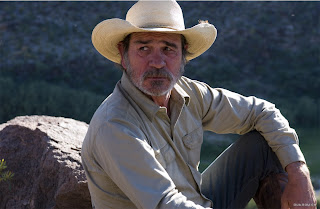
Tommy Lee Jones: The Hollywood Interview

 
Tommy Lee Jones: Director, star, co-writer of The Three Burials of Melquiades Estrada.

TOMMY LEE JONES DIGS DEEP
By
Alex Simon


Editor’s Note: This article originally was published in the December/January 2005-06 issue of Venice Magazine.

Tommy Lee Jones first brought his trademark intensity to the box office hit Love Story, in 1970, playing the small, albeit memorable role of Ryan O’Neal’s roommate, a Harvard football player. Appropriately enough, Jones himself was a real-life star of the Harvard gridiron, and graduated with a degree in English Literature just two years prior to Love Story’s release. Born in San Saba, Texas September 15, 1946, Jones was raised in the Midland area of west Texas, and spent his formative high school years at the exclusive St. Mark’s Academy in Dallas. After years perfecting his craft on the stage and in smaller films, Jones first garnered attention with his portrait of Howard Hughes in the 1977 television film The Amazing Howard Hughes, a turn that many consider the definitive portrait of Hughes by an actor to this day. Jones became a household name with his complex portrait of Doolittle Lynn, the ambitious husband of country singer Loretta Lynn (Oscar-winner Sissy Spacek) in Michael Apted’s 1980 classic Coal Miner’s Daughter. From that point on, Jones’ career has moved forward with a momentum that hasn’t ceased.
Tommy Lee Jones, who won a 1993 Best Supporting Actor Oscar for his portrait of the Javert-like U.S. Marshall who relentlessly pursues Harrison Ford’s Dr. Richard Kimble in The Fugitive, has now added the position of auteur to his already impressive resume. Co-written with Guillermo Arriaga (Amores Perros, 21 Grams), although Jones receives no credit, The Three Burials of Melquiades Estrada tells the picaresque story of a Texas rancher (Jones) who sets out to avenge the shooting death of his friend at the hands of a callow Deputy Sheriff (Barry Pepper). An existentialist western road trip worthy of the best films by masters such as Sam Peckinpah, Jerry Schatzberg, and Anthony Mann, Three Burials takes the viewer on a harrowing journey that you simply can’t shake off once the credits have rolled. In his feature directing debut (he helmed the television film The Good Old Boys for Turner Network Television in 1995), Jones shows that he is every bit as gifted behind the camera as before it (Jones’ acting chops earned him a Best Actor award at this year’s Cannes Film Festival). The Sony Pictures Classics release hits screens December 22 in limited release and goes wide February 3, 2006.
Tommy Lee Jones spoke with Venice over a beer during a recent stay in Los Angeles. Here’s what transpired:

This film reminded me of the great, existentialist road pictures of the 70s. Are you a Peckinpah fan?
Tommy Lee Jones: Yes, I am. Not for the clichéd reasons of violence and male bondage, but mainly for color and rhythm. It’s interesting you mention him and existentialism, because alienation is a theme of this movie, and we look at if from more than one perspective. Everyone’s an alien.

How was the film born?
Guillermo Arriaga and I thought it up together. This is the movie we wanted to make. I came up with a narrative form, which was basically an old, classical narrative form and we both liked the place and the issues there. With a classical form you can take those issues and raise even more, bigger issues, like alienation.

I like the fact that you took your time with it: the long takes, the emphasis on character. You let the characters be who they were, which you don’t see much in film anymore.
They’re all real. I would stand around the camera and say ‘You know guys, everyone in this movie’s an idiot.’ And they would say “What?!” They didn’t want to hear that because they felt they had a hierarchy of villains and heroes worked out. Eventually they caught on to what I meant, which was they were all human beings.

That’s something else Peckinpah was good at: painting shades of gray. There was no black and white in his films.
Yeah, he made very interesting characters. You just reminded me of the two killers in Bring Me the Head of Alfredo Garcia. They were very interesting killers, sort of Southern California suave.

Yeah, and they were both gay.
(laughs) Yeah, right.

So it was a completely different take on a familiar theme. Then you had Warren Oates, who was one of our greatest actors. He could say more with a raised eyebrow than he could with a soliloquy.
Yeah, I think so, too. You loved him that movie, but he was a sleazebag. But he was also a hero, and likable, and troubled. Peckinpah had an interest in humanity and a respect for real human character that was admirable.

Let’s talk about your character in the film, who is very much composed of grays. Tell us how you saw him.
When Guillermo and I made this character up, Guillermo wrote the screenplay in Spanish and I translated it, and how did I see it…? We just built him. I didn’t spend a lot of time working on the character once we were filming because I’d already created him. He emerged through the process of Guillermo’s writing and my re-writing and his criticism and this process went on through eleven drafts.

You directed one other film prior to this, The Good Old Boys. What was it like putting on the director’s hat for the first time?
Those were the happiest days of my creative life at that point. It’s a very happy occasion for me to be producer/writer/director/actor, very happy. My motivation, of course, is lust for creative control. I want everybody’s job! I don’t have time for craft service, but I would do it if I had time.

Did you not direct again during the past decade because you didn’t come across any material you were passionate enough about?
Well, those jobs are hard to get. I was busy acting, and I didn’t really aggressively solicit work, because I don’t have to direct movies for a living. My only motivation for directing a movie is complete control. Not everybody’s willing to give that away to a director. Not everybody’s willing to let a director direct. In many situations it seems that a director is expected to take direction.

Did you find that when you directed that first film you had a different take on the filmmaking process because you were already a seasoned actor?
I would think that was a help, it really is. It was an advantage to have been there. I’ve known a lot of directors who are afraid of actors, who hold them in contempt, or pretend to because they are afraid. Or regard them with both fear and contempt, and loathing. Some directors also hold actors in awe somehow, as they would a wizard who is possessed of some incomprehensible magic power or skill. I’m very comfortable with actors. (laughs)

Since you do have that comfort factor with actors, are you the type of director who “casts well,” then gets out of the way, once the cameras roll, or does it depend on the actor?
Of course it depends on the actor! The first thing we look for when we cast is the ability to read. In this screenplay, you can look at the pages and look at the words on them, and it will look pretty simple. You need someone who can read to find out exactly what’s going on there, because most of the action, whether it be emotional or physical, is certainly not in the dialogue.

The great thing about this cast was that while some of the faces were slightly familiar, there were no big stars with the baggage that iconic status entails. This really allowed them to disappear into their characters.
Yeah, wasn’t that wonderful? The thing they all had in common was they were really in love with the story and the idea of doing this, and as a result, were very highly motivated, and considered that reward and motivation enough, because we didn’t have any money.

What was your budget?
Not very much.

But you shot on 35mm, right?
Super 35. It’s easier to tweak and come up with that so-called “anamorphic format,” without using anamorphic lenses, which is a big savings, at least until you get into post-production. (laughs)

You grew up in Texas. Did you spend a lot of time south of the border growing up?
Well, west Texas is a bi-cultural society, so you’re going to be exposed to the Spanish language, culture, food. I started studying Spanish academically in the seventh grade and continued until halfway through college: a total of eight and a half years of academic Spanish. I’ve traveled a great deal in Mexico, Spain, Argentina and I’ve worked with a lot of people who don’t speak English, and I live in San Antonio, actually north of San Antonio, about 165 miles.

You have a working cattle ranch there.
Yeah, it works the hell out of me.

Did you feel an affinity with Latin culture growing up?
I lived in one. There are a lot of ethnocentric people who won’t admit to west Texas culture being bi-cultural…actually there’s only one culture there, and some of those people would deny that it’s of Hispanic character. I hope they see the film. (laughs)

You went from Midland to Dallas for high school, attending an exclusive school called St. Mark’s. What was that like for you?
It was a hell of a culture shock. I wasn’t used to doing any homework. It was a common thing in Midland to settle your differences with other people through violence, and I had to change those two things very quickly, in order to survive.

The gridiron was a place of refuge for you initially, both in high school and in college. Did you discover athletics concurrently with drama?
No. If you’re a kid in west Texas, you’re raised to play football. I had a great desire to play that game as a kid. It was a way for many kids to define achievement, manhood. It was a burning desire of mine from very early on.

When did you know you were an actor?
Well, I still haven’t decided what to do when I grow up. I’ve always thought acting was a lot of fun, and I haven’t had to quit it yet. I stumbled into it first when I was in prep school and stumbled into the little theater they had there and saw a rehearsal going on, and I’d done school plays and had fun, but that was really the first time it caught my eye. I did play Sneezy in Snow White and the Seven Dwarves in second grade, and having played the lead in Baby Bear’s Birthday Party in the third grade, I was already a seasoned actor by then. But I’d never really seen people moving through light in a communal effort to bring literature to life, until I got to St. Mark’s. When I saw that, I found it very attractive and I haven’t stopped acting since.

From there you studied English Literature at Harvard, and continued to excel at both dramatics and football. Your roommate was Al Gore. You also played in the famous “tie” game between Harvard and Yale in 1968.
Yeah, the 29-29 tie. That’s a very famous football game. We scored 16 points in the last 42 seconds of the game to tie Yale for the Ivy League championship. It was an exciting game. I played offensive guard.

I know you did a lot of theater at Harvard. Is that how you were discovered for Love Story?
No. I did do a lot of theater at Harvard when I wasn’t playing football. It became my summer job. During the summer I would join repertory companies. I’d done a lot of plays and inexpensive movies by the time I graduated and went to New York. I was there for a while, working in theater. I did not have a Screen Actor’s Guild union card, but I had been trying to get parts in movies, by going to open calls and agents. When they asked if I was a member of the union, I would slap my pockets and pretend to have left my wallet at home. I was able to insinuate myself into some interviews with casting directors. I went to see the casting director for Paramount, who casting roles for this upcoming movie called Love Story. It was for the role of a Harvard football player. I thought this might be a chance to do a couple day’s work and get a union card. So I went to the Paramount office and waited for a long time, and was finally admitted to see the casting director. As I opened the door, she glanced up at me and said “You’re not right.” I said ‘Well…,’ she said “No! You might pass for a football player, but these are special football players. Thank you very much.”

So how did you get cast?
I called an old Harvard guy, who was a friend of her boss’, boss’ boss. The next day they called me back and asked if I’d like to read for the director, Arthur Hiller. I did and I got the job and a union card.

The first film I remember seeing you in was The Amazing Howard Hughes. What did you learn about Mr. Hughes during the time you prepared for and played that role?
I did a lot of work on that, because I was very happy to have that part. I read every magazine and newspaper article that had ever been written about him. I had him profiled, a psychological profile, by a company in Connecticut. So I had a complete dossier on him, as well as every frame of film that had been shot of him, and all the recorded interviews. When it came time to shoot his testimony before the senate, we matched it pretty close. I tried to match his breathing patterns. That would be an interesting exercise: to look at the actual footage, shot I think by RKO News, and compare that to what you see in the film. I found a guy who wrote the December, 1946 Time Magazine story about Howard. He was an old guy, worn out, retired, living in one of those little houses at the bottom of Laurel Canyon, on the right side. He was happy to have the company, so I came and talked to him for about an hour, and he said “Come with me. I want to show you something.” We went down to his basement, and he wiped cobwebs out of the way, and moved boxes aside, and finally he found an old filling cabinet and pulled out all the notes that he’d made when he’d interviewed Howard—all of them! And there was the original manuscript of his article, complete with his editors’ red lines, of what they wanted to cut. So I got to read what Time wouldn’t print. That was really invaluable. Howard had a lot of things to say about his father that were not published in his lifetime, but could have been. I’m certain they thought it would have been too dangerous to print at that time.

Do you think a lot of Hughes’ personal psychology was based on his relationship with his father?
Absolutely. In the article he referred to his father as “a plenty tough son of a bitch.” Howard Sr. was a notorious character in the early days of the oil fields. History has changed him from “a plenty tough son of a bitch” to a swashbuckler. He was very hard on that kid. Very hard.

Do you think that horrible plane crash in Beverly Hills that almost killed him aggravated his psychosis?
Absolutely. It broke every bone in his body, damn near, and began his addictions. And it opened up the floodgates with those insecurities. It created a phobia of being invaded: by germs, by people coming through the door, by listening devices in the lamps, snakes under the carpet. Who knows where they are, or what they’re doing? You have to be ever vigilant…

Coal Miner’s Daughter was the film that really put you on the map in the film world. Did you spend a lot of time with your real-life counterpart, Doolittle Lynn?
Sure did. He taught me how to drive a bulldozer, the old kind, which has no real steering. You steer with the brakes. First of all, it has a decelerator instead of an accelerator. If you want it to run at an idle, you step on the pedal, which shuts the throttle down. If you want to go faster and open the throttle, you let the pedal up. It’s the exact opposite of what happens in your car. There’s no way to steer it other than by braking one of the tracks. You know, before that movie was made, the only way audiences had experienced people from those mountains was on The Beverly Hillbillies or Ma and Pa Kettle. It was a very good feeling to take part in something that had a chance of eroding the hillbilly stereotype.

You did three movies with Oliver Stone (Natural Born Killers, JFK, Heaven and Earth). Tell us about him.
He’s very bright, very smart and very talented, and very bold, and everybody knows that. He’s a friend. I just happen to like Oliver a great deal. He expects people to be prepared, rehearses a little bit, then shoots. He doesn’t waste time. He’s very unobtrusive.

Arguably Clay Shaw, in terms of the real people you’ve played, was your most mysterious character. What were your impressions of him?
He had an assistant who worked with him, and that assistant happened to be dying. His son interviewed his dying father on the subject of Clay Shaw, and I was able to acquire those interviews, and get really very close, about as close as you could to a dead man. This was a long-time employee who had no reason to lie, or distort. I also interviewed Jim Garrison three or four times specifically on Shaw, and of course the screenplay was pretty good. Shaw was a strange duck, to be sure. A desperate fellow, in some ways.

Andrew Davis is a terrific director, largely unheralded, that you’ve also done three pictures with (The Package, Under Seige, The Fugitive). He guided you to an Oscar on the last one, The Fugitive. What’s his process like?
Andy’s a good pal, also. He’s quite liberal, and very healthy in a sort of Chicago way. He’s a child of the theater, both his parents are actors. He’s also very bold. He’ll start shooting a movie before he’s got a completed script. Often working with Andy is a continual process of coming up with desperate, last minute solutions to impossible problems.

Some of that involves trusting his actors, too. Some of your best lines from all three of those films were improvised by you, right?
I don’t improvise, at all. I have written a few lines here and there, out of necessity. Sometimes that’s a good thing, to come up with your own dialogue, but not always. Ideally, you want a finished, shootable script before you start. That’s the way I prefer to approach thing. I don’t like writing or rewriting the day’s work at 7:00 in the morning, 45 minutes before we turn the damn cameras on.

You got to work with one of my heroes, Tony Richardson, on his last film Blue Sky. Tell us about that.
Oh, he was wonderful. He was a very elegant man of the theater, which is not to say that he wore fancy clothes, but he was very well prepared, very subtle. Totally disinterested in gimmicks or tricks. Or fads, or trends. I remember watching him review a script one time. I was just walking by, and he was in an isolated place but I could see him, and he was just going through the script, page-by-page, completely focused. It impressed me.

You worked with Clint Eastwood on Space Cowboys.
Another great one. He’s a hero. He’s iconic. He’s a hell of a lot of fun to be around. With those three guys: Sutherland, Jim Garner and Clint, I thought I’d heard every old actor joke there was, but they took me to school and kept me laughing every day. I had a hell of a lot of fun with them. It was so much fun to experience Clint’s work ethic. I’d heard about it, and admired what I’d heard. Then with the first movie I directed tried to follow what I’d heard second hand, but then to spend an entire shooting schedule with Clint, to watch him work and be part of the process was gratifying, of course, and educational to some degree. He was teaching me what I already knew.

Willem Dafoe: The Hollywood Interview

Actor Willem Dafoe.


"BEHIND THE SHADOW:
Willem Dafoe on portraying cinematic legend/enigma Max Schreck, being directed by Steve Buscemi, and how one prepares to play the Son of God"
by Terry Keefe


Editor’s Note: The following article appeared in the February 2001 issue of Venice Magazine.

Max Schreck. It’s a name that to film fans conjures up the unforgettable images of the cinema’s very first vampire, played by German actor Schreck in director F.W. Murnau’s 1921 silent horror masterpiece Nosferatu. Schreck holds the dual distinction of being both one of the most recognizable figures in film history and also one of the most enigmatic. Besides "Nosferatu", few, if any, of Schreck's films even exist anymore and almost nothing is known of his life.

Willem Dafoe. It’s a name that to film fans conjures up unforgettable images of his acting performances in some of the best films of the past 20 years. And it is Dafoe who has brought the mysterious Max Schreck back from the grave in Lions Gate Films’ Shadow of the Vampire, a deliciously macabre tale of historical fiction about the making of “Nosferatu”. The film’s hook is that Max Schreck was an actual vampire hired by F.W. Murnau for the purposes of realism. Dafoe turns in a terrific performance as the vampire Schreck in a role that might have been very one-note in another actor’s hands. But throughout his entire career, Dafoe has specialized in adding layers of depth and humanity to challenging characters. Along the way, he’s also been unfairly saddled with the image of an actor who specializes in playing odd or peculiar roles. A closer examination of his career reveals a deeper truth - that he’s a daring artist who simply refuses to be satisfied with the creation of the bland or ordinary.

Willem Dafoe was born on July 22, 1955, in Appleton, Wisconsin, the second youngest of eight children. After leaving the University of Wisconsin, Dafoe made his way to Manhattan in the late 1970's where he became one of the founding members of the Wooster Group, a now-famous theater company which has been a pioneer in incorporating experimental elements of multimedia into the theatrical language. Dafoe still performs with them today.

Dafoe made his screen debut as a featured extra in Michael Cimino's legendary cinematic disaster Heaven's Gate. Things could only go up from there and they did, as Dafoe was cast as a beatnik biker named Vance in Kathryn Bigelow's little-seen 1982 feature The Loveless. Dafoe's next big role was also as a biker, of a very different sort, as he played the evil Raven in Walter Hill's underrated rock 'n roll fable Streets of Fire in 1984. But if Raven was a great villain, he was only a warm-up for Eric Masters, the counterfeiter/painter that Dafoe portrayed in William Friedkin's brilliant To Live and Die in L.A., which was released in 1985. Masters is the perfect L.A. villain - a talented artist who also happens to be a merciless killer - and Dafoe colors Masters with so many realistic mannerisms that he becomes far, far scarier than the average criminal antagonist.

Then came the film that changed everything for him, Oliver Stone's Platoon in 1986. The shot of Dafoe as Sergeant Elias, riddled with bullets and his arms stretched towards the heavens, would become the defining image of the film. And "Platoon" would finally bring Dafoe both worldwide fame and an Oscar nomination for Best Supporting Actor. It's perhaps ironic that Dafoe's good-hearted Sergeant Elias is derisively referred to as a "water-walker" by another character in the film, because the next major role Dafoe would take would be as Jesus in Martin Scorsese's The Last Temptation of Christ. This choice as a follow-up to "Platoon" is all the evidence you need of Dafoe's daring as an actor. While it's true that this was a lead role in a film directed by Martin Scorsese, "Last Temptation"'s controversial subject matter was guaranteed to offend many, and for an actor who had only just broken through with mainstream audiences, it was a risky move. But it was also very characteristic of the path Dafoe's career would take during the next decade. With the possible exception of 1997’s Speed 2: Cruise Control, rarely will you see him in a big studio blockbuster that was done just for the exposure or the paycheck. The one thing you can always count on from a Willem Dafoe project is that it will be interesting, at the very least, and usually much more than that.

His next film after playing the Son of God would be an acclaimed teaming with Gene Hackman as a pair of mismatched F.B.I. agents investigating a hate crime in 1988's terrific Mississippi Burning, directed by Alan Parker. Other notable performances include Wild at Heart (1990, as the vicious hit man Bobby Peru, for director David Lynch), Clear and Present Danger(1994, as government operative John Clark), Tom & Viv (1994, playing poet T.S. Eliot), The English Patient (1996, in which he was the mysterious war veteran Carravagio), Affliction (1997, as Rolfe, the long-suffering brother of Nick Nolte's Wade), and American Psycho (2000, playing Kimball, the police detective hounding the serial killer of the title).

This past fall, Dafoe starred in Animal Factory, the second film to be directed by Steve Buscemi. Dafoe plays Earl Copen, a lifer con who is the top dog in the prison yard, and who enters into a relationship with Edward Furlong's much-younger character Ron. It's a definite love story, but the film skirts the usual genre conventions by keeping the relationship almost entirely cerebral. "Animal Factory" is based on the book by Edward Bunker, a former con turned writer-actor who many also remember as Mr. Blue in Reservoir Dogs.

Which brings us to the present and "Shadow of the Vampire", directed by E. Elias Merhige from a screenplay by Steven Katz. As mentioned earlier, little is know of the real-life Max Schreck and this has led to endless speculation about his true story by fans of "Nosferatu" throughout the years. The most famous quote on record about Schreck is that a prominent German film producer once referred to him as "an actor of no distinction". And then there's the name - the word Schreck in German loosely translates as "shriek" or "scream", and it seems likely that it wasn't the man's real moniker. "Nosferatu" is shot almost like an early documentary and the film has a creepiness that stays with you for days. All of these factors provided fertile ground for "Shadow of the Vampire"'s take on what really happened during the making of "Nosferatu". In fact, watching the original again after seeing "Shadow" is a very unsettling experience. You're left thinking "what if?"

As Schreck, Dafoe is a quivering, scheming mass of long claws, fangs, vanity, and loneliness. Remarkably, Dafoe creates a Max Schreck who is not only scary and sad, but also very funny. Although he's uncomfortable in front of the cameras at first, Schreck soon becomes something of a prima donna, asking for more make-up and questioning parts of the script. Dafoe also re-creates the real-life Max Schreck's original performance beat-for-beat in the "film within the film". It's a multi-layered, tour-de-force performance worthy of an Oscar.

In January, Dafoe began shooting the much-anticipated Spider-Man with director Sam Raimi. He'll play yet another icon in this one: Norman Osborne, who any good comic book fan knows is also Spidey's arch-nemesis -the sinister, pumpkin bomb-throwing Green Goblin. One imagines that the make-up required for "Shadow of the Vampire" will have been a good warm-up for what Dafoe will be wearing as the Green Goblin - in the comics, the Goblin is covered with green scales, has pointed ears, and flies around Manhattan on an airborne "goblin glider"! And it’s a safe bet that because it’s Dafoe behind the mask, the Green Goblin will have a lot more depth than your typical wisecracking comic-book villain. We sat down with Willem Dafoe this past December to discuss his career and all things Schreck.

Can you tell us about your preparation to play Max Schreck?
Well, there wasn't a lot I could do until I got in the make-up, in the costume. I read about Murnau. I looked at his films. I certainly acquainted myself with "Nosferatu", because I had to be well acquainted with the film...I had certain sequences that I knew we were going to replicate that I had to know very well. Also, I knew I wanted to have an accent, so I got some Slovakian accents from the Tatrus Mountains (in the South of Poland) and listened to them, then scored out an accent with a dialogue couch in New York. And then just made certain adjustments for clarity and what felt right. And through that, I found the voice, which of course had to be invented because there's nothing to copy in that case. Then it was really about dealing with the costume and the make-up, which was everything because that became the key, that became the mask, that became the mode to find the character, because it was so extreme that it informed everything you did.

When you finally did get into the make-up then, did you have to spend a lot of time finding the character further or was it immediate?
It was fairly quick. We did some tests. Then every morning of the shoot, I'd be the first one there. And it was three hours of make-up, which was always a great preparation for the day. Because you're sitting there every day for three hours and you have to be quite still because some of it is quite delicate work. And you look in the mirror and it was a process of seeing 'you' as you know yourself, what you identify with individually as yourself, starting to recede away and having this other character come forward, as you became more and more obscured. So you start to look less like yourself and then you start to feel less like yourself and then you start to even think less like yourself, because you're encouraging that transformation willfully. Then you apply yourself to the story and certain impulses come.

When I tried to find out more about the original Max Schreck, the only thing I really learned is that he was once referred to as "an actor of no distinction". Is that pretty much what you found out?
That's pretty much it. But to tell you the truth, I didn't feel that compelled to find out that much about him because, although any information can be useful, I was most interested in the Max Schreck of the performance, of the performance as Count Orlock. That's what I was dealing with. The other part was really the invention of Steven Katz' screenplay.

I was just curious about what you thought about Max Schreck as an actor.
Oh, I think he's great. You know....traditionally, silent film acting is considered hammy and unsophisticated and amateurish. But if you kind of let go your criteria for what is 'acting', which is usually based on our notions of realism and naturalism, there's some very beautiful things that happen (in Schreck's performance). In his awkwardness, there's a grace. There's a poetry to his simple actions. We aren't handing out prizes here, and it's particularly not important when the guy's been dead for so long. So whether he's a good actor or not, I don't know. But I do know that in watching him, there is some poetry.

How was working with your director, E. Elias Merhige?
It was great. An actor wants a good set-up. He gave me a good set-up, and he kept me on track. And then some. He's very supportive. He's very passionate about what he does. He paid alot of attention to the technical aspects of it, to create the conventions in the "film within the film" sequences. He's quite ambitious and quite driven and I think on some level he identified with Murnau (laughs). But in other ways he's not at all like Murnau, because he's very sweet and very warm.

You recreated Schreck's performance flawlessly for those "film within the film" sequences. How many times did you watch "Nosferatu"?
We had it on the set. I mean, we watched it a lot, but then...we had a cassette of it available always. And sometimes we'd huddle around it and there'd be debates about actually what we were seeing. We would get together and it would be amazing how some people would see different things than other people, watching the same thing. It was a lesson about perception. And sometimes we'd argue about what we actually saw. Because the rule was that, as much as possible, we'd try to recreate those moments.

Murnau and the Vampire are very similar people. It's very hard to say who's the real monster and also who's really directing the project.
As Schreck says in the movie, "We are not so very different, you and me." (laughs)

I wanted to talk about another film of yours that was just released, "Animal Factory". Could you tell us a little bit about working with the director Steve Buscemi?
Sure. Steve's an old friend and I only mention that not to name-drop, but that does make a difference in this case. I've known him for many years. I knew him when he was a fireman, before he was an actor...he was a New York City fireman in Little Italy. And he was doing his comedy sketches with Mark Boone Junior in the clubs. And I went off to do "Platoon" and he filled in for me at the theater, at the Wooster Group. And then I've known him through the years and we've kept in touch. And when this project came up, he said he wanted me to do it and I thought it was a beautiful story. It was fun being directed by someone you knew very well because you could skip to the chase on alot of stuff. And he directed me like an actor, because the language is there. I also felt like sometimes it was almost as if he was doing the role, but he was doing it through me.

Let's talk about your background a bit. You were raised in Wisconsin and you're the second youngest of 8 children. That's a big family - were your parents or any of your siblings also artistic?
They're all artistic but professionally they did other things. It's the old story - I'm the actor but when we get together for a family reunion, they're all far more talented than I am (laughs).

When did the acting bug get a hold of you?
When I was quite young...I was in school plays, and I was in summer stock. Then I went to Europe for a little while and I went to New York. And 23 years ago I started working with the Wooster Group and I still work with them now.

It seems like it's a great balance creatively to be able to do both the Wooster Group and the films.
It is. Sometimes it's frustrating because sometimes I feel like I'm cheating one world when I go to the other one. It's like having two lovers. But at the same time, being with one makes you better for the other one (laughs). Not sure if I should say that - get me in trouble! (laughs again). No, for me, sometimes it's hard because you have two masters. But sometimes it's good because when you go back and forth between the two it always forces you to find out why you do what you do. It really is a great insurance against falling into a routine.

One of your first major film roles was in 1985, when you played Eric Masters in William Friedkin's "To Live and Die in L.A.". It's a terrific film which was kind of overlooked at the time it came out.
It was. It's actually a film that directors have responded to. And I think I got alot of work in my early days from that movie. That was a very important movie for me. People, key people, really responded to it. It was seen as a failure. It was an independent at the time, when independents seldom got that kind of release, with a prestige director and basically an unknown cast. But the thing that I remember about it was that a lot of the reviews said the same things and I think it was ahead of its time, because they basically said, "We don't know who to root for. Everybody's so horrible in this. There's no one that we can identify with. This is a crummy movie because you've gotta have someone to identify with. These people are so corrupt." Well, I think Billy Friedkin somehow prefigured the coming of the kind of love affair with the anti-hero that someone like Quentin Tarantino knew so well and audiences responded to.

In 1986, you filmed a role that really catapulted you into the national spotlight, that of Sergeant Elias in Oliver Stone's "Platoon". Could you talk about the production a little bit?
I just remember meeting Oliver and thinking, "God, I don't know anyone in Hollywood like this guy!" (laughs) I loved the preparation for it, the training, it was very tough. We had people that really cared about what was being conveyed, so there were really high stakes in making the movie, Vietnam Vets that wanted their story to be told. So the training and the whole movie was done in a spirit, a very intense spirit. I loved making it. But I thought, because you've got to remember the climate at the time, I thought, "This movie is not going to see the light of day. There aren't any big stars in it. It's the kind of war movie that could be seen as depressing to some people. It could have political problems for some people. This is going to get misidentified and wind up on a video shelf next to kung-fu movies." I really did think that. And that's no judgment on what I thought we were making. It's a judgment on how I thought it would get to an audience.

The next major role you took after “Platoon“ was “The Last Temptation of Christ“. Did you have any reservations about taking the role?
No. And I've said it before, I don't know why I didn't (laughs). No, I didn't because the way Marty approached me...saying what kind of Christ he wanted it to be. I thought, "I'm the perfect guy to play this." And I think that movie probably had a profound influence on me, professionally and in my life. It was a great experience. It was a movie where I really felt used, I mean “used” in the best sense of the word. As an actor, I want to be used. I want to use my body and my mind, my voice, whatever I've got, for something. And Marty had this beautiful story to tell. He made this movie in his head for many years, and I felt privileged to be involved in it. It was a deeply felt experience, and when I finished it, I felt really spent. And that's such a good feeling.

What type of preparation did you do to play Jesus?
As little as possible. I mean, the thing that I'm always struck with is that it was more a process of elimination rather than accumulation. Because you wanted to cleanse yourself of any kind of expectation. The whole notion of the way the story goes, Jesus is a very reactive character. He's dealing with what is being presented to him. So you want to be in a place where you could receive that without knowing the outcome too much, you wanted to be very open-hearted and open-minded about it. So it's like sometimes I think I like to start from a place of not knowing, probably end up at a place of not knowing too (laughs) but in that one (Jesus) deeply there was an aspect of him that was like an innocent, so I didn't want the overview. I didn't want the information. I just wanted to deal with it as it was presented to me. And because it was so well-designed and it was framed so beautifully, that was a good place to be.

You made a lot of comic book fans, including myself, very happy when you agreed to play the Green Goblin in the "Spider-Man" film that you're about to shoot with Sam Raimi.
I'm excited about it. But there's not a lot I can say about it right now. Not purely for secrecy, but because I'm just starting. There's a lot of comic book fans we've got to make happy. The stakes are high (laughs).

Labels