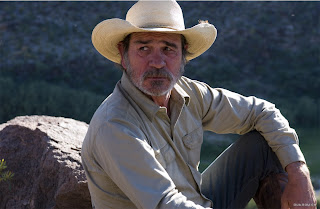
Tommy Lee Jones: The Hollywood Interview
 Tommy Lee Jones: Director, star, co-writer of The Three Burials of Melquiades Estrada.
 TOMMY LEE JONES DIGS DEEP
By
Alex Simon
Editor’s Note: This article originally was published in the December/January 2005-06 issue of Venice Magazine.
Tommy Lee Jones first brought his trademark intensity to the box office hit Love Story, in 1970, playing the small, albeit memorable role of Ryan O’Neal’s roommate, a Harvard football player. Appropriately enough, Jones himself was a real-life star of the Harvard gridiron, and graduated with a degree in English Literature just two years prior to Love Story’s release. Born in San Saba, Texas September 15, 1946, Jones was raised in the Midland area of west Texas, and spent his formative high school years at the exclusive St. Mark’s Academy in Dallas. After years perfecting his craft on the stage and in smaller films, Jones first garnered attention with his portrait of Howard Hughes in the 1977 television film The Amazing Howard Hughes, a turn that many consider the definitive portrait of Hughes by an actor to this day. Jones became a household name with his complex portrait of Doolittle Lynn, the ambitious husband of country singer Loretta Lynn (Oscar-winner Sissy Spacek) in Michael Apted’s 1980 classic Coal Miner’s Daughter. From that point on, Jones’ career has moved forward with a momentum that hasn’t ceased.
Tommy Lee Jones, who won a 1993 Best Supporting Actor Oscar for his portrait of the Javert-like U.S. Marshall who relentlessly pursues Harrison Ford’s Dr. Richard Kimble in The Fugitive, has now added the position of auteur to his already impressive resume. Co-written with Guillermo Arriaga (Amores Perros, 21 Grams), although Jones receives no credit, The Three Burials of Melquiades Estrada tells the picaresque story of a Texas rancher (Jones) who sets out to avenge the shooting death of his friend at the hands of a callow Deputy Sheriff (Barry Pepper). An existentialist western road trip worthy of the best films by masters such as Sam Peckinpah, Jerry Schatzberg, and Anthony Mann, Three Burials takes the viewer on a harrowing journey that you simply can’t shake off once the credits have rolled. In his feature directing debut (he helmed the television film The Good Old Boys for Turner Network Television in 1995), Jones shows that he is every bit as gifted behind the camera as before it (Jones’ acting chops earned him a Best Actor award at this year’s Cannes Film Festival). The Sony Pictures Classics release hits screens December 22 in limited release and goes wide February 3, 2006.
Tommy Lee Jones spoke with Venice over a beer during a recent stay in Los Angeles. Here’s what transpired:
This film reminded me of the great, existentialist road pictures of the 70s. Are you a Peckinpah fan?
Tommy Lee Jones: Yes, I am. Not for the clichéd reasons of violence and male bondage, but mainly for color and rhythm. It’s interesting you mention him and existentialism, because alienation is a theme of this movie, and we look at if from more than one perspective. Everyone’s an alien.
How was the film born?
Guillermo Arriaga and I thought it up together. This is the movie we wanted to make. I came up with a narrative form, which was basically an old, classical narrative form and we both liked the place and the issues there. With a classical form you can take those issues and raise even more, bigger issues, like alienation.
I like the fact that you took your time with it: the long takes, the emphasis on character. You let the characters be who they were, which you don’t see much in film anymore.
They’re all real. I would stand around the camera and say ‘You know guys, everyone in this movie’s an idiot.’ And they would say “What?!” They didn’t want to hear that because they felt they had a hierarchy of villains and heroes worked out. Eventually they caught on to what I meant, which was they were all human beings.
That’s something else Peckinpah was good at: painting shades of gray. There was no black and white in his films.
Yeah, he made very interesting characters. You just reminded me of the two killers in Bring Me the Head of Alfredo Garcia. They were very interesting killers, sort of Southern California suave.
Yeah, and they were both gay.
(laughs) Yeah, right.
So it was a completely different take on a familiar theme. Then you had Warren Oates, who was one of our greatest actors. He could say more with a raised eyebrow than he could with a soliloquy.
Yeah, I think so, too. You loved him that movie, but he was a sleazebag. But he was also a hero, and likable, and troubled. Peckinpah had an interest in humanity and a respect for real human character that was admirable.
Let’s talk about your character in the film, who is very much composed of grays. Tell us how you saw him.
When Guillermo and I made this character up, Guillermo wrote the screenplay in Spanish and I translated it, and how did I see it…? We just built him. I didn’t spend a lot of time working on the character once we were filming because I’d already created him. He emerged through the process of Guillermo’s writing and my re-writing and his criticism and this process went on through eleven drafts.
You directed one other film prior to this, The Good Old Boys. What was it like putting on the director’s hat for the first time?
Those were the happiest days of my creative life at that point. It’s a very happy occasion for me to be producer/writer/director/actor, very happy. My motivation, of course, is lust for creative control. I want everybody’s job! I don’t have time for craft service, but I would do it if I had time.
Did you not direct again during the past decade because you didn’t come across any material you were passionate enough about?
Well, those jobs are hard to get. I was busy acting, and I didn’t really aggressively solicit work, because I don’t have to direct movies for a living. My only motivation for directing a movie is complete control. Not everybody’s willing to give that away to a director. Not everybody’s willing to let a director direct. In many situations it seems that a director is expected to take direction.
Did you find that when you directed that first film you had a different take on the filmmaking process because you were already a seasoned actor?
I would think that was a help, it really is. It was an advantage to have been there. I’ve known a lot of directors who are afraid of actors, who hold them in contempt, or pretend to because they are afraid. Or regard them with both fear and contempt, and loathing. Some directors also hold actors in awe somehow, as they would a wizard who is possessed of some incomprehensible magic power or skill. I’m very comfortable with actors. (laughs)
Since you do have that comfort factor with actors, are you the type of director who “casts well,” then gets out of the way, once the cameras roll, or does it depend on the actor?
Of course it depends on the actor! The first thing we look for when we cast is the ability to read. In this screenplay, you can look at the pages and look at the words on them, and it will look pretty simple. You need someone who can read to find out exactly what’s going on there, because most of the action, whether it be emotional or physical, is certainly not in the dialogue.
The great thing about this cast was that while some of the faces were slightly familiar, there were no big stars with the baggage that iconic status entails. This really allowed them to disappear into their characters.
Yeah, wasn’t that wonderful? The thing they all had in common was they were really in love with the story and the idea of doing this, and as a result, were very highly motivated, and considered that reward and motivation enough, because we didn’t have any money.
What was your budget?
Not very much.
But you shot on 35mm, right?
Super 35. It’s easier to tweak and come up with that so-called “anamorphic format,” without using anamorphic lenses, which is a big savings, at least until you get into post-production. (laughs)
You grew up in Texas. Did you spend a lot of time south of the border growing up?
Well, west Texas is a bi-cultural society, so you’re going to be exposed to the Spanish language, culture, food. I started studying Spanish academically in the seventh grade and continued until halfway through college: a total of eight and a half years of academic Spanish. I’ve traveled a great deal in Mexico, Spain, Argentina and I’ve worked with a lot of people who don’t speak English, and I live in San Antonio, actually north of San Antonio, about 165 miles.
You have a working cattle ranch there.
Yeah, it works the hell out of me.
Did you feel an affinity with Latin culture growing up?
I lived in one. There are a lot of ethnocentric people who won’t admit to west Texas culture being bi-cultural…actually there’s only one culture there, and some of those people would deny that it’s of Hispanic character. I hope they see the film. (laughs)
You went from Midland to Dallas for high school, attending an exclusive school called St. Mark’s. What was that like for you?
It was a hell of a culture shock. I wasn’t used to doing any homework. It was a common thing in Midland to settle your differences with other people through violence, and I had to change those two things very quickly, in order to survive.
The gridiron was a place of refuge for you initially, both in high school and in college. Did you discover athletics concurrently with drama?
No. If you’re a kid in west Texas, you’re raised to play football. I had a great desire to play that game as a kid. It was a way for many kids to define achievement, manhood. It was a burning desire of mine from very early on.
When did you know you were an actor?
Well, I still haven’t decided what to do when I grow up. I’ve always thought acting was a lot of fun, and I haven’t had to quit it yet. I stumbled into it first when I was in prep school and stumbled into the little theater they had there and saw a rehearsal going on, and I’d done school plays and had fun, but that was really the first time it caught my eye. I did play Sneezy in Snow White and the Seven Dwarves in second grade, and having played the lead in Baby Bear’s Birthday Party in the third grade, I was already a seasoned actor by then. But I’d never really seen people moving through light in a communal effort to bring literature to life, until I got to St. Mark’s. When I saw that, I found it very attractive and I haven’t stopped acting since.
From there you studied English Literature at Harvard, and continued to excel at both dramatics and football. Your roommate was Al Gore. You also played in the famous “tie” game between Harvard and Yale in 1968.
Yeah, the 29-29 tie. That’s a very famous football game. We scored 16 points in the last 42 seconds of the game to tie Yale for the Ivy League championship. It was an exciting game. I played offensive guard.
I know you did a lot of theater at Harvard. Is that how you were discovered for Love Story?
No. I did do a lot of theater at Harvard when I wasn’t playing football. It became my summer job. During the summer I would join repertory companies. I’d done a lot of plays and inexpensive movies by the time I graduated and went to New York. I was there for a while, working in theater. I did not have a Screen Actor’s Guild union card, but I had been trying to get parts in movies, by going to open calls and agents. When they asked if I was a member of the union, I would slap my pockets and pretend to have left my wallet at home. I was able to insinuate myself into some interviews with casting directors. I went to see the casting director for Paramount, who casting roles for this upcoming movie called Love Story. It was for the role of a Harvard football player. I thought this might be a chance to do a couple day’s work and get a union card. So I went to the Paramount office and waited for a long time, and was finally admitted to see the casting director. As I opened the door, she glanced up at me and said “You’re not right.” I said ‘Well…,’ she said “No! You might pass for a football player, but these are special football players. Thank you very much.”
So how did you get cast?
I called an old Harvard guy, who was a friend of her boss’, boss’ boss. The next day they called me back and asked if I’d like to read for the director, Arthur Hiller. I did and I got the job and a union card.
The first film I remember seeing you in was The Amazing Howard Hughes. What did you learn about Mr. Hughes during the time you prepared for and played that role?
I did a lot of work on that, because I was very happy to have that part. I read every magazine and newspaper article that had ever been written about him. I had him profiled, a psychological profile, by a company in Connecticut. So I had a complete dossier on him, as well as every frame of film that had been shot of him, and all the recorded interviews. When it came time to shoot his testimony before the senate, we matched it pretty close. I tried to match his breathing patterns. That would be an interesting exercise: to look at the actual footage, shot I think by RKO News, and compare that to what you see in the film. I found a guy who wrote the December, 1946 Time Magazine story about Howard. He was an old guy, worn out, retired, living in one of those little houses at the bottom of Laurel Canyon, on the right side. He was happy to have the company, so I came and talked to him for about an hour, and he said “Come with me. I want to show you something.” We went down to his basement, and he wiped cobwebs out of the way, and moved boxes aside, and finally he found an old filling cabinet and pulled out all the notes that he’d made when he’d interviewed Howard—all of them! And there was the original manuscript of his article, complete with his editors’ red lines, of what they wanted to cut. So I got to read what Time wouldn’t print. That was really invaluable. Howard had a lot of things to say about his father that were not published in his lifetime, but could have been. I’m certain they thought it would have been too dangerous to print at that time.
Do you think a lot of Hughes’ personal psychology was based on his relationship with his father?
Absolutely. In the article he referred to his father as “a plenty tough son of a bitch.” Howard Sr. was a notorious character in the early days of the oil fields. History has changed him from “a plenty tough son of a bitch” to a swashbuckler. He was very hard on that kid. Very hard.
Do you think that horrible plane crash in Beverly Hills that almost killed him aggravated his psychosis?
Absolutely. It broke every bone in his body, damn near, and began his addictions. And it opened up the floodgates with those insecurities. It created a phobia of being invaded: by germs, by people coming through the door, by listening devices in the lamps, snakes under the carpet. Who knows where they are, or what they’re doing? You have to be ever vigilant…
Coal Miner’s Daughter was the film that really put you on the map in the film world. Did you spend a lot of time with your real-life counterpart, Doolittle Lynn?
Sure did. He taught me how to drive a bulldozer, the old kind, which has no real steering. You steer with the brakes. First of all, it has a decelerator instead of an accelerator. If you want it to run at an idle, you step on the pedal, which shuts the throttle down. If you want to go faster and open the throttle, you let the pedal up. It’s the exact opposite of what happens in your car. There’s no way to steer it other than by braking one of the tracks. You know, before that movie was made, the only way audiences had experienced people from those mountains was on The Beverly Hillbillies or Ma and Pa Kettle. It was a very good feeling to take part in something that had a chance of eroding the hillbilly stereotype.
You did three movies with Oliver Stone (Natural Born Killers, JFK, Heaven and Earth). Tell us about him.
He’s very bright, very smart and very talented, and very bold, and everybody knows that. He’s a friend. I just happen to like Oliver a great deal. He expects people to be prepared, rehearses a little bit, then shoots. He doesn’t waste time. He’s very unobtrusive.
Arguably Clay Shaw, in terms of the real people you’ve played, was your most mysterious character. What were your impressions of him?
He had an assistant who worked with him, and that assistant happened to be dying. His son interviewed his dying father on the subject of Clay Shaw, and I was able to acquire those interviews, and get really very close, about as close as you could to a dead man. This was a long-time employee who had no reason to lie, or distort. I also interviewed Jim Garrison three or four times specifically on Shaw, and of course the screenplay was pretty good. Shaw was a strange duck, to be sure. A desperate fellow, in some ways.
Andrew Davis is a terrific director, largely unheralded, that you’ve also done three pictures with (The Package, Under Seige, The Fugitive). He guided you to an Oscar on the last one, The Fugitive. What’s his process like?
Andy’s a good pal, also. He’s quite liberal, and very healthy in a sort of Chicago way. He’s a child of the theater, both his parents are actors. He’s also very bold. He’ll start shooting a movie before he’s got a completed script. Often working with Andy is a continual process of coming up with desperate, last minute solutions to impossible problems.
Some of that involves trusting his actors, too. Some of your best lines from all three of those films were improvised by you, right?
I don’t improvise, at all. I have written a few lines here and there, out of necessity. Sometimes that’s a good thing, to come up with your own dialogue, but not always. Ideally, you want a finished, shootable script before you start. That’s the way I prefer to approach thing. I don’t like writing or rewriting the day’s work at 7:00 in the morning, 45 minutes before we turn the damn cameras on.
You got to work with one of my heroes, Tony Richardson, on his last film Blue Sky. Tell us about that.
Oh, he was wonderful. He was a very elegant man of the theater, which is not to say that he wore fancy clothes, but he was very well prepared, very subtle. Totally disinterested in gimmicks or tricks. Or fads, or trends. I remember watching him review a script one time. I was just walking by, and he was in an isolated place but I could see him, and he was just going through the script, page-by-page, completely focused. It impressed me.
You worked with Clint Eastwood on Space Cowboys.
Another great one. He’s a hero. He’s iconic. He’s a hell of a lot of fun to be around. With those three guys: Sutherland, Jim Garner and Clint, I thought I’d heard every old actor joke there was, but they took me to school and kept me laughing every day. I had a hell of a lot of fun with them. It was so much fun to experience Clint’s work ethic. I’d heard about it, and admired what I’d heard. Then with the first movie I directed tried to follow what I’d heard second hand, but then to spend an entire shooting schedule with Clint, to watch him work and be part of the process was gratifying, of course, and educational to some degree. He was teaching me what I already knew.


