Showing posts with label Billy Bob Thornton. Show all posts

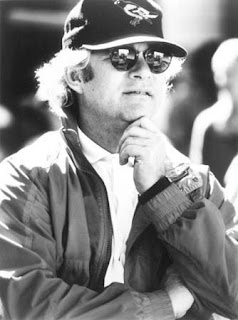
Billy Bob Thornton: The Hollywood Flashback Interview


I sat down with Oscar-winning screenwriter, actor, director and musician Billy Bob Thornton for Venice Magazine in October of 2001. He had a slate of very diverse projects he was promoting: his first solo music album, "Private Radio," as well as the films "Monster's Ball," "Bandits," and "The Man Who Wasn't There." My strongest memory is of Thornton's quiet intensity and an undercurrent of Southern affability, which came out once he decided you were okay. He seemed to feel that way about me after I shared with him my idolatry of legendary filmmaker Fred Zinnemann, something we shared. I also remember his unusual diet, when our lunch was served. Thornton got the biggest plate of sliced papaya I've seen to date, artfully presented. I got a seafood salad. He looked at my plate, smiled, and told me about the horrible shellfish allergy he'd been saddled with all his life, and how he can never touch anything remotely related to an exoskeleton-bearing aquatic invertebrate.

In spite of our differing gastro tastes, we shared a wonderful and memorable conversation I treasure to this day.


BILLY BOB'S TRIPLE THREAT
By
Alex Simon


Editor’s Note: This article originally appeared in the November 2001 issue of Venice Magazine.

Few Hollywood insiders have lived the real-life Cinderella stories they often portray on-screen like Billy Bob Thornton has. Born in Hot Springs, Arkansas in 1955, Thornton's years of struggle on the fringes of Hollywood were finally rewarded when his writing/directing/starring labor of love, Sling Blade (1996) became the toast of the indie, and legit, film world, copping the Arkansas native a Best Original Screenplay Oscar for his efforts. From then on, Thornton's spot on Tinseltown's A-list was etched in cement that would have made the denizens of the concrete around Mann's Chinese theater jealous, delivering memorable starring and supporting turns in diverse films such as The Apostle, Primary Colors, A Simple Plan, Armageddon, and Pushing Tin, to name a few.

2000 also saw Thornton direct and produce an elegant, lyrical adaptation of Cormac McCarthy's novel All the Pretty Horses, and pen (with Tom Epperson) the supernatural thriller The Gift. As 2001 comes to a close, Thornton brings his talents to three distinctly different projects: Barry Levinson's Bandits, in which he plays the screen's most neurotic bank robber since Woody Allen bumbled through Take the Money and Run, The Coen Brothers' moody noir thriller The Man Who Wasn't There, as a stoic barber embroiled in a murder plot, and Marc Forster's Monster's Ball, a visceral masterpiece of a film that has Thornton sizzling the screen as a racist prison guard who finds his life coming apart at the seams. As if that weren't enough to have on one's plate, Billy Bob releases his first solo album this month, entitled Private Radio, a unique blend of country, blues and folk sung by Thornton in a voice described by Rolling Stone.com as "a cross between Leonard Cohen and Tom Petty. These preceding reasons alone are testament to Thornton's versatility and evidence that his status should be elevated from writer/actor/director/producer/musician to that of national treasure.

Billy Bob Thornton sat down with Venice recently over a plate of freshly-sliced papaya to discuss his newest films, the greatness of High Noon, and the beauty of keeping it simple.


We have a lot to talk about. Let's start with Barry Levinson, your director on Bandits.

Billy Bob Thornton: Barry is, first of all, just a great guy, probably the funniest human being I've ever met. We could hardly wait for him to say "Cut" so he could tell us another story. Plus, he's very intuitive. You can real feel him with you while you're doing the scene, and that makes all the difference in the world for an actor, especially if you're doing comedy. I've been pretty fortunate in my career to work with, for the most part, some pretty amazing directors.

Even early on, when you were just doing small parts, you worked with some heavyweights.

Oh yeah, I worked with Taylor Hackford (Blood In, Blood Out), Adrian Lyne (Indecent Proposal). I tell you what I really loved about Taylor, is that he's a music guy, like I am. We hit it off right away because of our mutual love of music. Any time someone's musical, we always hit it off. Bruce Willis is very musical and during the Bandits shoot he would play for the crew a lot of times. That was great. Bruce loves music and does a lot of recording in his home studio, just like I do.


Is that where you cut Private Radio?

Yeah, the whole thing. We mixed at A&M on the radar system, which is where you use all the modern technology, but it still sounds stripped-down, like analog.

You mentioned Bruce Willis earlier. You guys had a great chemistry on-screen.

Yeah, we actually already knew each other. We've been friends for several years. He's the sort of guy that's always been there for me, and I've never forgotten that. In terms of hanging out together, I don't really "hang out," so to speak. I have friends and I'll see them over at their house or if they come over to mine. I'm not a partyer. I don't like going to premieres, and haven't even been to the premieres of all the movies I've been in. I don't like going out to big functions just because that atmosphere makes me uncomfortable. Sometimes you have to go, and when I do, once I'm there I'm usually okay. It's like flying. I don't like to fly, but once I'm on the plane I'm fine. But not before.

Did you guys improv a lot? The whole film had a very naturalistic quality.

We did some. Harley Peyton is such a great writer that we didn't really want to stray too far from the script. But Bruce and I have always found it really easy to sort of riff with one another. Cate (Blanchett) is the same way. Cate's my buddy, so we work real well together. We've been friends since Pushing Tin, and Cate's just one of the coolest people on the planet. When you get to make movies with friends like them and work with a director like Barry, it doesn't get too much better than that.


Tell us about The Man Who Wasn't There, and the Coens.

Once again, it was an honor just to work for them. I'd always wanted to and we'd spoken about it before. When I was nominated for A Simple Plan and they were nominated for Fargo, they sat behind me at the awards show and we got to talking, and every time we saw each other after that, we'd always say "You know, this would be a perfect fit." But part of their genius is that they bide their time. They know when it's the right time and the right part. And this was it. It's one of my favorite parts I've ever played. It's one of the hardest parts I've played, because there wasn't a lot of dialogue to work with.

Do the Coens give a lot of direction or do they leave you alone?

They kind of cast the right person for the part and then love it if you come up with something on your own. Again, they're such good writers, you don't want to digress too much from the script. I did come up with little things that we put into my character. For example, if you look closely at (my character) Ed Crane in the movie, you'll see that he's always doing this little nod. We started calling it the "Ed nod." And that became part of their direction. "I think at the end of the scene it might be time for an Ed nod." That kind of thing.

Let's talk about your background. You grew up in Arkansas.

I was born in Hot Springs but grew up in a little town of about 110 people up in the mountains. We lived in my grandmother's house, which is kind of common among poorer southern families. Close-knit families. I remember when we were really little, we didn't have running water or electricity. I tell my friends that and they laugh: "Billy Bob, you're describing the 19th century, that's impossible." But they don't understand that in the rural south, there are areas where when it's night time, it's pitch black because there's no lights! I mean, we weren't like Lil' Abner, or shit like that, (laughs) but we didn't have much.


Your parents sound like a real study in contrasts: your father was a high school basketball coach and your mom was the town psychic.

Yeah, dad was a hot-headed little Irishman and mom is part Italian and part Choctaw Indian. I remember I'd come home from school as a kid and there'd be all these little white-haired ladies from town waiting for their turn to have a reading. The Gift was based on her and an experience we had as kids. It was a strange household. My dad and I were never close and he died when I was eighteen, of cancer.

Do you have siblings?

Two younger brothers, one of whom is now deceased, also. He had a heart condition and passed away when I was going through a real self-destructive period. His death really made me come to terms with that, get out of the self-destruction and into self-preservation.

That must've been tough for an 18 year-old boy, losing his dad.

Tough on a lot of levels. I'd just graduated high school, and now suddenly I had to be the man of the house. It's also made me really terrified of older men. Maybe it's a need to be accepted by them, or something, 'cause my dad and I never really came to any understanding before he died. (pause) And people wonder where I get these stories, right? (laughs)

2015-07-25-1437782700-4573443-babybbt

Did you take to acting and writing early on?

No. First it was rock n' roll, then it was baseball. I thought I'd try to be a professional baseball player because I was pretty good in high school. Then when I went to try out for the pros, I got injured, busted my collarbone, and that was the end of that.

You struggled for more than a decade out here, supporting yourself with some really demeaning, miserable jobs.

Yeah, but I had this catering job that changed my life. I was working this party where all these real powerful Hollywood types were just filling the room, like a who's who of Hollywood, right? Then this little German guy asks me if I'm an actor. So I said 'Yeah,' and we started talking. He said "You'll never make it just being an actor. You're not good-looking or ugly enough to stand out. Can you write?" I said 'Yeah, I can write. My buddy Tom (Epperson) and I have written a couple things.' "That's the ticket," he said. "Stick with the writing and you'll make it." I go back into the kitchen and one of the other waiters says to me "So what were you and Billy Wilder talking about?"

No way!

Can you believe that, man? (laughs) I had no clue who the man was! But that's when I got really serious about writing. And that is what changed everything.


One False Move (co-written with Tom Epperson) really put you on the map in terms of your career as a writer, jump started your career as a character actor, and was a huge indie hit in 1992.

Yeah, I'm very proud of that and a lot of the credit should also go to the director, Carl Franklin (Devil in a Blue Dress) who's really brilliant. It really upset me how controversial it was for its violence though. I mean, here you have these summer action movies where dozens, hundreds of people get killed with squibs going off in every direction, and it's almost sanitized, like a video game or something. We had a couple scenes of violence in that film that showed violence for what it was: ugly, sick, horrifying, with lasting consequences. Which is worse to show to someone with a sick mind? If you're going to show violence on film, you should be honest about it, and not glamorize it. That's when it becomes dangerous, I think.


Then Sling Blade took you up to the next level.

Yeah, it's funny. The way they do movies now with all this test-marketing stuff. Sling Blade tested very average, was made for $900,000 and then made something like $27 million at the box office. I've had other movies I've done that tested through the roof, like A Family Thing (co-written with Tom Epperson), which was made for $15 million and earned something like $13 million. So you never know.

What kind of film did you shoot Sling Blade on?

We shot it on 35mm with Panavision, the whole deal. But because I shot it back home in Arkansas, a lot of folks were real nice and helpful and we got a lot of stuff for free. We had a great time doing that movie, shot it in 24 days.

Sling Blade had a true genesis from one man show, to short film, to feature. Tell us about that.

The short film was done because I'd worked with the director, George Hickenlooper, on another film and he asked if I had any scripts he could look at. I said 'Yeah, I've got this short film,' and he liked it and we took it from there. I like the short very much. It all came from the character, really, and just grew from there, sort of took on a life of its own. I just knew what this guy looked like, talked like, how he walked, how he smelled. I do that when I read a script. When I read A Simple Plan for the first time, I just knew what this guy looked and sounded like. You just know.


Mike Nichols is one of the greats. Tell us about working with him on Primary Colors.

Mike is another director like Barry Levinson. He gets a kick out of the whole process, laughs a lot during the shoot. He gets very immersed in the movie itself, talks with the actors a lot about the story and their characters. He's a very psychological director and our rehearsals consisted of sitting around a table and psychoanalyzing the characters. Another really terrific thing about that movie is that Elaine May, who wrote the screenplay, was there. So we got to hear Nichols and May comedy routines every day! That was a lot of fun.

Your character was based on Clinton campaign manager James Carville. I know that you're friends with President Clinton. Were you initially gun-shy about doing that part?

I actually called him and asked if he'd mind if I did the movie. He said "Are you kidding? It's a great part. Play it." I played a character based on Carville, but I didn't want to imitate him. I tried to imitate his attitude, but that's it. I wanted to make him a more laid-back, smart-ass southern guy, as opposed to a hyperactive one. (laughs)


It was Mike Nichols who turned you on to All the Pretty Horses, right?

Yeah, he was thinking about directing it for a while, but thought I'd be better for it. How can I start this story? Okay, let me start by saying that my favorite movie of all time is High Noon. I watch it probably three times a month. I think it's a perfect movie. Everything is in that movie. Everything you need to know about human beings is in that movie. The poetry of that movie is so beautiful, yet so simple. I believe in simple stories with complex people, about behavior.

When I was given the book of All the Pretty Horses, I didn't want to direct someone else's movie. I didn't want to film a book. It just all seemed to me like way too much. I get over to Sony and they said "Mike Nichols really wants you to do it! We really want you to do it!" Which was probably bullshit. I'm sure they really wanted Spielberg or somebody, but they probably went "Well, Mike wants this asshole..." I'm not sure what happened. Anyway, I had a deal with Miramax, so they had to be involved, too. So we all started to hook up and they started to tell me how things should go. At that point I said "Look, I don't have to direct this movie. I don't need to. I kind of don't even want to. But I love the book. I think Cormac McCarthy is a great writer, and this is the kind of book where if I were as good a writer as Cormac McCarthy, I might have written it. So I would like to do it, but I'm using my crew, not the Star Wars crew like you want. They said "We want a big movie." I said 'Yeah, but the desert's already lit. My crew can probably do this better than your crew. They understand me and they understand how I work. What's hard to light is a 12x12 room, and that's what we do best.' I said 'You understand that I see this as a big character story. So when we're inside, I'm going to shoot this movie just like Sling Blade. When we're outside, it's going to be John Ford. You understand that by hiring me, this is what you're going to get. Is that what you want?' "Oh yeah, yeah!" Then they say: "Who's gonna be in it?" I said 'Here's who's gonna be in it.' They said "We don't want those people. We want these people." So I argued with them for several minutes. Finally I said, 'Fine, make the movie your way, I'll walk away with no hard feelings. I've got stacks of stuff at my house that I want to do. I don't have a problem with a choice of movies to direct. But if you want me to do this one, here's what you're going to get. Are you sure it's me that you want to do this? You realize that this is an epic movie that's going to be about three hours long?' "Oh, of course!"

So they agreed to all the rest of my terms. We went and shot the movie and I had the best experience I've ever had doing a movie. The minute we were done, it became a nightmare, and they proceeded to change it into a love story with an airbrushed poster aimed at getting 14 year-olds into seats. They cut out any of the edge, and what was meant to be a three hour movie became a less-than-two hour movie and they removed Daniel Lanois' beautiful music score.

Is there any chance you'll do a "Director's Cut" DVD?

Well, it doesn't exist in that form except in a very poor quality VHS version, with the original score. They originally told me I was going to get to do a DVD, but then said it was going to be too expensive to do, and not worth it. I don't want to point any fingers, but no one's ever going to see the film as it was intended, which was about three hours and forty or fifty minutes long. You know, against my better judgment, when that 3 hour, 50 minute assembly was done, I screened it for the executives at my house. They all wept during the movie, clapped at the end, were all patting me on the back, with one guy telling me that not only was it the best movie he'd ever been involved with, but the classic American film of all time. And then they proceeded to re-make it into a two hour movie and took the guts out of it, in my opinion.

Now, in spite of what all this must sound and read like, I have no hard feelings against any of those people. I want that to be clear. I understand what they do. They are business people, and always will be, no matter how much they love or hate movies. The bottom line is, they want 14 year-olds to come to their movies. If they give you $50 million to make a movie, you can be damn sure they're going to double that number with 14 year-old butts in seats. The problem was, they took a movie that was about the end of the west, and one kid's journey into manhood and the future which is unknown and realizing that he can't live in the past even though the past is where he thought his future was. And that's what that movie is about.

I always felt that a good companion piece for it would be The Last Picture Show, which explored many of the same themes.

Absolutely! Great comparison, great analogy. And it could have been that kind of film, too.

Well, look at what Coppola just did with Apocalypse Now. It doesn't have to be over yet.

Well, maybe...We'll see.

With that war story in mind, any advice for first-time directors?

Don't pay any attention to anyone's advice. Make your movie about something that's close to you, that's your thing, as opposed to trying to make something that you think "they'll" like. Basically know what it smells like, feels like, tastes like and sounds like, and then go do it. And nobody else has to know what you're doing, except you. That's my advice.

HALLE BERRY: The Hollywood Interview


This interview with Halle appeared originally back in the February 2002 edition of Venice Magazine. It was on the eve of her Best Actress win at the 2002 Oscars.


WITH A LANDMARK OSCAR FOR HER SEARING PORTRAYAL OF THE GRITTY BELLE OF MONSTER'S BALL, HALLE BERRY'S ON A ROLL
by Terry Keefe


Halle Berry wasn't looking to take the easy path to fame and fortune when she went in to read for her first movie role in Spike Lee's Jungle Fever (1991). Originally called in for the fairly conventional role of Lee's wife, Berry pushed Lee to cast her in another part - that of Vivian the young crack addict. It was a telling move as to the type of acting career Berry was seeking. This totally unglamorous role was not what most people would have expected from the young and beautiful Ms. Berry, but it presented a challenge for the young actress that she embraced with passion. Berry's Vivian was a strung-out bundle of nervous tics, grime, and explosive anger. It was a great career decision because it established her as a serious talent in her very first film; she clearly was not just another beautiful-model-turned-beautiful-actress. Of course, it's undeniable that her near-perfect looks and charisma hark back to the Golden Age of Hollywood when stars were stunners who could stop traffic. But she's also that rarity of rarities, a movie star with true acting talent to burn and a desire to continue to push that talent as far as she can. And as we all know, some 11 years after Jungle Fever, that combination of talent and desire earned her the honor of being the first African-American woman to win the Academy Award for Best Actress in a Leading Role, for her work in Monster's Ball. The entire world watched on March 24th as she was overcome with emotion and gushed, "This moment is so much bigger than me. This moment is for Dorothy Dandridge, Lena Horne, Diahann Carroll. It's for the women that stand beside me, Jada Pinkett, Angela Bassett, Vivica Fox. And it's for every nameless, faceless woman that now has a chance because this door tonight has been opened." She had come a very long way.

How long a way? Well, all the way from a land quite a few miles east of Hollywood - Cleveland, Ohio, where Halle was born on August 14, 1968 and named after the nearby Halle Brothers Department store. Her teenage years saw great success in beauty pageants, as she won the Miss Teen All-American Pageant at the age of 17 in 1985 and was first runner-up in the Miss USA Pageant a year later. She became a model shortly thereafter and then segued into acting with a few television appearances, followed by her big-screen debut in Jungle Fever. Lead roles followed in the films Strictly Business (1991), The Last Boy Scout with Bruce Willis (1991), Boomerang (1992) with Eddie Murphy, The Flintstones(1994), Executive Decision (1996), and Bulworth (1998). Then came the HBO film Introducing Dorothy Dandridge (1999), which also re-introduced Halle Berry to the world in a sense. Berry produced the movie and gave a performance that was quite simply a revelation.

It was no easy role to pull off. The real-life Dorothy Dandridge was a complex individual who was incredibly talented, driven, and loving to her friends and family. But she also harbored a great inner loneliness and a self-destructive streak. This was partially due to the sexual abuse she had suffered as a young woman and which seemed to send her on a lifelong series of destructive relationships with all the wrong men. Berry wrapped all of those diverse threads into her portrayal, giving us a glimpse into Dandridge's golden soul in the process, along with the demons that haunted her. There were also the challenges of recreating the singing and dancing of Dorothy Dandridge, performances which left audiences spellbound so many years ago. And yes, Berry managed to leave us equally spellbound, particularly when she recreated the musical numbers from Dandridge's landmark film Carmen Jones (1954). You forgot you weren't watching the real Dandridge, which is perhaps the greatest compliment for any actor starring in a bio pic. The film was to earn Berry a Golden Globe and a great deal of critical respect.

The box office would also show its respect for her as she donned the black cape of Storm, the mutant superhero goddess who controlled the weather, in director Bryan Singer's smash hit X-Men (2000) which was based on the most popular comic book series of all time. Then there was last summer's Swordfish where she starred opposite John Travolta and was also reunited with X-Men co-star Hugh Jackman. Both films were hits, further cementing Berry's star status. It would have been easy for her to coast on her fame with less challenging roles. But she did exactly the opposite when she jumped into the cauldron of Monster's Ball.

Directed by Marc Forster, Monster's Ball features Berry as Letitia Musgrove, an emotionally beaten-down woman in the rural south whose convict husband Lawrence (played by Sean Combs) is put to death in the electric chair. Through a series of tragic circumstances, Letitia meets Hank (played by Billy Bob Thornton), the prison guard who presided over her husband's execution and who also is dealing with his own personal tragedy. Despite being the most unlikely of couples, they fall in love and manage to heal each other amongst the turmoil around them. Letitia's life is an ongoing train wreck which is difficult to watch, but you can't take your eyes off of her thanks to Berry's performance. She creates a subtle, nuanced arc in which Letitia slowly regains her strength and dignity. The film also features one of the rawest love scenes in recent memory between Berry and Thornton. But it's also one of the only times in recent memory that this type of scene is absolutely integral to the plot. These two characters have been through such hell at that point in the story that only an extreme physical catharsis could bring them together. Monster's Ball was shot on an extremely low-budget with all of the actors reportedly working for scale.

I reached Halle by phone while she was shooting the new James Bond film in London, where she plays a character named Jinx.

Tell us how you first became involved with Monster's Ball.

I first received the script from my manager who had gotten the script from (director) Marc Forster's agent. She passed it onto my manager already knowing that Marc really wasn't interested in me. But she thought I would be right for the role, and if my manager got me to read it, then maybe I would like it and I would fight for it. Which is exactly what happened. She kind of went behind his back (laughs).

So after you decided to fight for the role, what happened?

After I read it, I said `You're right. I have to play this part!' and so we worked on getting a meeting with Marc. From there it was just a process. There were no auditions - it's hard to really audition for a part like that. It was just a series of meetings and conversations and lunches and dinners, talking about it and just sort of fleshing out the character, and me trying to express how much passion I had for the project, how much I connected to her. How I saw her and ultimately how I saw her living through me. And also convincing Marc that I would do all the things it called for. So it was trying to convince him that I was really down to do it.

Once you were cast, what was your preparation process to become Leticia?

There was no real research. It was really just discovering how she lived in me and discovering things in my own life or my own experience to help bring the colors to her. So that was really my work as an actress - trying to figure out the nuances of her.

Leticia went through such tragedy in her life that it seems like hers would be a difficult skin to inhabit. Did you take her home with you at night?

When we worked on it, I really didn't leave her. We only shot in 21 days and we worked such long days that at the end of the day all I had time to do was go home, sleep, get up, and do it again. And I was in Louisiana, without my family. So for those 21 days, for all practical purposes, I was her. It was a good way to work on this character. I didn't have to worry about my family and going home and switching gears because I was on location by myself.

Monster's Ball is filled with so many intense scenes. What was the most difficult to shoot?

I think the scene where I sort of had to abuse my son (played by Coronji Calhoun). That was really hard because he was a real little boy. 10 years old and struggling with issues of obesity, you know? He wasn't an actor, never acted before. And I thought, 'Wow, I could psychologically really damage him.' I thought I could. I was afraid I would.

Was there anything you did during the shooting to make those scenes easier on him?

I just talked to him about the process of acting a lot. Explained things to him, methods that different people used, you know? I tried to give him a crash course in all the acting I knew. And then tried to hug him and kiss him a lot. Before the takes and after the takes. When I'd see him in the morning, I'd try to be as nurturing and as loving as I could all the time. We had a really good connection so that when we did work, he felt more like it was work and not me.

The film wouldn't have been as effective if the first love scene between you and Billy Bob Thornton wasn't as raw as it was. Did you have any hesitations about taking the role for that reason?

No, not at all. I knew it when I read it. I thought it was so pivotal. As a reader for the first time with the script, I kind of knew where it was going to go, where those two characters were going to end up. It's like when you read a romantic comedy, you know where they're going to end up, but it's the journey of how they get there that makes it interesting. I kept thinking, `How are these two polar opposites going to come together?' So when it did happen, it all made sense for me. I thought, `Oh, now I get it.' So I knew how important that scene would be to the movie.

You and Billy Bob must've had a real level of trust built up to do that scene.

He was great. He was as invested in it as I was. He was as naked, as committed to it, as vulnerable, as free as I was. I felt like I had a real partner. It wasn't the typical situation where the woman is usually the one who is sort of exploited, you know? We were in this scene together and that felt really good.

Is it true that Marc Forster gave you final cut over the scene?

Yes. That's the only way I think we both felt free enough to just go there. Because we knew that if we went too far and woke up the next morning and saw it, we could say `Oh-oh. What were we thinking? Axe it all out.' That gave us the freedom. We had that power. But we ended up leaving it all in (laughs). We didn't cut anything.

On a smaller film like Monster's Ball, there are fewer perks and luxuries than on a studio film. But are there more freedoms for an actor also?

What was great about it for me, because I had never really worked like that before, is that because there was no money we didn't have the luxury of time. We didn't have the luxury of shooting things over. It was a way of working where you come to the job totally prepared. And every day just following our instincts and going for it. Because we knew that we'll probably only get two shots at all the scenes, so it heightened our level of concentration and sort of our level of commitment because we knew we only had one or two takes and then we had to move on, because time doesn't allow us to do this all day. It heightened everyone's intensity. It was really great and felt really organic as a result of that.

Are you surprised at the level of acclaim the film has received or did you always think it had a shot at that?

I never thought that people would be nominated for Academy Awards. That was never in my thinking. I knew that it was a jewel of a movie. I knew that it was special when I read it. That's why I was willing to fight so hard for it. But I thought, `I don't know if people are really going to get this. I don't know if people are ready to deal with some of these issues.' But as an actor, I knew that the roles were just brilliant for actors to play, brilliant characters. Really colorful and full. I just didn't think anybody would be nominated for an Oscar, especially me (laughs).

I wanted to ask you a little bit about your earlier films. You had done some modeling and television work when you landed your first feature role, as the crack addict in Spike Lee's Jungle Fever. Was that first break tough to land?

Yeah, that was my first movie. Spike called me in to audition for the role of his wife originally. All I was up until that point was a model and I had done some beauty pageants, and I thought, `How can I shed this image?' And I asked him if I could read for the part of the crack kid in the movie and he let me do it and he eventually offered me that part. So that was a great way to start in the industry, sort of shedding my physical self and doing a little bit of a character piece. That was a great entry.

I understand your preparation for the role was pretty method-based and you went out and sort of lived the role?

At that point that was all I could do (laughs). I had no technique. I said, `Let me go and live on the street and try to be this girl as best I can.' So yeah, I didn't shower, I didn't shave. I went to a real crack den with an undercover police officer. These are things that today I doubt I would ever do, because it's too dangerous and it really doesn't make a lot of sense. But at that time, I was young and I was like, 'I don't know anything about crack. I've got to go see'(laughs).

A few years later you did such an amazing job playing the legendary Dorothy Dandridge. I wanted to ask about your preparation process.

The producing end was like 7 years on it. We tried to shop it around for 7 years, so that was a long prep time (laughs). But playing her, I had to work on singing, I had to learn to tap dance, all that physical stuff I had to do beforehand. I did a lot of interviewing with Sidney Poitier, Diahann Carroll, people that actually knew her. I spent a lot of time with these people, picking their brains, and sort of trying to get to the essence of who she was. And if I could find some common thread that they all said about her, I could use that. Basically I read every book, every piece of material there was to read about her. I saw tons of pictures. Her manager, who is still alive, let me go through everything that he had of hers, from personal private letters to all of her clothes, her jewelry he had, her family photo album. It was just about a six-month period before the shoot of finding every piece of information I possibly could.

You mentioned that you were looking for a common thread when you interviewed Dorothy Dandridge's close friends and associates. Did you find that common thread?

I would ask each one of them, `If you can tell me one thing that I must capture in order to play her, what would that be?'. They all said the same thing, `You have to find a way to be sad on every day, in every scene, in every moment. And always try to hide the sadness. And you'll get the essence of who she was.' I thought that because they all said that, it had to be true. I thought that was a good place for me to start.

Then you won the Golden Globe for your role as Dorothy. How were you feeling at that moment?

That was the first time I had ever been nominated for an award like that. And playing her life, there were so many opportunities she was not afforded. A lot of it had to do with the state of racial relations in the country at the time. And the other 50% was her own masochistic personality that led to her own downfall, you know? I felt very much when I was up there, that I was sort of up there for her. For all the things that didn't come her way, that in that moment I felt that it was really about her too. Because I was winning for telling her story, I felt very much like it was her moment.

And right now you're shooting the new Bond film. As the villain it`s reported. How does it feel playing the villain?

Well, that sort has been a little bit of a misrepresentation. It's not really clear exactly who this girl Jinx is (laughs). She's a little mysterious. Even to me right now.

Can you talk about the story at all?

No, I'm sorry. They make you sign your life away (laughs).

No problem. And after Bond, you've got the X-Men sequel coming up. How was it working with director Bryan Singer on the first one?

That was good. Directing that movie, there was so much pressure. The fans were just like, you know (laughs). Oh my god, I was so glad I wasn't him. And I thought he did a really great job dealing with all of the pressure. Every day he'd be on the internet, wanting to know what they said next. He did a really good job. He took those comic book characters and made them real. And I really loved that we weren't wearing, you know, silly suits and spandex. He really made them real people. I'm hoping that in the next one they'll even become more real.

Did you read a lot of the old X-Men comics before playing the famous character of Storm?

You know, I didn't. Bryan didn't want it. The people who didn't grow up with the series, he didn't want us to. He wanted us to read the script and read the back story that he provided us. Because all the characters changed from decade to decade, and they sort of went off in different directions. So he thought it would be really confusing and he thought it would be easier, and I think rightfully so, not to go back and read all the comic books. I read some, that pertained to the way he wanted Storm to be played. Those were the ones he suggested that I read and he gave me.

So what's next after the X-Men sequel?

It won't be being a superhero, I can tell you that much, after Bond and X-Men (laughs). I want to go do another Monster's Ball, another little character. I'm seeking that out right now.

Barry Levinson: The Hollywood Interview


I interviewed Barry Levinson a few days before 9/11 regarding his heist comedy, "Bandits." Released a month later, the film's askew humor failed to draw big audiences from an American public largely still in mourning, in spite of strong critical response. Levinson proved a wonderful conversationalist during our time together: energetic, a great raconteur with a quick laugh who also wasn't afraid to put up his dukes (in a friendly way) if he disagreed with you. Our chat remains one of my favorites.


BARRY LEVINSON:
MAKING OUT LIKE BANDITS


In the annals of modern filmdom, few directors have amassed the kind of body of work that Barry Levinson has, in as short of period of time. Now almost synonymous with the city of his birth, Baltimore, Maryland, Levinson made his debut on April 6, 1942. Levinson's father owned the city's first discount appliance warehouse and young Barry initially followed in dad's footsteps, selling encyclopedias and used cars while attending junior college. It was after Levinson made the move to Washington D.C. to attend American University that he discovered his true calling, enrolling in radio/TV classes on a lark.

After several more years of abortive attempts to finish his degree, Levinson packed his things and moved west, hooking up with actor Craig T. Nelson (Coach) in an improv class and forming a successful comedy duo that played clubs in and around L.A. during the late 60's and early 70's. Levinson got his first break as a writer working for the late Marty Feldman and Tim Conway, later moving to the legendary Carol Burnett Show as its leading sketch writer. Levinson and writing partner Rudy De Luca were enlisted by Mel Brooks to pen his hits Silent Movie (1976) and High Anxiety (1977, featuring Levinson in a cameo), kickstarting his career as a successful screenwriter, penning the features ...And Justice for All. (1979), Inside Moves (1980), uncredited work on Tootsie (1982), and Best Friends (1982).

...And Justice for All., a stinging satire starring Al Pacino as an earnest Baltimore attorney who is forced to defend a powerful judge (whom he despises) in a high-profile rape trial, earned Levinson his first Oscar nomination for Best Original Screenplay (shared with his then-wife and writing partner, Valerie Curtin). This put Levinson on Hollywood's A-list of writers and also gave him the leverage to start doing what he always wanted: direct.

Diner (1982) put Barry Levinson on the map as a filmmaker. Telling the story of a disparate group of young men coming of age in the Baltimore of the late 50's, Diner re-wrote the book on low key character study infused with a healthy dose of humor derived from real life. It also introduced a cast of stars to be: Kevin Bacon, Mickey Rourke, Tim Daly, Steve Guttenberg, Paul Reiser, Daniel Stern, and Ellen Barkin. Levinson hasn't left Hollywood's "A" list since, helming such films as the classic The Natural (1984), Young Sherlock Holmes (1985), Good Morning Vietnam (1987), Tin Men (1987), the Oscar-sweeper Rain Man (1987) for which Levinson copped a Best Director statuette, Avalon (1990), Bugsy (1991), Disclosure (1994), Sleepers (1996), Wag the Dog (1997), Liberty Heights (1999), and An Everlasting Piece (2000).

Levinson's latest is another gem of understated comic charm. Bandits tells the tale of the country's most wanted bank robbers (Bruce Willis and Billy Bob Thornton) and their serpentine odyssey across the country with a dizzy housewife (Cate Blanchett) in tow who captures both their hearts. Barry Levinson spoke to us recently to spin his own story of cinematic success and innovation.


Tell us about the genesis of Bandits.

Barry Levinson: Well, it's funny. I was sent the script, and turned it down initially, twice. Then one day I suddenly got an idea of how it could work for me and decided to get involved with it, and try to make the film more in line with my own sensibilities.

At what point did Bruce Willis and Billy Bob become involved?

Well Bruce had been kind of intrigued by it early on, and then I called Bruce when I became interested. We discussed our thoughts, what changes we thought should have been made, things like that. So Bruce came on board, then I had a similar conversation with Billy Bob not long after that, and he came on board, and then I spoke with Cate when she was working on, I think, The Gift (co-written by Billy Bob Thornton). We met in person later on in Santa Monica and decided to come on board at that point. The pieces just sort of fell into place. It's nice when that happens, because it's so rare.

All three of your leads really show new sides of themselves in this.

Good, I thought so, too. Obviously each one of them is very different and have their own distinctive personas and ways of working. Bruce and Billy Bob really played off each other beautifully, and are both very good at just sort of letting things happen. And of course, both were very excited to work with Cate, and when the four of us would sort of play around with some of the scenes, some great things would happen.

Do you rehearse before you shoot?

No, I don't like to really rehearse. I've always felt that you can rehearse something to death, and then it gets stale. I like to talk about things before we do them. For stage, it's a whole other thing. For me, it's more like, let's get familiar with what we're going to do, then go from there.


Do you believe in leaving actors alone generally once the cameras are rolling?

Basically. I've always felt that you have to work within certain boundaries. Within those boundaries I want to create a kind of controlled freedom, you might say. I might come over, mention a little thing here and there, make an adjustment, and then take it from there. I don't like to be all over everybody because I feel that inhibits the creative process for an actor. If things are going well, there's no point in doing a lot of talking when things are working.

Bandits has a tremendous sense of fun throughout. Was it that way on the set?

It was overall. We were always traveling, always moving, so physically it wasn't always the easiest shoot, but we were able to find and play around with a lot of things, to explore the boundaries to see if there's any new moments to be had, and they were always up for that.

Let's talk about your background. I think all of your fans feel they know you a little bit through your "Baltimore" series of films (Diner, Tin Men, Avalon, Liberty Heights). Let's start with Avalon. Was it pretty much a straight autobiography?

It was very close. I never really thought about being a filmmaker growing up there. I mean, at that time in Baltimore, to think about directing movies would be like thinking about going to the moon one day, it just wasn't within the realm of possibility. What happened was, I got involved with radio and television in college just by avoidance! I thought, 'How hard can a course in radio/TV be?' (laughs) So initially I was looking for an easy way out, then found I really liked radio and television, which evolved to working at local stations, then to me moving out west to study acting, which led to improvisational work, which led to writing.


Your comedy partner was Craig T. Nelson (Coach). You guys seem like an unlikely duo in hindsight.

Yeah, we were in acting school together for two years, then we played clubs and wrote for television for a while, so we worked as a team for about three years total, I guess. It's funny because Craig really wanted to be an actor. I didn't know what I wanted to do, but I knew that I didn't want to act. When we were in improv class, we always got a lot of laughs, just goofing off, so we said 'Hey, why don't we play some clubs and make some money?' (laughs) So we actually got hired to play some clubs.

From there you got hired to write for Tim Conway's variety show.

Right, along with Rudy De Luca. We wrote for time and played a place called the Icehouse in Pasadena a lot. Ultimately, Craig wanted to focus on his acting, and I began to get involved with writing screenplays.


Tell us about Marty Feldman, for whom you also wrote during the early 70's.

Oh, Marty was fantastic. He was a great guy. I was pretty new to the business at that point. Larry Gelbart was the head writer/producer. He brought me over with Rudy De Luca to write sketches for Marty. Marty was really cool, had an offbeat sense of humor, and we wrote these really strange sketches, so it was a perfect collaboration and a great period of time.

Was Gelbart a mentor for you?

You know what was funny? We used to bring him a sketch. And he'd look it over, say "Yeah, okay, this is good. It could use a little of this here, and that there," and he would say everything we needed to make that sketch go from good to great in about seven seconds, that's how quick he is. As young kids in the business, our impression then was 'Wow, these producer/writers really know their stuff!' (laughs) When I worked for other people after that, nobody was close to Larry. There's nobody like Larry, and there never will be.

After that you got involved with Mel Brooks.

It's funny when you look back on it, all my mentors were former disciples themselves: of Sid Caesar! We got involved with Mel Brooks because the head writer/producer of the Tim Conway show, a guy named Ron Clark, had this idea to do a contemporary silent movie. At this point I was writing for Carol Burnett. This producer said "I'm going to pitch this idea to Mel, and if he likes it, you guys would be perfect to work on the script." And we go "Okay, sure!" Afterwards, we said 'What're the odds that he's going to get a meeting with Mel, that Mel will say "yes," and we'll be the writers?" Literally at 3:00, Ron calls us and says "Mel loves the idea, wants to meet you guys tomorrow!" We said "Really?!" (laughs) So we met with him the next day, and got to work on Silent Movie.


What's Mel like to work with?

He's a zany guy who's very serious about his work. Again, it was a great apprenticeship for me because I got to work with Mel as a writer, then I got to be around when he was shooting it, then later on when he was editing, through every phase of it. The same was true with High Anxiety. So for those two films, I was involved with all the aspects of it. That was a great introduction the film business for me. Even though my sensibilities would be different, that learning period was very, very helpful. Mel was actually the one who encouraged me to write Diner, after I told him all the stories about the guys there.

Let's back up and talk about Carol Burnett. That was the one show, pre-Saturday Night Live, that really shaped my generation's sense of humor.

It was great because most of the shows at that time had people reading cue cards, and it's really hard to get a rhythm going reading cue cards. Carol and the rest of the cast used to really work it and they performed it when it went in front of the studio audience. So, as a writer, you got a chance to see you work really played out. Then you could see where your mistakes were, and how they could get hold of something and take it to another level. It was a very well-run show. We used to do a lot of the Tim Conway stuff, like the old man sketches. We had a lot of fun.

The movie that changed everything for you was Diner. Tell us about your seagway into directing and how this story, which had obviously been gestating for some time, grew into what it was.

What happens is, sometimes you write a screenplay and you say 'I want to direct this, because it will be inexpensive to make.' And then every once in a while, a door opens up at the studio where you can sneak in. It happens every so often. We got to sneak through a door with this little film that nobody really paid any attention to.


So the brass left you alone during the shoot.

Yeah, it was really cheap to make, $5 million, and was eclipsed by all these other huge films that (MGM) was working on, initially.

You also discovered the greatest cast of young actors since American Graffiti (1973).

That's what happens sometimes with a film like that where you have a young cast, you get to dip from this incredible pool of emerging talent. Ellen Barkin was the first and only person I read for the girl. The minute she came in, I knew she was the one. I thought 'Hey, casting is easy!' (laughs) Then I read literally hundreds and hundreds for the guys.

What was the transition like from working writer to famous filmmaker?

I think with Diner I went through all the stages one can go through with a movie: I made the movie the way I wanted to make it. The studio hated it, barely released it, then pulled it. So I felt basically like a bum. It was like "You did this terrible film. It's unreleasable. You'll never work again in this business!" (laughs) Then within six weeks, the movie gets rediscovered and it's this highly-praised film. Then all of the sudden, "You're terrific!" So I got to see both extremes in a very short time. It was a real lesson.


There was actually a short-lived TV spin-off of Diner, right?

Not a series, just a pilot. They thought it wasn't compatible with the current programming line-up they had. You remember who was in the cast: Paul Reiser, James Spader, Michael Madsen, Robert Pastorelli and I'm forgetting somebody. We had a great cast for that too, but CBS thought otherwise.

Your next film, The Natural, is one of the most beloved films of all time. It's still the only film to capture why it is we all love sports so much: because of the mythic qualities that surround the games and their players.

When people talk about baseball games, or "a game," and it gets told over and over, it becomes bigger and more magnified. That's the way we tried to approach The Natural: a story that keeps being retold until it reaches mythological status. And baseball itself, if you watch it without understanding the past, it's a different game, because when the pitcher is about to pitch, it's not just about that particular game. It's about how that pitcher's been pitching, how that batter's been hitting, what's the history between the two teams, it's all adding to that moment. So when you blend those two things, that's what we tried to do in The Natural. At the time, people thought it was really unusual, plus with Randy Newman's score with that great Americana sound, all those elements were pretty new at the time. The reviews were mixed at the time it came out, but now I think people seem to get it for the most part.


Your films have always seemed to me to have much more a European sensibility than American. Who are some of your biggest influences?

I can't think of anyone specifically. I can talk about the people I like. Probably the earliest influence I had was Elia Kazan. I remember as a kid thinking that there was something going on with these actors in On the Waterfront, that I'd never seen before. I saw a lot of Bergman movies when I got older and very foolishly thought I understood everything that was going on (laughs), and thought it was really fascinating. I would also say Godard, in terms of Breathless (1958) and a couple films around that time that he did were really interesting in the way he turned American pop culture on its side. I always liked Fellini because he created this reality that was an invention, that's what always intrigued me about his work.

Young Sherlock Holmes was an interesting departure for you.

I loved the idea of being able to do a Victorian type of film, and also loved the idea of how flamboyantly wild it could be. At that time, it was very unusual to have special effects in that kind of film. I thought it was interesting storytelling. There's a point where you do have to expose yourself to all kinds of filmmaking and I wanted to force myself to work in the special effects area. The scene with the stained glass was the beginning of CGI effects that are now standard in films.

Is it a different experience directing your own scripts as opposed to someone else's?

To a degree. Obviously the stuff I write is a lot more personal, therefore I have an understanding of it already, whereas when you direct someone else's material, you have to learn that understanding so it's second nature to you. You've got to really know it in your bones what you're up to so you can react at any given moment and change, and fix anything at that given moment.


Let's talk about Rain Man, another very unusual film.

Well, I wanted to show a way to deal with issues regarding family, even though there are a million ways to deal with those issues. I also didn't want to treat the subject of autism in such a serious, reverential way as you would in a TV movie. I thought we needed at times to laugh at it in the context of what was happening, which would give us the audience greater empathy for it in the end, instead of being so serious about it all. Then when certain things happen, they're even more frightening, like the scene when the smoke alarm goes off. So I knew that we had to find that kind of freedom and not have the feeling that we were making something "important."

This is the first film you did with Dustin Hoffman, who's become your most frequent collaborator in terms of actors.

I have a great time working with Dustin, as I did with Tom, although we haven't worked together since then, which I hope will change. One of the things that happened with Rain Man was a combination of elements, one of which was I got involved in the script very late, and then the Writer's Guild strike happened right when we were going off to shoot. I worked with Ron Bass up to the point when we discussed why they would drive to California. I brought up the point of why wouldn't they just fly back instead of driving all the way cross-country. I mean, who the hell does that anymore, right? (laughs) So we decided to give him another phobia, fear of flying, and I happened to know the fact that Quantas Airlines had never had a crash. So we worked all that into the scene, and that was the final scene he worked on before the strike commenced. So we went off to film and had a lot of open issues, which we basically handled as we went along on the road, and made up a lot of stuff!

Like what?

The accident on the highway, which explains why (Dustin Hoffman) won't go on an interstate anymore. I said 'I'm tired of all these highways. They all look the same.' So we invented that scene to get them on the back roads. The whole thing with K-Mart we did ("K-Mart sucks") about underwear and things, not leaving the motel because it's raining outside, all those kinds of things began to filter their way into the film as we went along.


What was it like winning the Oscar?

It's sort of an unreal experience, really. Like I said, I never had this ambition to be a director as a kid, so the idea that I'd grow up and one day win an Oscar wasn't even in my mind. Certainly when I did the movie, it wasn't in my mind, either. Even when the movie opened, we didn't do big business that first weekend. It gained momentum through word-of-mouth that, unfortunately, doesn't always apply to movies nowadays. Now you have to have that $100 million opening weekend or you're done for.

Your approach to Bugsy was interesting because you didn't approach it as a gangster picture, but as a love story. What did you learn about Bugsy Seigel and his world?

I think the line in the ad campaign summed it all up: "Glamour was his disguise." That was how we shot it as well, and this made him acceptable to people as a person even though ultimately he was a really sick human being. Warren was great to work with. Annette was just beginning to break out as an actress around then. She seemed to be a good match for Warren with her sexiness, intelligence and strength. Who knew that would lead to marriage? (laughs)


Did you get to know the late, great Bill Graham (who played mob boss Lucky Luciano) at all during the shoot?
A little bit. Remember the mamba bit he did in the film? We were talking one day and he told me how much he loved that kind of music and how he loved to dance to it. So that's how in the movie, Lucky Luciano is dancing the mamba while Bugsy is kicking hell out of Joe Adonis. Bill was a fascinating character. We just had him to talk one day, and he told us that originally he wanted to be an actor. When that didn't work out, that's when he began his career as a concert promoter.

Sleepers was an amazing film, and another departure for you in terms of style and subject matter.

Yeah, it had a completely different look to it. We caught a lot of flack from certain camps about whether it was true or not, particularly from the religious right. It was because the character of the priest (played by Robert de Niro) lied on the stand at the trial, without understanding what the issues were that he was lying about! Just the thought that we'd show a priest lying under oath was abhorrent to them, and we got a ton of hate mail for it. Most of the people who attacked the film, of course, hadn't even seen it, otherwise they would have seen that the priest was one of the most sympathetic characters in the film. He tried to protect these boys and fought for them and believed in them, and was an extremely nurturing human being. So, God knows how it all got turned around and swept up in this controversy, but it did. But on a positive note, it was a very interesting shoot and it was great to work with those actors: Dustin again, De Niro, Brad Pitt, Kevin Bacon.


What was Vittorio Gassman (who played the mob boss) like?

Oh, just wonderful! I had been a huge fan of his going all the way back to Big Deal on Madonna Street (1958). He wasn't really well at the time, but I was thrilled when he agreed to do it. He was a real old school gentleman, a real kick to be around.

Wag the Dog turned into one of the most prophetic films of all time.

The irony of that, right? (laughs) It was bizarre. We had great reviews everywhere except from the Washington Post. It said I was naive, stupid, that I didn't know any better, what a far-fetched piece of junk. Even the title was stupid! (laughs) I couldn't have been raked over the coals any worse! Then two weeks later, the President and Monica, and she was wearing a beret, "Wag the dog" is being used as part of the vernacular for press manipulation. The transition amused me to no end. We shot this thing in 29 days for very little money with the idea that it would be this little, independent movie. Who knew? (laughs)


Liberty Heights, I think, is your greatest film and was unjustly overlooked by Oscar. Let's talk about the quartet of Baltimore films, and what it's like writing a personal film. Is it possible to retain objectivity?

I'm not sure. All you know is what does it sound like, feel like and look like to you. That's the only thing you can really go by. Whether it's objective or subjective, I'm not really sure. I tried to be honest with Liberty Heights and wanted to deal with those issues that we addressed not in a singularly dramatic manner, but to let some the humor come out in the absurdity of the way we deal with one another. That was my objective, really. When I think about the things that went on with anti-Semitism or racism, I remember so many things that went on, that I heard or observed with such astounding naiveté, or downright stupidity as opposed to hatred or real bigotry. We've seen those movies handled before. I wanted to show the other side of that, which really boiled down to a lack of understanding between people. It's crazy when you think that relatively recently, Jews and blacks couldn't swim in certain public pools, that blacks couldn't go to school with whites until 1954. And we really thought that we lived in a democracy then! Things changed very quickly and suddenly.

Are there going to be anymore Baltimore films?

I'd like to, but I don't really know how to approach it anymore. I can't go down the road of putting my heart into making those films and then having the studio just sort of toss them away.


Liberty Heights and An Everlasting Piece were both just sort of dumped by their respective studios, which shocked me, because I would think that those would be the kinds of films that the studios would market as Oscar contenders, especially Liberty Heights.

You have to nurture those kinds of movies. Miramax and Harvey Weinstein really nurtures those kinds of movies. But if you don't have someone who's basically willing to stand up and take a position, you can get lost in the crowd. We came out, had really good reviews, but the studio didn't stand behind them in a way that was necessary. There are no real villains here, ultimately, because they were the sorts of films that shouldn't have been made at a studio. Terry Semel, who okayed Liberty Heights, wanted to prove that Warners could go down that road and do that kind of film as well as Miramax. Terry wound up leaving before the film came out and Warner Bros. didn't have the tools at that time to do it correctly. So I don't think I'd ever do another one like that unless I got some kind of guarantee that the same thing wouldn't happen, because I don't know if I could handle that again. With An Everlasting Piece, it was even worse. Most people in the business I know didn't even know the movie existed. It was out for a week and then pulled. You can't release a movie at Christmas time unless you're really willing to do a selling job. We didn't even have ads for the first week when we got really good reviews! My wife went into the city to try and see it and couldn't find it anywhere!

Any advice for first-time directors?

Somebody once told me the best advice was "Don't stand up too much." (laughs) I think what you need to do is be prepared for how exhausting an experience it is, so you never get to a point that you're too tired to not want to do something that you need to do. Because what can happen is, you can get so tired that you'll go "Oh fuck it, let's not do that." The second you do that, you begin to compromise your movie. That's all I know. (laughs)

Labels