Paul Schrader: The Hollywood Interview

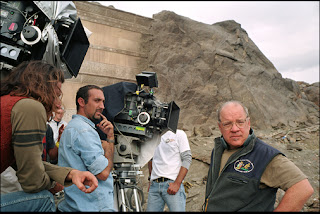
Writer-director Paul Schrader (right) on the set of Dominion: Prequel to The Exorcist.
PAUL SCHRADER:
DOMINION OF THE DARK
By
Alex Simon
Editor’s Note: This article originally appeared in the November 2005 issue of Venice Magazine.
Paul Schrader cemented his legendary status in cinema when he penned the Oscar-nominated script of Taxi Driver, which was directed by Martin Scorsese in 1976. Since that time, Schrader has become a sort of thinking man’s mogul, a writer-director whose work plumbs the depths of the human soul and psyche, and takes viewers to many dark corners that they may have preferred to remain hidden.
Schrader’s journey has been as fraught with dark shadows as some of his characters. The product of a strict Calvinist upbringing, he was born July 22, 1946 in Grand Rapids, Michigan, the second child of a business executive and a homemaker who refused to let their children (older brother Leonard is also a renowned screenwriter, earning an Oscar nomination for Kiss of the Spider Woman) see a film until they were 18. Schrader was educated at Calvin College, Columbia University, and UCLA and was heavily influenced by foreign filmmakers such as Robert Bresson, Carl Theodor Dryer and Yasujiro Ozu. After an initial stint as a film critic, Paul and Len Schrader became established screenwriters with the sale of their script The Yakuza to Warner Bros., with Paul’s Taxi Driver soon following. Written during a period of intense alcohol and drug abuse, and suicidal behavior, Taxi Driver has gone on to become the ultimate look into the heart, mind and soul of a societal fringe-dweller whose yearning for recognition explodes with furious violence. Robert De Niro’s psychotic cabbie Travis Bickle seemed to provide the world with insight into what made previously incomprehensible “whackos” like Lee Harvey Oswald, Sirhan Sirhan, and Charles Manson tick. It remains a potent classic and a testament to Schrader’s gifts as a writer.
Schrader made the jump to director with 1978’s Blue Collar, followed by the classic American Gigolo (1980, and regarded by many as a touchstone film of the era), Cat People (1982), Mishima: A Life in Four Chapters (1985), Light of Day (1987), Patty Hearst (1988), The Comfort of Strangers (1990), Light Sleeper (1992), Touch (1994), Affliction (1997), Forever Mine (1999), and Auto Focus (2002). Schrader has penned the scripts for such diverse films as Obsession (1976), Rolling Thunder (1977), Old Boyfriends (1979), Raging Bull (1980), The Mosquito Coast (1986), The Last Temptation of Christ (1988), City Hall (1996), and Bringing Out the Dead (1999).
Paul Schrader’s latest film has had a perilous journey that could be a movie plot in and of itself. Schrader inherited Dominion: A Prequel to The Exorcist after director John Frankenheimer died during pre-production. Intended as an exploration of the Father Merrin character (portrayed by Max Von Sydow in the 1973 film) and his first encounter with the demon who dominates the original story, Schrader’s film was rejected by Morgan Creek Pictures and its CEO James G. Robinson as being too cerebral and not gory enough. Schrader was then let go as director, and replaced by Renny Harlin, who proceeded to reshoot almost 100% of the picture, resulting in the box office and critical bomb Exorcist: The Beginning.
Schrader’s version has been given a new lease on life, however, having received a limited theatrical release last summer and arriving on Warner Bros. DVD this month. Watching the two films back-to-back, one is struck by how distinctive the two schools of filmmaking are that Schrader and Harlin’s work represents. Paul Schrader sat down with us recently to discuss his experience making the film, as well as other aspects of his storied, legendary career.
When I heard you were going to be directing a prequel to The Exorcist I was a bit surprised, since it’s a change for you in terms of genre. What attracted you to the story?
Paul Schrader: Three things, not in any particular order: I loved the inversion of the premise, that instead of tormenting a cute little girl, you edify an afflicted outcast and turn him into Lucifer. I just thought that was genius. I loved that it was a real character study, with Father Merrin’s journey. I also loved the fact that it was in motion, and real. From the day I read the script to the day we started shooting was only three months. (John) Frankenheimer had scouted locations, had partially cast the movie, developed the script, budgeted the movie. It was a going, happening thing. For someone who’s spent years and years raising money to get films made, that was very attractive.
Is there a certain degree of baggage for a filmmaker when you’re making a film as a sequel to a legendary film that came before it?
An enormous amount of baggage. The kind of baggage that would scare off a number of other directors, because you can’t recreate The Exorcist, and you can’t compete with it. That’s a losing game. I’ve never been afraid of trying things other people say are impossible. I ended up with Patty Hearst because no one could figure out how to do it. I ended up with The Comfort of Strangers because (John) Schlesigner couldn’t figure out how to do it. So when someone tells me “You can’t do this,” my response is “Yes, I can.” But most importantly, this film takes place 25 years before the events in Georgetown. I wasn’t locked into anything, as a result, except I had to show Father Merrin meeting the devil, I had to show an exorcism, and I had to be sure that Merrin survives in the end. Beyond that, I had no allegiance to the Friedkin film. So I can roll back in history and make a film that stylistically, is more like an old-fashioned film, like the films of the 40s, when this film takes place.
Did you watch a lot of the old Universal horror films from that period to prepare?
No, mostly westerns. This film was never a horror premise, to begin with. This film is essentially a western, right down to the last shot, which is Shane. It’s the gunslinger who’s gotten out of the gunfighting business and has to strap on the six-shooters one more time to face the bad guys who ride into town. There were a lot of conscious references to the American west. This was because, when I was getting ready to do the movie, I went to the African location where the movie takes place, which is in West Kenya on the Sudan border, very wild country. There was a civil war going on, half-naked teenagers walking around with AK-47s, that part of the world. Very desolate, very wild, like the old American west. The architecture was even reminiscent of the old American west. That’s when we went back to the drawing board, and said this isn’t Nairobi in 1947, this is Fort Apache. This is a frontier post in the middle of nowhere. So we created this town based on that. The cowboys and Indians became the colonials and the natives.
This film is also unusual for you because it was written by someone other than yourself. Usually, you’re a writer/director.
Yeah, although I’ve directed a few pictures before that were written by others. The truth is, I sit down and retype the whole script anyway if it’s by someone else. I change things into my punctuation, my phraseology, so that when we’re on the set I can say ‘Oh yeah, I remember when I wrote this,’ (laughs) which is very unfair, in a way. When you write and direct, you’ve got to separate the two functions. It’s two different sides of your brain. Writing is very left brain, while directing is very right, and you can’t confuse the two. Whether you’ve written the script yourself or not, you have to attack it and destroy it so it fits the new form of logic that is directing. It’s also important that you understand the antagonistic nature of the two tasks, because writers and directors often lie to each other, and if you’re the same person, you believe those lies.
How was the film received by the studio brass during that first screening?
We had a ten week shoot: five in Morocco, five in Italy. I was under enormous pressure to deliver a cut very, very quickly, which always makes me suspicious. So I showed the first cut, which ran about two hours, ten minutes, to Jim (Robinson, CEO of Morgan Creek). We talked for three or four minutes, he said “It’s a little long. Take ten minutes out of it.” So I did and showed it to him the next week, and he didn’t come. In fact, that was the day that the editor was fired, and I was told to go home. There were no notes, and there were no discussions. That’s why I feel it’s a case of buyer’s remorse. I think somewhere towards the end of the process, Jim realized that they’d financed the wrong movie. He hoped they could bring in another editor and re-edit it, and it didn’t work. When they brought in Renny (Harlin) he said the same thing: “You don’t have a horror premise.” So they went back and started re-writing the script and changed the premise to have the demon possess a beautiful, young girl, a la the Friedkin original. And then they had their new movie, and more of a horror film.
I actually rented the Renny Harlin version after I saw your film. The contrast between the two was quite striking.
Yeah, it’s interesting isn’t it?
My guess is there will be many articles, papers and monographs written about the two for years to come.
Yeah, maybe to the point where film professors will start saying “You can write your term paper on anything you want, except the two Exorcist prequels!” (laughs)
What really stood out about Harlin’s version is that it was so clearly made as an exploitation film: Graphic violence, sex, over-the-top histrionics. What I liked about your film, is that it explored the human psyche instead of quarts of blood. Once upon a time that’s what films used to do, in general.
When you see the two films as you did, you see a generational gap. There’s the generation that was raised on story and character, ostensibly a version of stage drama. And then you have a generation that was raised on video games, commercials and MTV. And no one saw my film. It’s been sitting on a shelf for two years. It wasn’t shown to Warner Bros., or in house at Morgan Creek. Only Jim, Guy McElwaine and David Robinson, they’re the only ones who saw it. Never previewed, never tested. So finally, I heard the most true comment from someone over at Morgan Creek who said “Schrader’s is a better film, but Renny’s is a better trailer.”
Which sums up the difference between the Easy Riders and Raging Bulls and the MTV generation.
Yeah, exactly. And he was right: Renny’s is a better trailer.
The other big difference between your generation of filmmakers, who were students of film and only made films, and the newer crop of filmmakers is that they cut their teeth on commercials and music videos—which isn’t filmmaking, it’s advertising. So they’re inherently not storytellers, they’re salesmen. And what they wind up making is $100 million mouth wash ads, disguised as movies.
Yeah, and the core of those movies, the stories, have to be greatly simplified, just as in advertising, the message is greatly simplified. “Buy this product, and you’ll get laid.” That’s how simple it is. You never sold anything by saying “Buy this product, maybe you’ll get laid, maybe you won’t.” (laughs) It’s very frustrating. If you like language, and character conflict, and ambiguity, there’s not a lot of room for you in a movie studio. And that’s one reason that I think the theater has been getting so much better lately. So many writers who were shuttled off to Hollywood a decade ago have started coming back to the theater. Writers like John Patrick Shanley, who won an Oscar for Moonstruck (1987), then got stuck writing stuff like Congo (1995), he won the Pulitzer this year for Doubt. John is a close friend of mine, and he’s returned to the theater because movies just don’t have the substance that they used to.
The other option you have is to go indie, but you also don’t make the same kind of living you would doing studio pictures, especially if you have a family to support.
I don’t even know if the indie route is all it’s cracked up to be. The studios have swallowed most of them up. To release a $2 million indie film, requires the same $5 million print and ad budget that a $50 million film does. When a distributor looks at a $2 million film, they’re looking at how much money they’re going to have to put in to get it out there. This might all change, of course, with broadband distribution, showing first run films on the web. Who knows how this is going to change things? I read a piece in The New York Times the other day, about how the Hong Kong film industry from a high of 300-400 films a year in the mid-90s, is now down to less than 50 films a year. From the Hong Kong perspective, the industry is near-dead now. They attribute its death to piracy, that there’s no money in making films anymore. Music in China is 95% pirated now, so that music groups issue albums to promote their tours, the opposite of the original paradigm, which was you went on tour to promote your album. If China is in some way the precursor of the new economics of entertainment, we’re in for a big shock, and a major case of whiplash, because this whole house of cards with these prohibitively expensive movies is going to come crashing down, just as it has in the music business. There is no more pressing issue than piracy. The best solution is the I-tunes solution: just sell it on the web and go to your competitors and fill their free software with viruses. (laughs) So movies may be headed toward that direction: on-demand, an IMDB catalog of films, available on a per-view basis. Everything about movies is obesely bloated at this point, and it deserves to collapse.
It’s gotten to the point where the people in charge of greenlighting movies don’t know or even like movies.
I can’t tell you the last agent or executive I talked with who likes movies. It’s becoming harder and harder. I was talking with Steven Soderbergh recently and the same subject came up, and he said “I find that I can’t mention films I like now if they didn’t make money.” Anytime you mention a film that didn’t make money, they get this look in their eyes, and it’s like: oops! (laughs) The people who run the business who don’t like movies are shameless about viewing movies as simply a commodity. They’re proud of it!
What do you do in that situation? Do you jump on the bandwagon to try and make a living, or do you hold fast to your ideals?
Well, fortunately I’m at an age where it’s almost too late to jump on the bandwagon. I’ve got another three or four films left in me, and I will struggle and I will get these films made.
But you’re still a young man. You’re what, 58?
Yeah, but it’s not easy for me to get a film made.
What was the last film you made that, according to Hollywood standards, was a “success”?
Well, both Affliction and Auto-Focus made money, but they don’t count.
Even the Oscars that Affliction won and was nominated for don’t count?
Nobody’s interested in prestigious, low income films. It’s just not what they do. The first time I realized this, I made a movie called Light Sleeper. It was made for Carolco, and because of Carolco’s arrangement with either Universal or United Artists, it had to be offered to them. Mike Medavoy, was at that time the executive. Mike is someone I had known for many years, and at one time was my agent. So Mike had to look at the film to see if they would release it. He called me up and said “This is really a good film. I really like it but you know, we don’t really distribute this kind of movie anymore.” And it was that blunt, that simple. They’re in another business now. So the films that I was making when I began, which were all studio films, then became independents.
One thing that struck me about Dominion was its theme of a protagonist questioning his faith, which is something that runs through most of your work. You came from a very strict, Calvinist family growing up. Although you obviously didn’t adopt that philosophy as an adult, it would seem that certain questions were raised in your psyche that have stayed with you.
They never leave you, no matter how far or how fast you run, you don’t outrun your childhood. And if you’re raised in an environment of good and evil, a very real hell, moral consequences, that stays with you your whole life. If you’re raised that at any moment, Jesus will return and judge you, maybe catch you masturbating, you’ll go straight to hell. I remember this very vividly, here give me your hand (Schrader takes my hand, palm up). I asked my mother, when I was about seven or eight, what was hell like? She took a sewing needle and went like this (Schrader jabs my finger, gently, with his fork) and jabbed me, and blood was coming out of my thumb. She said “You know how that felt when that needle went in your thumb? That’s what hell’s like, all the time.” I thought ‘Oh boy! Okay! I’m not going there. You want me to wash the dishes, clean my room, no problem! I don’t want to go to that needle in the thumb place!’ So that was the world in which I was raised. I later saw it for the metaphorical construct it was: a system of thought in order to make the world simple and understandable.
What did your father do?
Well, to his great chagrin because he wanted to be a minister, the Depression came, and he couldn’t support his family, so he dropped out of Calvin College, the college that both Len and I went to, and ended up as an executive for a pipeline company called Michigan-Ohio Pipeline. He then decided that his sons would become ministers, so that was the great drama and trauma of our adolescence. I learned a lot from my brother, who is three years older than I, because my father came at him. My brother resisted him, but he broke my brother. He broke his spirit. I remember watching him work my brother over verbally. I remember talking to Len, and Len saying “This is what’s going to happen.” So when my turn came, I fought back. I punched him. And that’s probably the difference between my brother and I. When my father died, my brother was not able to go to the funeral. And I think my father is still alive inside my brother. He never really got to punch him. It’s so strange, so Freudian, when you look at people whose lives are still defined by hating somebody who’s long in the ground. That’s what therapy is all about.
Has therapy been helpful to you over the years?
Yeah, very. The very first money I made, for the sale of The Yakuza, I went into analysis five days a week. I was frightened. I was walking around, carrying a gun. I could only sleep with a gun in my mouth. And I was thinking, ‘How long can this go on?’ (laughs) So when I went on the couch five days a week, it saved my life. And I’m forever grateful for that. My presenting cause--which is an infirmity you have that’s psychosomatic--of my neurosis was extreme claustrophobia, which I learned through research results from fear of the womb. I couldn’t ride on elevators, or go on airplanes. I’d have rather walked up twenty flights of stairs that go on an elevator. My doctor said to me “When you see a woman’s vagina, what do you think?” I said ‘The first thing I think is that I’m in the wrong place, that I walked into the girls’ locker room by mistake. I shouldn’t be there.’ Then I said, right out of the blue, ‘I feel like I’ve stepped into an elevator, and once those steel doors close, they’ll never open again.’ And I jumped up from the couch and started running around the room saying ‘I just said it! I just said it! I made the connection!’ It was about the power of the female to swallow your ego, and devour it.
So was your mother more dominant in your life than your father?
Yeah, but I mean, it’s always a give and take. I loved my mother and feared my father. My hatred of my father was more resolved than my love of my mother.
Did your father see any of your films?
It’s funny, the one time my father and I discussed it—and he didn’t go to movies, didn’t believe in movies—I started getting phone calls from him around the time Last Temptation was finished: “How’s the new movie coming along?” and so forth. The first couple calls I was a bit confused by it all. The third time he called, he started to ask me about the theaters it was going to be playing in. I said ‘Dad, are you by any chance in the group that is trying to block this film?’ And he said “Yes, but only locally.” (laughs) And he did manage to block it locally! There is some comfort in the fact of knowing that your father walked the line, even though it might have been tempting for him to support the work of his son, he stuck to his beliefs to the end. After he died, every film that my brother and I had done, he had purchased on video. And we found them all, still in their original plastic wraps. He never opened them or watched them, but he had them! (laughs) “My sons have done this, but I haven’t seen them!”
How have you maintained your relationships with your fellow Easy Riders and Raging Bulls: Scorsese, Spielberg, De Palma, Lucas?
Not much, really. Obviously, once you get successful, everyone has their own little communities, and you live inside those. So those early years of swapping each other’s ambitions, that goes away. Some of my fellow soldiers have wearied of the fight, which is the premise of Peter Biskind’s book. I disagree with the premise. I think he found himself a premise that he was determined to see through regardless of the evidence that he gathered. I remember calling Peter just before the book came out and saying ‘Peter, I know you think we all sold out, but I just finished a film called Affliction that’s as pure a film as anything I’ve ever done. I wish you’d see this before you go to press on your book,’ but I couldn’t get him to see it. It’s like that graduate student who decides on his doctoral thesis premise and then makes everything fit into it, no matter what.
Getting back to the purity of your films, I would argue that Affliction is the second purest, and your purest is Mishima, which to me is an unheralded masterpiece.
Well, it’s the most original, but I don’t know that it’s the most personal. I think Light Sleeper is the most personal. But it is the most original and the most unique. When I was younger I knew Charles Eames, the architect. I used to spend a lot of time hanging around his workshop at 901 Washington. Charles said to me once “Art is really only about problem-solving. Before I make a new chair I go around and measure everyone’s ass in the workshop—problem-solving.” In a way, the genius of Mishima lay in problem-solving. Here you have a functioning schizophrenic: a man who lives multiple, simultaneous lives, contradictory ones. How do you portray such a character? How do you portray his inner life as well as his creative one? So you create this odd, cross-hatch structure: time, place, film stock that reflects the contradictory, schizophrenic nature of the character. So the beauty of Mishima is that it was the right solution to the right problem. I never made another film like it because I never had a problem like that before. It was the only way I could see to solve it.
Tell us about how Taxi Driver changed your life.
It’s kind of a wonderful thing to be associated with a classic. People have actually said to me “It must be terrible when one of your first scripts becomes a classic. How do you live up to that?” And I know full well that in my obituary, the first line will mention Taxi Driver, unless I kill the President or something. (laughs) And my response to that is, ‘Don’t you understand that it’s a wonderful film?’ I have friends in their 40s and 50s who are still on their hands and knees, crawling down Hollywood Boulevard for a little recognition. The fact that I got that kind of recognition early and powerfully, is not an intimidation, it’s a liberation. I suddenly could say that I never had to worry about becoming somebody. I did something that has allowed me to go on, and be free because I will never top it. Rather than being a sword hanging over my head, it really released my self-confidence as an artist because I knew that I had produced creative work that had value.
What was it like making the jump from screenwriter to writer/director with Blue Collar.
I made the decision not because I felt my work was somehow being ruined by the directors who’d shot my screenplays—which is the normal screenwriter’s lament. But I came to the point where I said ‘What are you? What is your identity? Are you a writer, why don’t you write something, like a book, where your words are the final product. Or, are you a filmmaker, in which case, you’d better start making films. This thing called screenwriting has such an unshaped background that by itself, will only bring unhappiness as you go down the road.’ So that’s when I started thinking about directing. I think I would have gone back to film criticism, rather than just be a screenwriter, because in being a film critic, your words are still the final product, whereas as a screenwriter, that’s never the case.
Is a first-time director ever prepared for that first day they walk on the set, or is it baptism by fire?
It’s on-the-job training. It’s not that hard to direct a movie. That’s one of the myths of filmmaking. All you have to do, is surround yourself with an experienced team. So many cinematographers and assistant directors ghost direct movies. We know their names. They get paid to do that. I can take anyone here, put them with that team, and an efficient, workable movie will result. So what you are bringing to the dance is not experience, but a kind of vision and originality. “I would like to tell this story. It hasn’t been told before, I don’t think. But I don’t quite know how to tell it. Help me out.” I did two films where I didn’t know how to direct: Blue Collar and Hardcore. Somewhere during American Gigolo I figured out what directing was, which was primarily because of a production designer named Ferdinando Scarfiotti, who got me to start thinking in visual terms instead of literary terms. They’re different thought processes. By the time I did Gigolo, I was starting to think as a picture maker much more than as a storyteller. But it takes a while. During the first and second film in particular, you’re just trying to keep your goddamned head above water.
One thing I’ve always loved about your films is that you’re a proponent of “less is more.” This is never more evident that if you put your version of The Exorcist next to Renny Harlin’s.
You have to get the viewer into the dance. And the only way you can do that, is to back off. If you keep throwing things out there, there’s no way they can ever participate in the story. And when the viewer participates, that’s when the viewer comes alive, and becomes part of the creative process. And therefore there has to be a certain mystery in every story that the viewer can address, a kind of disparity, a kind of uncertainty where the viewer says “Wait a second. This, and this, and this, they don’t really go together. But if I move this here and this, then they go together.”
What you’ve just said sums up what so many filmmakers today have forgotten: they know how to stimulate they eyes and the ears, but not the brain.
Right, and unless the viewer can join in the creative process, they’re strictly outside voyeurs.


