Showing posts with label George Lucas. Show all posts

Samuel L. Jackson: The Hollywood Interview

Samuel L. Jackson in John Boorman's In My Country.


SAMUEL L. JACKSON: B.M.F.!
BY
ALEX SIMON


Editor’s Note: This article originally appeared in the March 2005 issue of Venice Magazine.

No actor since Michael Caine has had as diverse, or as numerous, a body of work as Samuel L. Jackson. With 84 film credits since making his big screen debut as “Gang Member No. 2” in Ragtime (1981), Jackson has played everything from philosophical hitmen to Jedi masters during his remarkable career. His commitment to working consistently and his instinct for choosing quality work earned him a rare distinction in January of this year: Samuel L. Jackson is now the highest-grossing actor in film history, with his films earning over $3 billion worldwide in box office receipts, surpassing the previous record held by Harrison Ford. Not bad for a kid born into poverty in Washington D.C. December 21, 1948, as Samuel Leroy Jackson. Raised by his maternal grandparents (and later his mother) in Chattanooga, Tennessee, Jackson was a child of the 60s, discovering his social conscience early by taking active part in the civil rights movement while still in high school. After graduating from Atlanta’s Moorehouse College with a degree in drama in 1970, Jackson toiled for years in New York as a stage actor, gradually establishing a reputation as one of his generation’s finest actors, but still doing jobs like working as Bill Cosby’s stand-in on TV’s The Cosby Show to pay the bills.
As the 80s progressed, Jackson became a more familiar face on the big screen, with bit parts in films such as Coming to America, but it was Spike Lee who really gave Jackson his big break in 1987’s School Daze, followed by scene-stealing turns in his classic Do the Right Thing (1989), Mo Better Blues (1990) and finally in Jungle Fever (1991), playing a crack addict (just weeks after getting out of rehab himself for a long-time drug and alcohol addiction). The role earned Jackson the Best Supporting Actor award at the Cannes Film Festival, the first time a supporting acting award was ever given at the legendary fete. Finally, in his early 40s, Jackson found Hollywood calling him for work. Jackson has averaged 4-5 films per year ever since. As his career as a character actor took of with supporting roles in hits such as Goodfellas, Patriot Games, Jurassic Park, True Romance, Menace II Society, Fresh, and Against the Wall, stardom was just around the corner.
Quentin Tarantino’s 1994 landmark Pulp Fiction not only was the seminal film of the 1990s and the most influential film since 1967’s Bonnie & Clyde, it also earned Samuel L. Jackson a Best Supporting Actor nomination, and international stardom with his portrait of hitman/philosopher Jules Winfield. Since that time, Jackson has seemed to appear on movie screens everywhere. While there is no doubt that some of the films have been better than others, Jackson’s undeniable talent and screen presence have been a consistent factor throughout. This year alone, Jackson has five films hitting cinemas around the world: Coach Carter, Star Wars Episode III: Revenge of the Sith, XXX: State of the Union, The Man, and John Boorman’s In My Country, in which Jackson portrays an American reporter covering the truth and reconciliation trials in South Africa. Co-starring the luminous Juliette Binoche, Brendan Gleeson, and Menzi Ngubane, the Sony Pictures Classics release hits American screens March 11.
Samuel L. Jackson sat down with Venice recently, wearing his trademark Kangol cap, to discuss life, politics and his love of cinema. Here’s what transpired:


In My Country deals with post-Apartheid South Africa and the Truth and Reconciliation hearings that the new government held. Tell us about what drew you to the project.
Samuel L. Jackson: I was drawn to it because when I was in college in the 60s I had classmates who were from South Africa. And we would talk about their country, about Apartheid, how they got away from it and what it was like for them to be in the United States during the Civil Rights movement. As I got in the world, I met more and more people from South Africa, people like Hugh Masekela, and I kept up with what was going on there, particularly during the truth and reconciliation trials, which was like page eight news in this country. I also kept in touch with many friends who went back to South Africa after Apartheid ended, who would tell me all about the changes happening in the country. I just felt like this was a very important story to tell, because it’s one many Americans don’t know about. We know that Apartheid ended and that Nelson Mandella was released from prison, but for most of us, it stops there. We believe in vengeance. They believe in reconciliation and forgiveness. It’s a tough concept for Americans to understand, I think.

You shot the film on location in Cape Town, South Africa. Was this your first trip there?
No, I’ve been there several times before, doing promotional tours and things for my films. I also have some relatives who live there.

What have been your impressions of the country during your visits there?
Well you see, I’d never been to Cape Town. Joburg is kind of like the wild, wild west. As soon as I got off the plane, I was surrounded by five bodyguards: great, big Boer guys. The leader was like “I’ll always be in front of you. This man will always be behind you. This man will be to your left because he draws from the left. This man will be to your right because he draws from the right. The guy behind you will always be watching our backs. If we try to take you down, just let us take you down.” I was like “Uh, okay…Where am I?” (laughs) I just got off the plane. Nobody said “hello.” We got in the car and they were doing evasive maneuvers the whole way, it was crazy. I wanted to go visit Soweto, and they said no. They said if they took me there, I might have to watch them do what they really do, and they didn’t want that. They would screen people who came to my room. It was bizarre. Cape Town is totally different. It’s like a resort. I could walk around, had no bodyguards. It’s a totally relaxed atmosphere. There’s shantytowns everywhere, but there’s not much crime to speak of. The biggest tension there is between the Africans, the blacks, and “the coloreds,” who are the mixed people. The black people came in (after Apartheid) and started to do all the menial labor, and the colored people lost their place. They never had to have pass cards and could come and go as they pleased. Now they don’t know where they belong. It’s very strange.

Tell us about working with the great John Boorman.
I had been reading this script for a couple years, and they kept trying to find a director. When John came on board and started talking about it, it was the first time it made sense to me in terms of where I thought the film could go. John’s got such an amazing body of work, particularly in dealing with the intricacies of relationships, he was able to make the film about much more than the truth and reconciliation hearings. He made it about two people who had to discover their own truth, and reconcile their lives. John brought a great deal of humanity to the film, I think.

Tell us about Miss Binoche, who I love.
Yeah, me too! (laughs) She is so passionate and so driven, that it was hard to believe some days that she wasn’t South African. She really absorbed herself in the country and culture. She did intricate research. Being with her in a scene is pretty incredible. She gives of her whole self the whole time. She’s very attentive to detail. We really enjoyed being together. There was a time when a scene was over, and we needed to laugh, to relieve the tension, and we were able to do that quite easily. There were a lot of people in the film who were part of the truth and reconciliation hearings and survived Apartheid, so it wasn’t uncommon for people to break down after a scene was over. So having some laughter in there was very healthy.

Your body of work, nearly 90 films since 1981, is varied but has one common thread, and that is a tremendous social conscience. What are the roots of that, do you think?
I grew up with segregation, in Tennessee, so all my life I felt a disparity for inequity, and how I saw people treated, especially my grandparents. I used to go to work a lot with my grandfather. He was a maintenance man for a real estate company and worked in a hotel. My grandfather always looked like an “older person” to me, although he was only in his mid-50s at the time. All the (white) guys who worked in the office would call him “Ed” or “Edgar.” Whenever white people would come to our house, they would call my grandmother “Pearl,” and she would call them “Mr. Smith,” “Mr. Venable,” and so on. That was confusing to me for a very long time, because I was always told that younger people addressed older people as “Sir,” “Ma’am,” or “Mr.” and “Miss.” That never happened with them, no matter where they went if the people were white. If they didn’t know their names, they would call them “boy,” or whatever. Then there were places I couldn’t go. Things I couldn’t do. There were white kids who would ride the bus to school every day while we walked that would unscrew the lightbulbs from inside and throw them at us, yelling “Nigger!” And there wasn’t shit we could do because they were on a moving bus! (laughs) So I lived with that for a very long time. When the sit-ins started in the early 60s, I took part in them. I didn’t tell anyone at home about it. But I would participate, sit at the lunch counter, and when the police would show up, I would just run! I didn’t want to go to jail, either. I reached a point when I got to high school, I would read a lot more than the people I hung out with, and was pretty worldly about politics, because that was one thing I always knew in my heart: that I was not going to spend my life in Chattanooga, Tennessee, so everything I did was geared towards escape! I even applied to colleges that were so far away from home, like University of Alaska, that my mother said “You must be out of your mind, if you think you’re going there!” (laughs)

Then you went to Morehouse College in the mid-60s.
Yeah, 1966, at the height of the black power movement. It was so bizarre, because there were some older guys, in their early 20s, who were part of my freshman class. They were Vietnam vets, going to school on the G.I. Bill. We’d be up all night, drinking, raising hell, and these older guys would come in, really pissed because they were trying to study. They said “You guys need to study, pay attention and get serious! There’s a war going on. We just came from it.” We were like “What fuckin’ war?” “Vietnam?” “Where’s that? Let’s get the map. There’s no place called Vietnam on this map!” “Right there, Indochina. That’s Vietnam. We’re in a war over there. My friends are dying there. Your relatives are going to be dying there!” Sure enough, a month and a half later, my cousin was killed in Vietnam. He’d just joined the army, shipped out, and was killed almost immediately. So that really woke me up, and started reading up on it, and thinking “Wait a minute, the French were there all that time and got their asses kicked. What makes us think we can win this war?” “Well, we’re the United States.” “No, they fight guerilla style, kind of like what the Indians did using the terrain and nature to fight back against the French and the English when they came over here.” So it was a very “fight the system” mentality where we learned to question everything our government was doing, something that’s really missing in younger people now, I think. These kids today have no idea what they’re going to inherit once all this bullshit’s over.

Yeah, it’s very disconcerting. They should be raging against the machine, but if anything, they’re bigger conformists than even my generation, Generation X was, at their age.
It’s comfort, man. Playstation, hip-hop, there’s so much alcohol out there right now that I’ve never even heard of! It sure wasn’t around when I was still drinking. It’s like “What? You drink something called Hypnotic?!” (laughs)

You have a daughter that age who just graduated from Vassar. What do you guys talk about when these issues come up?
Well she has a very strong social conscience. When I was on my way to South Africa to make the film, she was in England and taking part in all the anti-war demonstrations that were going on. So she inherited that same political awareness of what’s going on in the world, that if they don’t do something, everything’s going to get out of hand. The 22 year-olds, for the next 20 years it’s going to be their generation that’s going to have to run things. Believe me, we’ve entered into something that we weren’t a part of before, but now we’re going to be a part of forever, because when you look at history, anyone who gets involved with a war against Islam, winds up fighting them forever. Their attitude is “You killed my great, great, great, great grandfather in 1503, so now I have to do something because my family honor is at stake!” To which I say “No, motherfucker! You weren’t there!” There’s no reasoning with people who think that way. So we have to figure out a way to rationalize with them in a way they can understand. The problem is, we’re not fighting for the right cause. We’re fighting for profit, profit which doesn’t trickle down to the ordinary American citizen.

I really think, though, on the one hand that Bush and his cronies really do believe in what they’re doing, which is empire building. They’re brining white, Christian, “democratic” values to the pagans of the Middle East.
Only because they keep saying it, over and over again. I think they really know what their raison d’etre is.

Chaney, Rice and the rest of the Hitler youth, maybe. But I think Dubya really believes in what he espouses.
(laughs) You know what, I think he has fooled all of us into believing he’s this sort of dim-witted puppet. The biggest trick the devil ever pulled was making the world believe he didn’t exist. This is no fool. He’s been playing the fool for so long, that we bought into it. You can’t come from the background that he does, with his dad being the biggest drug dealer in the world when he ran the CIA, and not have some of that rub off.

Let’s get back to your film work. Probably the most socially conscious filmmaker you’ve worked with is Spike Lee, whom you worked with three times. In fact, the first film I remember seeing you in was School Daze.
Spike was like our savior when we were all struggling actors in New York. Every summer we knew we were going to go to Spike Lee’s summer film camp, and make enough money to get us through to Christmas. He had a great core group of people and we’d make a film. Being in those situations with those people, there was a strong sense of family. And because all the actors had worked together so much in the theater, we had a way of coming in and taking what Spike had on the page and giving it a different kind of life than what he gets out of his films now. We had been connected for a very long time. Me, Fish, Giancarlo, Bill Nunn, Ossie and Ruby, who brought a wealth of experience and whom we respected so deeply.

Tell us about Mr. Davis, who recently passed.
Working with him on Do the Right Thing was a fascinating experience because I was always in that radio station, watching him through that was. I grew up in a very similar neighborhood in Chattanooga, and knew what the neighborhood drunk was all about. Ossie really embodied all those things in playing that role. He also was like the heart, soul and conscience of that community in being there. We were all pretty crazy during that time, and Ossie was sort of our balance. It was also pretty dangerous shooting in Bed-Stuy at that time, because we’d wiped out all these crack houses to shoot there, and the dealers and users were pissed off. They were always trying to reclaim the territory at night or intimidate during the day. There were some guys they could intimidate, but there were others of us that were like “You know, I just happen to be an actor, but I used to be the same kind of guy you are, so when you talk about fuckin’ me up, you think I’m just gonna stand there and let you fuck me up? That’s not gonna happen.” So Ossie was just sort of a calming influence during all that and he really helped to keep things cool.

Speaking of that, you were just a few weeks sober when you played Ossie’s junkie son in Jungle Fever.
I was two weeks out of rehab. It was great that I had Ossie and Ruby there, especially during the scene when Ossie shoots me. When my character died, it was almost like I was killing off that part of my life. It was very cathartic. As soon as I wrapped that movie, I suddenly started getting all these other jobs. I ran into Spike about three days before he took the film to Cannes. He was like “Probably gonna get an award at Cannes.” I said “They don’t give supporting awards at Cannes. But, I’d still love to go with you. Are you gonna take me?” “No, no. John’s going and Annabella and Wesley…” And then they called me to tell me I had won Best Supporting Actor, the first year they gave the award out. Boy was I pissed he didn’t take me! (laughs) And it took me almost a year to get the award from Spike! One day not long after, I called my agent and I’d always joke with her, asking ‘So, did Hollywood call today?’ And she said “You what Sam, amazingly, they did!” And that’s when I got White Sands, which was my entrée into Hollywood.

You made it as a working, supporting actor in your early 40s. But you didn’t become a bonafide star, playing leads, until your mid 40s. What helped you keep the faith during the lean years?
Interestingly enough, I used to have this idea about how acting jobs worked. When I was going to college getting my theater degree and learning all this stuff, I would go to New York and jump into this huge actor pool, and I figured that theater was like the mail room. I’d toil in there for a while, then I’d get a TV job, which would be like getting my own desk, hanging around in the office. Then I’d get big in the TV world, which would be like becoming a supervisor. Then I’d get discovered and start doing movies, which would be like being at the top of the food chain! (laughs) That’s how I thought it worked. Then the more I did work, the more I realized it was about breaks and timing. As I started to do more and more plays with different directors of greater and greater magnitude, with directors who would challenge me more, I got so caught up with that and the audience’s appreciation every night, that I forgot all about that other stuff and it became for me, all about the craft and becoming a better and better actor. I was so happy with what I was doing, I forgot all about being a movie star. By the time I did go into rehab, I had absorbed all those lessons already. When I came out and did Jungle Fever all those things I had done just crystallized in that particular moment. Rather than playing Gator as an “addict,” I played him as a family manipulator, because that’s what I was. I used up all my friendships, in a whole lot of ways. I had so many people tell me how cathartic it was to see that film because, it seemed, everyone had a crackhead in their family. When I was in rehab, I remember doubting if I could be an actor without using drugs, because I’d never done anything without drugs or alcohol before. That was the first thing I’d done substance-free. So it never occurred to me that it was going to happen, but I knew that I just couldn’t give up on the acting thing, because it’s just who I was, and who I am. I still have lots of friends in New York doing plays, making a living. And if I hadn’t had the breaks that I’ve had, I’d probably be back there with them.

You really hit paydirt with Pulp Fiction, earning an Oscar nomination as Jules Winfield, the philosophical hitman. You’ve gone on to work with Quentin Tarantino 1 ½ more times (Jackie Brown and a bit in Kill Bill). Tell us about the universe of Q.T.
There’s so much to say about Quentin: the passion, the knowledge, the joy and enthusiasm while he’s working, the sheer cinematic encyclopedia that he is, is just joyful. The poetry of his words is infectious. I love speaking his dialogue. It’s so much fun being on his sets. It’s all about the collaboration. He makes us go to dinner together, to form relationships. He has big beer busts for the crew on Friday. He has film nights where he’ll show some quirky films he wants everyone to see. He’s also open to suggestions all the time. I’d walk through fire for Quentin.

How did you feel when a lot of the black community in Hollywood got upset by Quentin’s frequent use of the “n word” in his films?
To me it was total bullshit. Even the Hughes brothers came to me with that shit. I was like, ‘Wait a minute. I was in Menace II Society. I know how many times you said “nigger.” So it’s okay for you to say that, but Quentin can’t?’ That doesn’t fly with me. We’re talking about art here. We’re not talking about censorship. For Spike to say it, that his wife ran out because she was offended, probably right after I said that six nigger sentence in Jackie Brown, then he turns around and does Bamboozled, and in the first eight minutes, he said “nigger” like, 80 times! So you can’t have it both ways. If you use it in the proper context and you know what you’re doing, then I don’t see the problem. Quentin grew up watching blaxsploitation movies because this black guy who lived downstairs took care of him, so he knew what he was talking about. So they have to know that Quentin uses the word not for the excitement or titillation of it, but for the reality of what’s going on, especially a character like Ordell. I probably added the word about 30 more times than Quentin wrote it. I did what I had to do to make the character real. I grew up with people like him and grew up being him to a large extent.

You got to work with the late John Frankenheimer on his comeback movie, Against the Wall.
To actually meet somebody like John and be part of his resurgence in film was a real honor. He was a real actor’s director. He would place the camera after he watched us rehearse, and made sure it wasn’t in our way instead of framing the shot first, and then putting the actors in it, like a lot of directors do. They just put you on a spot, and you have to act on that spot. He offered a lot of creative freedom for us and what he was able to capture on film. The results were a lot more dynamic than what most ordinary directors were able to get. I think coming from live television like he did, he really appreciated what actors brought to the table, as opposed to what he was bringing. He felt it was his job to capture our work, instead of the other way around.

Another great you got to work with was Martin Scorsese in the classic Goodfellas, along with De Niro, Joe Pesci and Ray Liotta.
That was an interesting shoot. I was frankly the only person of color around there and we were shooting in some sort of mob connected neighborhoods and there would be guys hanging around the set who actually knew Stacks Edwards, my character, and gave me a lot of insight into who he was. They would kind of stash me in people’s houses that I would use as my dressing room. I would spend a lot of time with these Italian families in Queens, eating dinner with them, watching TV, and hanging out. I didn’t get to talk to De Niro at all during the shoot because my character didn’t interact with him. Bobby didn’t really deal with people he didn’t have to deal with. We got to be friends later, on Jackie Brown, though. Joe and Ray were the guys who talked to me the most on set. My part was essentially an improv, even the morning Joe came to kill me. We kind of made up that whole dialogue and tried to come up with ways Joe could kill me. Marty got concerned about the blood spatter and kept saying “No, no. More, more!” So I took about eight showers that day while Marty kept upping the amount of blood and brains he wanted flying across the room. (laughs)

A few years later you worked with another legend: Steven Spielberg, on Jurassic Park.
That was an interesting way to watch a guy work. I actually auditioned before they had a script, so I read from a book. He would say “Faster.” And I’d read it faster. Then he’d say “Faster” again, and I’d do it faster, and he did this a few times. When I left there I was like, ‘Gee, I’m not sure if I got that part, or what that was all about.’ But when I did get it, it was only the second time I was working on a studio lot, the first being Patriot Games. Steven had what I thought was a comic book, but it was really a shot list. And sometimes he’d even get behind the camera and operate. He was meticulously prepared. He’s both a technical director and an actor’s director, which is a rare combination.

What was it like working with P.T. Anderson on his first feature Hard Eight AKA Sydney.
Paul was kind of brand new at the time, and I really liked the script because it was very gritty and my character had a lot of issues. Gwyneth (Paltrow) I knew from doing some Shakespeare stuff in New York, plus I knew her mom. And John C. Reilly I knew from before, so it was a cool group, our small ensemble. We went to Reno and had a great time. Paul is sort of a degenerate gambler and we’d hang out at the tables and spend our per diem!

How’d you do?
Really well! I actually won a lot of money while we were shooting that film. Paul had a great sense of what he wanted to do and how he wanted to do it. It was cool to help out a young director like that, who hasn’t hired me since, I might add! (laughs)

I heard that he wanted you for Boogie Nights but you weren’t available.
Yeah, that’s true. And that’s the last time he called me.

He’s still a young man. I’m sure there’s another job in your future there.
Okay, I hope so. (laughs)

Now we have to talk about George Lucas and being part of the legendary Star Wars family.
Wow, it all started so long ago. I was in the first audience the first day Star Wars opened in New York, back in ’77. I remember being totally caught up in it, wondering where the auditions were held for this, and how to get into it, since I was so far away from it at that point. Eventually I ended up on a talk show somewhere in London, and the host asked me if there were any directors that I still wanted to work with, and I said ‘George Lucas. I’d love to be in Star Wars.’ Somebody who worked for George saw it and told him about it. I went back to Sonoma, where I was shooting Sphere, and I got a call and went over to Skywalker Ranch and met with George, and I said I didn’t care what I had to do. I was willing to be a Storm Trooper and wear one of those white helmets just to walk across the screen and be in it! George was surprised that I wanted to be in it, based on my past work, but said he’d think about something for me if I really wanted to do it. So a few months went by, and I got a call saying that George wrote a part for me, and that I should come to London to start work. I said ‘I’ll be there.’ Mind you, I hadn’t seen any script pages, and didn’t know what sort of character I was playing. So I went to London, and the first thing I did was go to a costume fitting. And they brought in these boots, and this tunic and big brown robe. And I was like ‘Wait a minute, that’s a Jedi costume! I’m gonna be a Jedi?’ Then some guys open up a Halliburton case, and there’s three light sabers there, and they tell me to pick one! I’m about ready to pass out now, okay? (laughs) So the next day they give me some pages, and my first scene is with Yoda at this funeral, and I was like ‘Oh my God, I’m talking to Yoda!’ (laughs) That’s when I knew it was official: I was part of it and it was working out. Being part of the Star Wars family is a very cool thing. George creates a very familial atmosphere and is very open to suggestions, like my suggesting the purple light saber that my character has. He’s not as close-minded as people would have you believe. It’s a very important and kind of inspiring feeling to know that when I’m gone, I’ll have that as part of my filmography.

Is it true that the prop department carved the initials “B.M.F.” (a homage to his character’s wallet in Pulp Fiction that read “Bad Motherfucker”) into the handle of your light saber?
Yeah! Isn’t that cool? They did that after episode III wrapped and they gave it to me.

Was it tough doing all the green and blue screen acting in the Star Wars films?
No, not at all. For me, it was like going back to my childhood. I was an only child, and I spent a lot of time fighting imaginary monsters and things in my room when I was growing up. So it was really an extension of that.

You made an interesting comment a few years ago about rappers-turned-actors that may, or may not have been, misinterpreted by the press. Would you care to comment or clarify that statement now?
They only wrote that part. Here’s what I said: I know there are young actors out there doing what I did every day: trudging, pounding the pavement, studying. And if you take someone from another venue, and just hand them that job, and then say to me “act with them,” and I have credentials and people respect the things I do, then I’m condoning the fact that they allow this to happen. If I do that, I invalidate all the things I did and all the things these young actors are doing, and I just refuse to do that.

Let me follow that up with another question, then. I have a very close friend who’s a brilliant, classically trained actor, who is very frustrated by the fact that he’s always losing parts to people like LL Cool J, Ice Cube and Mos Def. What would you say to him, and to other young actors who are in the same spot?
I’d say to keep doing the things they’re doing. Your work and focusing on the craft is more important than that particular job. You’ll start to work when it’s your time to work. I had that same feeling when all the stand-up comedians were getting the jobs. They were hiring athletes, occasionally there’d be someone from the music world. The same thing happens over and over again. Stop focusing on the goal, and focus on the craft.

Any final thoughts before we wrap?
I think that the world of cinema is changing in a very healthy and interesting way. The fact that Jamie (Foxx) and all these other people were nominated for Oscars this year, the fact that we’re doing stories now about African tragedies, that people are watching movies like House of Flying Daggers and Hero means that audiences are expanding their interests. That’s the world we need to be a part of, not the cold world it’s always been. The studios have to embrace a new way of thinking in terms of who the audiences are, and what they can appreciate. I think that’s a great thing. Diversity is always good.
Paul Schrader: The Hollywood Interview


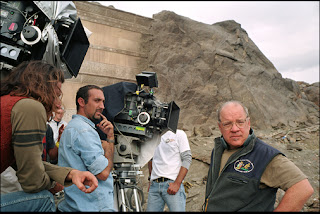
Writer-director Paul Schrader (right) on the set of Dominion: Prequel to The Exorcist.


PAUL SCHRADER:
DOMINION OF THE DARK
By
Alex Simon


Editor’s Note: This article originally appeared in the November 2005 issue of Venice Magazine.

Paul Schrader cemented his legendary status in cinema when he penned the Oscar-nominated script of Taxi Driver, which was directed by Martin Scorsese in 1976. Since that time, Schrader has become a sort of thinking man’s mogul, a writer-director whose work plumbs the depths of the human soul and psyche, and takes viewers to many dark corners that they may have preferred to remain hidden.
Schrader’s journey has been as fraught with dark shadows as some of his characters. The product of a strict Calvinist upbringing, he was born July 22, 1946 in Grand Rapids, Michigan, the second child of a business executive and a homemaker who refused to let their children (older brother Leonard is also a renowned screenwriter, earning an Oscar nomination for Kiss of the Spider Woman) see a film until they were 18. Schrader was educated at Calvin College, Columbia University, and UCLA and was heavily influenced by foreign filmmakers such as Robert Bresson, Carl Theodor Dryer and Yasujiro Ozu. After an initial stint as a film critic, Paul and Len Schrader became established screenwriters with the sale of their script The Yakuza to Warner Bros., with Paul’s Taxi Driver soon following. Written during a period of intense alcohol and drug abuse, and suicidal behavior, Taxi Driver has gone on to become the ultimate look into the heart, mind and soul of a societal fringe-dweller whose yearning for recognition explodes with furious violence. Robert De Niro’s psychotic cabbie Travis Bickle seemed to provide the world with insight into what made previously incomprehensible “whackos” like Lee Harvey Oswald, Sirhan Sirhan, and Charles Manson tick. It remains a potent classic and a testament to Schrader’s gifts as a writer.
Schrader made the jump to director with 1978’s Blue Collar, followed by the classic American Gigolo (1980, and regarded by many as a touchstone film of the era), Cat People (1982), Mishima: A Life in Four Chapters (1985), Light of Day (1987), Patty Hearst (1988), The Comfort of Strangers (1990), Light Sleeper (1992), Touch (1994), Affliction (1997), Forever Mine (1999), and Auto Focus (2002). Schrader has penned the scripts for such diverse films as Obsession (1976), Rolling Thunder (1977), Old Boyfriends (1979), Raging Bull (1980), The Mosquito Coast (1986), The Last Temptation of Christ (1988), City Hall (1996), and Bringing Out the Dead (1999).
Paul Schrader’s latest film has had a perilous journey that could be a movie plot in and of itself. Schrader inherited Dominion: A Prequel to The Exorcist after director John Frankenheimer died during pre-production. Intended as an exploration of the Father Merrin character (portrayed by Max Von Sydow in the 1973 film) and his first encounter with the demon who dominates the original story, Schrader’s film was rejected by Morgan Creek Pictures and its CEO James G. Robinson as being too cerebral and not gory enough. Schrader was then let go as director, and replaced by Renny Harlin, who proceeded to reshoot almost 100% of the picture, resulting in the box office and critical bomb Exorcist: The Beginning.
Schrader’s version has been given a new lease on life, however, having received a limited theatrical release last summer and arriving on Warner Bros. DVD this month. Watching the two films back-to-back, one is struck by how distinctive the two schools of filmmaking are that Schrader and Harlin’s work represents. Paul Schrader sat down with us recently to discuss his experience making the film, as well as other aspects of his storied, legendary career.

When I heard you were going to be directing a prequel to The Exorcist I was a bit surprised, since it’s a change for you in terms of genre. What attracted you to the story?
Paul Schrader: Three things, not in any particular order: I loved the inversion of the premise, that instead of tormenting a cute little girl, you edify an afflicted outcast and turn him into Lucifer. I just thought that was genius. I loved that it was a real character study, with Father Merrin’s journey. I also loved the fact that it was in motion, and real. From the day I read the script to the day we started shooting was only three months. (John) Frankenheimer had scouted locations, had partially cast the movie, developed the script, budgeted the movie. It was a going, happening thing. For someone who’s spent years and years raising money to get films made, that was very attractive.

Is there a certain degree of baggage for a filmmaker when you’re making a film as a sequel to a legendary film that came before it?
An enormous amount of baggage. The kind of baggage that would scare off a number of other directors, because you can’t recreate The Exorcist, and you can’t compete with it. That’s a losing game. I’ve never been afraid of trying things other people say are impossible. I ended up with Patty Hearst because no one could figure out how to do it. I ended up with The Comfort of Strangers because (John) Schlesigner couldn’t figure out how to do it. So when someone tells me “You can’t do this,” my response is “Yes, I can.” But most importantly, this film takes place 25 years before the events in Georgetown. I wasn’t locked into anything, as a result, except I had to show Father Merrin meeting the devil, I had to show an exorcism, and I had to be sure that Merrin survives in the end. Beyond that, I had no allegiance to the Friedkin film. So I can roll back in history and make a film that stylistically, is more like an old-fashioned film, like the films of the 40s, when this film takes place.

Did you watch a lot of the old Universal horror films from that period to prepare?
No, mostly westerns. This film was never a horror premise, to begin with. This film is essentially a western, right down to the last shot, which is Shane. It’s the gunslinger who’s gotten out of the gunfighting business and has to strap on the six-shooters one more time to face the bad guys who ride into town. There were a lot of conscious references to the American west. This was because, when I was getting ready to do the movie, I went to the African location where the movie takes place, which is in West Kenya on the Sudan border, very wild country. There was a civil war going on, half-naked teenagers walking around with AK-47s, that part of the world. Very desolate, very wild, like the old American west. The architecture was even reminiscent of the old American west. That’s when we went back to the drawing board, and said this isn’t Nairobi in 1947, this is Fort Apache. This is a frontier post in the middle of nowhere. So we created this town based on that. The cowboys and Indians became the colonials and the natives.

This film is also unusual for you because it was written by someone other than yourself. Usually, you’re a writer/director.
Yeah, although I’ve directed a few pictures before that were written by others. The truth is, I sit down and retype the whole script anyway if it’s by someone else. I change things into my punctuation, my phraseology, so that when we’re on the set I can say ‘Oh yeah, I remember when I wrote this,’ (laughs) which is very unfair, in a way. When you write and direct, you’ve got to separate the two functions. It’s two different sides of your brain. Writing is very left brain, while directing is very right, and you can’t confuse the two. Whether you’ve written the script yourself or not, you have to attack it and destroy it so it fits the new form of logic that is directing. It’s also important that you understand the antagonistic nature of the two tasks, because writers and directors often lie to each other, and if you’re the same person, you believe those lies.

How was the film received by the studio brass during that first screening?
We had a ten week shoot: five in Morocco, five in Italy. I was under enormous pressure to deliver a cut very, very quickly, which always makes me suspicious. So I showed the first cut, which ran about two hours, ten minutes, to Jim (Robinson, CEO of Morgan Creek). We talked for three or four minutes, he said “It’s a little long. Take ten minutes out of it.” So I did and showed it to him the next week, and he didn’t come. In fact, that was the day that the editor was fired, and I was told to go home. There were no notes, and there were no discussions. That’s why I feel it’s a case of buyer’s remorse. I think somewhere towards the end of the process, Jim realized that they’d financed the wrong movie. He hoped they could bring in another editor and re-edit it, and it didn’t work. When they brought in Renny (Harlin) he said the same thing: “You don’t have a horror premise.” So they went back and started re-writing the script and changed the premise to have the demon possess a beautiful, young girl, a la the Friedkin original. And then they had their new movie, and more of a horror film.

I actually rented the Renny Harlin version after I saw your film. The contrast between the two was quite striking.
Yeah, it’s interesting isn’t it?

My guess is there will be many articles, papers and monographs written about the two for years to come.
Yeah, maybe to the point where film professors will start saying “You can write your term paper on anything you want, except the two Exorcist prequels!” (laughs)

What really stood out about Harlin’s version is that it was so clearly made as an exploitation film: Graphic violence, sex, over-the-top histrionics. What I liked about your film, is that it explored the human psyche instead of quarts of blood. Once upon a time that’s what films used to do, in general.
When you see the two films as you did, you see a generational gap. There’s the generation that was raised on story and character, ostensibly a version of stage drama. And then you have a generation that was raised on video games, commercials and MTV. And no one saw my film. It’s been sitting on a shelf for two years. It wasn’t shown to Warner Bros., or in house at Morgan Creek. Only Jim, Guy McElwaine and David Robinson, they’re the only ones who saw it. Never previewed, never tested. So finally, I heard the most true comment from someone over at Morgan Creek who said “Schrader’s is a better film, but Renny’s is a better trailer.”

Which sums up the difference between the Easy Riders and Raging Bulls and the MTV generation.
Yeah, exactly. And he was right: Renny’s is a better trailer.

The other big difference between your generation of filmmakers, who were students of film and only made films, and the newer crop of filmmakers is that they cut their teeth on commercials and music videos—which isn’t filmmaking, it’s advertising. So they’re inherently not storytellers, they’re salesmen. And what they wind up making is $100 million mouth wash ads, disguised as movies.
Yeah, and the core of those movies, the stories, have to be greatly simplified, just as in advertising, the message is greatly simplified. “Buy this product, and you’ll get laid.” That’s how simple it is. You never sold anything by saying “Buy this product, maybe you’ll get laid, maybe you won’t.” (laughs) It’s very frustrating. If you like language, and character conflict, and ambiguity, there’s not a lot of room for you in a movie studio. And that’s one reason that I think the theater has been getting so much better lately. So many writers who were shuttled off to Hollywood a decade ago have started coming back to the theater. Writers like John Patrick Shanley, who won an Oscar for Moonstruck (1987), then got stuck writing stuff like Congo (1995), he won the Pulitzer this year for Doubt. John is a close friend of mine, and he’s returned to the theater because movies just don’t have the substance that they used to.

The other option you have is to go indie, but you also don’t make the same kind of living you would doing studio pictures, especially if you have a family to support.
I don’t even know if the indie route is all it’s cracked up to be. The studios have swallowed most of them up. To release a $2 million indie film, requires the same $5 million print and ad budget that a $50 million film does. When a distributor looks at a $2 million film, they’re looking at how much money they’re going to have to put in to get it out there. This might all change, of course, with broadband distribution, showing first run films on the web. Who knows how this is going to change things? I read a piece in The New York Times the other day, about how the Hong Kong film industry from a high of 300-400 films a year in the mid-90s, is now down to less than 50 films a year. From the Hong Kong perspective, the industry is near-dead now. They attribute its death to piracy, that there’s no money in making films anymore. Music in China is 95% pirated now, so that music groups issue albums to promote their tours, the opposite of the original paradigm, which was you went on tour to promote your album. If China is in some way the precursor of the new economics of entertainment, we’re in for a big shock, and a major case of whiplash, because this whole house of cards with these prohibitively expensive movies is going to come crashing down, just as it has in the music business. There is no more pressing issue than piracy. The best solution is the I-tunes solution: just sell it on the web and go to your competitors and fill their free software with viruses. (laughs) So movies may be headed toward that direction: on-demand, an IMDB catalog of films, available on a per-view basis. Everything about movies is obesely bloated at this point, and it deserves to collapse.

It’s gotten to the point where the people in charge of greenlighting movies don’t know or even like movies.
I can’t tell you the last agent or executive I talked with who likes movies. It’s becoming harder and harder. I was talking with Steven Soderbergh recently and the same subject came up, and he said “I find that I can’t mention films I like now if they didn’t make money.” Anytime you mention a film that didn’t make money, they get this look in their eyes, and it’s like: oops! (laughs) The people who run the business who don’t like movies are shameless about viewing movies as simply a commodity. They’re proud of it!

What do you do in that situation? Do you jump on the bandwagon to try and make a living, or do you hold fast to your ideals?
Well, fortunately I’m at an age where it’s almost too late to jump on the bandwagon. I’ve got another three or four films left in me, and I will struggle and I will get these films made.

But you’re still a young man. You’re what, 58?
Yeah, but it’s not easy for me to get a film made.

What was the last film you made that, according to Hollywood standards, was a “success”?
Well, both Affliction and Auto-Focus made money, but they don’t count.

Even the Oscars that Affliction won and was nominated for don’t count?
Nobody’s interested in prestigious, low income films. It’s just not what they do. The first time I realized this, I made a movie called Light Sleeper. It was made for Carolco, and because of Carolco’s arrangement with either Universal or United Artists, it had to be offered to them. Mike Medavoy, was at that time the executive. Mike is someone I had known for many years, and at one time was my agent. So Mike had to look at the film to see if they would release it. He called me up and said “This is really a good film. I really like it but you know, we don’t really distribute this kind of movie anymore.” And it was that blunt, that simple. They’re in another business now. So the films that I was making when I began, which were all studio films, then became independents.

One thing that struck me about Dominion was its theme of a protagonist questioning his faith, which is something that runs through most of your work. You came from a very strict, Calvinist family growing up. Although you obviously didn’t adopt that philosophy as an adult, it would seem that certain questions were raised in your psyche that have stayed with you.
They never leave you, no matter how far or how fast you run, you don’t outrun your childhood. And if you’re raised in an environment of good and evil, a very real hell, moral consequences, that stays with you your whole life. If you’re raised that at any moment, Jesus will return and judge you, maybe catch you masturbating, you’ll go straight to hell. I remember this very vividly, here give me your hand (Schrader takes my hand, palm up). I asked my mother, when I was about seven or eight, what was hell like? She took a sewing needle and went like this (Schrader jabs my finger, gently, with his fork) and jabbed me, and blood was coming out of my thumb. She said “You know how that felt when that needle went in your thumb? That’s what hell’s like, all the time.” I thought ‘Oh boy! Okay! I’m not going there. You want me to wash the dishes, clean my room, no problem! I don’t want to go to that needle in the thumb place!’ So that was the world in which I was raised. I later saw it for the metaphorical construct it was: a system of thought in order to make the world simple and understandable.

What did your father do?
Well, to his great chagrin because he wanted to be a minister, the Depression came, and he couldn’t support his family, so he dropped out of Calvin College, the college that both Len and I went to, and ended up as an executive for a pipeline company called Michigan-Ohio Pipeline. He then decided that his sons would become ministers, so that was the great drama and trauma of our adolescence. I learned a lot from my brother, who is three years older than I, because my father came at him. My brother resisted him, but he broke my brother. He broke his spirit. I remember watching him work my brother over verbally. I remember talking to Len, and Len saying “This is what’s going to happen.” So when my turn came, I fought back. I punched him. And that’s probably the difference between my brother and I. When my father died, my brother was not able to go to the funeral. And I think my father is still alive inside my brother. He never really got to punch him. It’s so strange, so Freudian, when you look at people whose lives are still defined by hating somebody who’s long in the ground. That’s what therapy is all about.

Has therapy been helpful to you over the years?
Yeah, very. The very first money I made, for the sale of The Yakuza, I went into analysis five days a week. I was frightened. I was walking around, carrying a gun. I could only sleep with a gun in my mouth. And I was thinking, ‘How long can this go on?’ (laughs) So when I went on the couch five days a week, it saved my life. And I’m forever grateful for that. My presenting cause--which is an infirmity you have that’s psychosomatic--of my neurosis was extreme claustrophobia, which I learned through research results from fear of the womb. I couldn’t ride on elevators, or go on airplanes. I’d have rather walked up twenty flights of stairs that go on an elevator. My doctor said to me “When you see a woman’s vagina, what do you think?” I said ‘The first thing I think is that I’m in the wrong place, that I walked into the girls’ locker room by mistake. I shouldn’t be there.’ Then I said, right out of the blue, ‘I feel like I’ve stepped into an elevator, and once those steel doors close, they’ll never open again.’ And I jumped up from the couch and started running around the room saying ‘I just said it! I just said it! I made the connection!’ It was about the power of the female to swallow your ego, and devour it.

So was your mother more dominant in your life than your father?
Yeah, but I mean, it’s always a give and take. I loved my mother and feared my father. My hatred of my father was more resolved than my love of my mother.

Did your father see any of your films?
It’s funny, the one time my father and I discussed it—and he didn’t go to movies, didn’t believe in movies—I started getting phone calls from him around the time Last Temptation was finished: “How’s the new movie coming along?” and so forth. The first couple calls I was a bit confused by it all. The third time he called, he started to ask me about the theaters it was going to be playing in. I said ‘Dad, are you by any chance in the group that is trying to block this film?’ And he said “Yes, but only locally.” (laughs) And he did manage to block it locally! There is some comfort in the fact of knowing that your father walked the line, even though it might have been tempting for him to support the work of his son, he stuck to his beliefs to the end. After he died, every film that my brother and I had done, he had purchased on video. And we found them all, still in their original plastic wraps. He never opened them or watched them, but he had them! (laughs) “My sons have done this, but I haven’t seen them!”

How have you maintained your relationships with your fellow Easy Riders and Raging Bulls: Scorsese, Spielberg, De Palma, Lucas?
Not much, really. Obviously, once you get successful, everyone has their own little communities, and you live inside those. So those early years of swapping each other’s ambitions, that goes away. Some of my fellow soldiers have wearied of the fight, which is the premise of Peter Biskind’s book. I disagree with the premise. I think he found himself a premise that he was determined to see through regardless of the evidence that he gathered. I remember calling Peter just before the book came out and saying ‘Peter, I know you think we all sold out, but I just finished a film called Affliction that’s as pure a film as anything I’ve ever done. I wish you’d see this before you go to press on your book,’ but I couldn’t get him to see it. It’s like that graduate student who decides on his doctoral thesis premise and then makes everything fit into it, no matter what.

Getting back to the purity of your films, I would argue that Affliction is the second purest, and your purest is Mishima, which to me is an unheralded masterpiece.
Well, it’s the most original, but I don’t know that it’s the most personal. I think Light Sleeper is the most personal. But it is the most original and the most unique. When I was younger I knew Charles Eames, the architect. I used to spend a lot of time hanging around his workshop at 901 Washington. Charles said to me once “Art is really only about problem-solving. Before I make a new chair I go around and measure everyone’s ass in the workshop—problem-solving.” In a way, the genius of Mishima lay in problem-solving. Here you have a functioning schizophrenic: a man who lives multiple, simultaneous lives, contradictory ones. How do you portray such a character? How do you portray his inner life as well as his creative one? So you create this odd, cross-hatch structure: time, place, film stock that reflects the contradictory, schizophrenic nature of the character. So the beauty of Mishima is that it was the right solution to the right problem. I never made another film like it because I never had a problem like that before. It was the only way I could see to solve it.

Tell us about how Taxi Driver changed your life.
It’s kind of a wonderful thing to be associated with a classic. People have actually said to me “It must be terrible when one of your first scripts becomes a classic. How do you live up to that?” And I know full well that in my obituary, the first line will mention Taxi Driver, unless I kill the President or something. (laughs) And my response to that is, ‘Don’t you understand that it’s a wonderful film?’ I have friends in their 40s and 50s who are still on their hands and knees, crawling down Hollywood Boulevard for a little recognition. The fact that I got that kind of recognition early and powerfully, is not an intimidation, it’s a liberation. I suddenly could say that I never had to worry about becoming somebody. I did something that has allowed me to go on, and be free because I will never top it. Rather than being a sword hanging over my head, it really released my self-confidence as an artist because I knew that I had produced creative work that had value.

What was it like making the jump from screenwriter to writer/director with Blue Collar.
I made the decision not because I felt my work was somehow being ruined by the directors who’d shot my screenplays—which is the normal screenwriter’s lament. But I came to the point where I said ‘What are you? What is your identity? Are you a writer, why don’t you write something, like a book, where your words are the final product. Or, are you a filmmaker, in which case, you’d better start making films. This thing called screenwriting has such an unshaped background that by itself, will only bring unhappiness as you go down the road.’ So that’s when I started thinking about directing. I think I would have gone back to film criticism, rather than just be a screenwriter, because in being a film critic, your words are still the final product, whereas as a screenwriter, that’s never the case.

Is a first-time director ever prepared for that first day they walk on the set, or is it baptism by fire?
It’s on-the-job training. It’s not that hard to direct a movie. That’s one of the myths of filmmaking. All you have to do, is surround yourself with an experienced team. So many cinematographers and assistant directors ghost direct movies. We know their names. They get paid to do that. I can take anyone here, put them with that team, and an efficient, workable movie will result. So what you are bringing to the dance is not experience, but a kind of vision and originality. “I would like to tell this story. It hasn’t been told before, I don’t think. But I don’t quite know how to tell it. Help me out.” I did two films where I didn’t know how to direct: Blue Collar and Hardcore. Somewhere during American Gigolo I figured out what directing was, which was primarily because of a production designer named Ferdinando Scarfiotti, who got me to start thinking in visual terms instead of literary terms. They’re different thought processes. By the time I did Gigolo, I was starting to think as a picture maker much more than as a storyteller. But it takes a while. During the first and second film in particular, you’re just trying to keep your goddamned head above water.

One thing I’ve always loved about your films is that you’re a proponent of “less is more.” This is never more evident that if you put your version of The Exorcist next to Renny Harlin’s.
You have to get the viewer into the dance. And the only way you can do that, is to back off. If you keep throwing things out there, there’s no way they can ever participate in the story. And when the viewer participates, that’s when the viewer comes alive, and becomes part of the creative process. And therefore there has to be a certain mystery in every story that the viewer can address, a kind of disparity, a kind of uncertainty where the viewer says “Wait a second. This, and this, and this, they don’t really go together. But if I move this here and this, then they go together.”

What you’ve just said sums up what so many filmmakers today have forgotten: they know how to stimulate they eyes and the ears, but not the brain.
Right, and unless the viewer can join in the creative process, they’re strictly outside voyeurs.

FRANCIS COPPOLA INTERVIEW!

(Francis Coppola on the set of Youth Without Youth.)


FRANCIS COPPOLA GOES BACK TO BASICS
by Alex Simon


Perhaps more than any other filmmaker in history, Francis Coppola has tasted the fruits of phenomenal success, and also suffered the tortures of the damned. After becoming arguably the most successful director of the 1970s with his quartet of films that are regarded as the pinnacle of American filmmaking (The Godfather I & II, The Conversation, Apocalypse Now won a cumulative 11 Academy Awards), Coppola’s life in the 1980s was met with a series of professional disappointments and personal tragedy: a series of ambitious films from his Zoetrope Studios were financial and critical disasters. In 1986, his eldest son, Gian-Carlo, was killed in a boating accident.


In the interim, Coppola never stopped working, with more than 30 films to his credit as director, nearly 70 as producer, and 25 as screenwriter (Coppola won a Best Screenplay Oscar in 1970 for Patton). In addition, the Coppola family has joined the ranks of the Fondas and Hustons in the number of talented progeny they have sired over several generations: Coppola’s sister Talia Shire is an Academy-Award nominated actress; his late father Carmine Coppola was an Oscar-winning film composer; daughter Sofia is an Oscar-winning screenwriter and the first woman to be nominated for an Oscar as Best Director; and nephew Nicolas Cage (real last name Coppola) is an Oscar-winning actor and has been a renowned international star for nearly 20 years. Son Roman is also a successful filmmaker and producer.

After a ten year hiatus from directing, his last feature being the 1997 John Grisham adaptation of The Rainmaker, Francis Coppola returns to his avant-garde roots that began in the mid-60s with films like You’re a Big Boy Now and The Rain People. Youth Without Youth stars Tim Roth as Dominic Matei, an elderly Romanian man in 1938 who, just before he is about to commit suicide, is struck by lightning and miraculously survives. Not only does he survive, but he finds that his body has begun aging in reverse, making him a young man again during the rise of Fascism in Europe of the late 1930s. Gifted not only with a second chance at life, but also renewed youth, Dominic finds that he has the rare gift of having the body of a young man, but the wisdom of an aged one. He re-expereinces a first great love affair, and a series of moral choices that dictate the course of his second life. Based on the writings of religious and philosophical scholar Mircea Eliade, Youth Without Youth offers some of the most stunning imagery (equal parts beautiful and repellent) put onto film in recent memory, and refreshingly asks more questions than it answers. Not for every taste, to be sure, and in no danger of being set up for sequel to be helmed by Michael Bay, Francis Coppola seems to have come full-circle with this fascinating, and challenging cinematic work.

I sat down with Mr. Coppola recently, during a short respite before he was off traveling the world once again, this time to Argentina, where he is in pre-production on his next film, Tetro.

This is one of those films that has many different layers to it, both conscious and unconscious. Was it the complexity of the story that drew you to it?

Francis Coppola: Absolutely, but I’m not sure that it’s such a complex story. My feeling was always that, like Hamlet, we all know what’s going on here: a guy’s father is murdered and the guy plots revenge. That’s what Hamlet is on the surface. The story of Youth Without Youth is exotic and certainly a lot of crazy things happen, not unlike an episode of "The Twilight Zone" in some ways, but it’s not difficult to understand what it’s about.

But it’s really more about the subtext than the context.

Well, the subtext is a different story, and what I think is the real fun of it. You can think about it and relate to it in terms of where you are in your own life, maybe see it again at different times in your life and each time it will take on a new meaning. That’s what’s fun for me.

I feel like I might have to see it a couple more times to really feel as though I’ve seen the film.

But I would argue that you didn’t miss any of the story the first time you saw it. What you missed perhaps, were some of the implications, but you’re supposed to miss them. Again, not that this is Hamlet, but you could enjoy that play simply on the level of a murder mystery, and you should. You shouldn’t feel that you can’t enjoy it because it’s somehow over your head. It’s not over your head. It’s over everybody’s head. It’s meant to be a positive thing that the story can always be changing and taking on new meaning for you as your life changes and things take on new meanings. We live in a time of dramatized criminology where we have to have all the clues and have all the questions be answered in sixty minutes, or less. But this is not that kind of a story. Some of the mysteries here have to do with the nature of existence and who could pinpoint that? You could get into a long conversation about why you can’t, and that’s something that I enjoy doing.

This is a return to avant-garde filmmaking for you.

Well, that would be a privilege…

Your early films: You’re a Big Boy Now, and The Rain People were certainly avant-garde, as was The Conversation and Rumble Fish. Plus, if you look throughout your body of work, there are avant-garde elements in virtually all of your films. Obviously it’s an artistic movement which had a profound effect on you. Were those the elements of Youth Without Youth that made you want to step back behind a camera again, after ten years?

Those first three you mentioned were original screenplays, which is what I want to get back to doing. A lot of directors have a hiatus between films, usually about three years, especially if you’re writing your own stuff, because it takes two years to write something. So I don’t think it’s that unusual for a director to be absent for a while, unless you’re talking about someone who’s just a big director, who’s got three or four scripts being developed for him all the time, and he just keeps working because he wants to work every year. In my case, I was searching for what my little niche would be. I didn’t want to be a “big director” directing big, complicated movies with big stars for big studios. You know, the sort of movie that’s going to have a lot of producers and notes, and that kind of thing. You look at a movie today, and you’ve got a dozen producers listed. I also didn’t necessarily want to do a film just because I thought it would be a hit, and make me a lot of money, because I’ve got plenty of money. What I really was looking for was some kind of personal fulfillment, so I was trying to write this ambitious screenplay called Megalopolis, which was about utopia, which sort of got tough after 9/11, and I didn’t know how to deal with that story, which was set in New York, without somehow incorporating the tragedy of the Twin Towers. So I was sort of trapped, and a little depressed, and then ultimately a friend of mine who I had given my script to and was an associate of Eliade, suggested I read some of his work. Because even in Megalopolis, there were a lot of inquiry into the nature of consciousness and time, and she said “You have to read some Eliade,” and when I read Youth Without Youth it was like I had been hit by lightning, and I thought ‘Gee, I could just go off and make this. I could fly off to Romania, use my own money, and the kind of technology that I had done when I was young and made films like The Rain People, and just have all the equipment in a truck and ship it there.’ And although this is a big picture, I approached the production in such a logical way, that I could afford to make it exactly as I wanted to. In the process, I was able to fix this part of my life that was so frustrating.

So in many ways, there were parallels between your own life and that of the Tim Roth character.

Yes, and I realized that. I thought it was good that I was making a movie about something that I was going through at the time. I felt that when I was young, I was catapulted into an old man’s career with The Godfather, which I made when I was about 30. I wanted to be a young filmmaker, but here I was, a big Hollywood filmmaker. So I thought, why not at 67, try to have a young, student filmmaker experience. That’s why I tried to hire young people: my cinematographer was barely 28, and try to make a movie with young eyes.

A few months back, I interviewed William Friedkin, who’s going through the exact same thing in terms of going back to his roots, as are many directors of your generation. His latest film, Bug, primarily takes place on a single set with two characters. Throughout our talk, Billy kept commenting on how if he were in his 20s today, he probably wouldn’t be in the movie business, simply because the kinds of stories that he likes to tell aren’t being funded by studios anymore.

What would he be doing now?

We didn’t get into that, but I know for the past decade he’s been directing operas. So maybe he’d be focusing more on the stage, or on writing.

Well, I think filmmaking is the most exciting art form there is. First of all, it’s young, which means it’s going to continue to evolve, and it also encompasses so many other art forms. What Billy says is certainly true. It’s a tough time because the studios which used to owned by showmen and wacky guys like Jack Warner and Darryl Zanuck who really loved movies are now owned by big communications czars who are more interested in the stock price of their companies than they are in movies, so it’s tough. There’s not a big variety of filmmaking happening anymore. Everything has got to be a big-budget blockbuster, because that’s the only way they can support what they’ve got going. I understand that it’s tough to even get a drama made today. But it was always tough, even when Billy and I started.

I think Billy’s point was, and Peter Bogdanovich made this same point when we spoke a few years ago, when you guys started out in the mid-60s, the guys who ran the studios were interested in telling the same stories that you were. Today, that simply isn’t the case.

They’re not even interested in telling stories anymore. They’re just interested in making money, which they always were, but with a difference: if Sam Goldwyn could do a picture like The Best Years of Our Lives, he was proud to do this beautiful drama, and to have it make money. But success today is defined differently, I think. The prize is the big stock price, and the G5 jet, and whatever it is. They’re not show people so much. They’re business people. I mean, Zanuck was a writer for many years, and Warner and Goldwyn had come out of the early days of exhibition, so they were coming at it from a different mind set. Harvey (Weinstein) is like that. Harvey is the most like the old guys: he’s tough and vulgar and it might be a nightmare to work with him, although I never have, but still he loves movies and he wants to have the best movie of the year, every year.

So when your kids Roman and Sofia expressed interest in entering the business, you didn’t discourage them at all?

No, I disagree with Billy on that. I think it’s still the most exciting art form in the world, and I don’t think kids should be discouraged from anything they want to do. I mean, what’s the point of life, to see who dies with the most toys? My answer would be to die with the best memories.

I agree with you, but I don’t think a lot of the power structure of Hollywood does.

No? What about somebody like Mark Cuban? He seems like he likes his toys.

He’s also got good taste. He’s put his name on some interesting pictures.

Yeah, that’s true.

Let’s get back to Youth Without Youth. It’s a picture with an epic scope. Was shooting in Eastern Europe with a crew from that region make it a different experience than shooting in the U.S. with Americans?

The crew was amazing but the primary thing that made it different was the fact that it was a masterpiece of production: because I put up my own money, I was able to eliminate a lot of the waste that comes through banking arrangements and completion bonds and various studio affiliations…you’d be surprised how much creative financing goes on. So the trick was I said ‘We’re going, and they money is there,’ and because of that, we didn’t have to jump through other people’s hoops. And the crews there also work for far less than the crews here. We made it with a 100% Romanian crew, with the exception of hair and makeup because I knew that would be important and I wanted the very best. Those two people for hair and makeup wound up costing me almost as much as the entire rest of the crew! In terms of everything else, it all becomes fewer: the number of people you have to have on-set, the number of people making decisions. It was really wonderful.

Tell us about how you like to work with actors. I’ve been a fan of Tim Roth for years, and he does terrific work in this.

Tim is one of those actors who’s always done good work, but has never had his day in the sun, where they say “Wow! Look at what he can do.” They did it with Nicolas (Cage) finally, after Leaving Las Vegas. And Tim gives a tremendous performance. He had to be 24 and he had to be 94 and every age in between. Plus, he had to have a heartbreaking love story, whereas he’s largely played villains before. Plus, his head is wrapped in gauze during a big chunk of the film, so he’s just acting with his eyes.

You’re known for giving actors a great deal of latitude. Is your philosophy to cast well, and then get out of the way?

Well, it’s more complicated than that. I always do a couple weeks of rehearsal and I have a theory that during the early phase of the movie, one-by-one the actors find their character. Once they find their characters, then they are the person. For example, if I said to you ‘Alex, I want you to go down the hall and slap the press lady,’ and you said “Well, okay. If I have to.” You would do it as Alex would do it. But if you’re Tim Roth and after two or three weeks you’ve arrived at who your character is, whatever I ask you to do, you’re going to do it in character. You’ll know the character better than I do. So in that sense, I do give the actors a lot of leeway because I want the best for them, and I want their characters to come alive. But I do lots of things to put you in the context. I love using props, and laying them on actors, in a way making very narrow the path that you’re going to go through. So if you Alex are going to play Dominic, I’m going to surround you with Dominic props and Dominic stimulus and give you a Dominic labyrinth to go through. So you’ll be acting in a very free way, but you’re also in a route that’s been made for you that can’t miss.

And sometimes you do that on the spur of the moment. I heard that you’re the one who dropped that cat into Brando’s lap during the opening scene of The Godfather to help him get into character.

Yeah, and it was a cat that just happened to be wandering around the soundstage. It helped Marlon to focus. He was talking to the other person in the scene, but he was also focusing on petting and playing with the cat that was on his lap. It put him in the moment.

So do you block during your rehearsals?

No, we do more improvisations and games and odd things that I think of or other things that people suggest that might lead the actor to click into who they are. I’ll tell you a Billy Friedkin story. On The French Connection, Gene Hackman was playing the part of Popeye Doyle. He said in the first few weeks, he had no idea who he was. He said “I put on this funny porkpie hat, and was talking fast…and at one point in the morning, it was cold and I went to craft service and got a cup of coffee and a donut and I dunked the donut in the coffee, took one bite of the donut and then I tossed the donut in the street. Then I heard a voice say ‘That’s him! That’s Popeye.’” And it was Friedkin, who had watched the whole thing. So sometimes, some little moment can give you the key to the entire character.

Now that DVDs have become the new cinematheque, and you’ve recorded commentary tracks for some of your most famous films, is it easier for you to watch your work with some time behind it?

I don’t watch my work, really. Once in a while I’ll be in a hotel room, and I’ll notice they’re playing one of my films on TV. Last I was in Lima, Peru and they were playing Jack, with Robin Williams. And I liked it, and remembered liked working with those kids. When they ask me to do a commentary, they sit me in front of a screen and I usually haven’t seen the film, as with Dracula most recently, and then I just say whatever I think while I’m watching it. Once I finish a film, I’m usually done with it. I’m much more interested in the new one than I am in the old one. Although sometimes it’s a very pleasant experience. One of my films that’s one of my favorites is Rumble Fish, made in the period when I supposedly wasn’t making good movies, but I think Rumble Fish is as good as any movie I’ve ever made.

But oftentimes artists are their own worst critics. I’ve interviewed many filmmakers who have gone back to their work that was excoriated at the time of its release and they think that it’s actually pretty good. I’ve also spoken with others who’ve had the opposite experience.

Yeah, I don’t agree with what a lot of the critics have said about my work. Certainly, The Outsiders would fall under that category and the version we put out on DVD with the extra footage I think is really terrific. Even Jack, which I watched last week, I realize that nobody liked it, but I must say it was a production where I was a director-for-hire, I thought it was a very sweet movie. And Big, which was essentially the same idea, which was my first objection as to why anyone would want to make Jack, with a film as good as Big already out there. I think Big is certainly the better film of the two, because it was the first time that idea was done, and maybe Robin wasn’t the best for that kind of mawkish character. He can be absolutely brilliant, but maybe I let him be a bit too sentimental in Jack. People seemed to resent the fact that a guy like me, who is supposedly a more intellectual, avant-garde filmmaker, would make a film like Jack.

Yeah, that was the reaction that I remembered. When people see a Francis Coppola picture, they’re raising the bar higher than they would for most other filmmakers, and they want something more serious, or at least something that’s perhaps somewhat elevated from the rest of the pack.

But there are all kinds of movies…

I agree with you. But human beings, especially critics and scholars, like to pigeonhole people.

Definitely. And from the artist’s point of view, that can be very frustrating, and hurtful.

I know a lot of your work has been heavily influenced by the Italian neo-realists: Rossellini, De Sica, Visconti, Pasolini. Who are some of your other influences?

I love Fellini’s films, both the pre-La Dolce Vita films, which was a revelation and the films he did after that. I love Kurosawa because he just made so many great films. He was a case where his new film was as great as anything he’d done before. I don’t know how he was able to do it. I loved the French New Wave and Truffaut, and Antonioni, and Rossellini was like the father to them all…Visconti with Rocco and His Brothers

One of my favorite films.

That’s the kind of movie I’m making in Argentina next. It’s the story of brothers.

I read somewhere that the banquet scene at the end of Visconti’s The Leopard was what influenced the wedding scene at the opening of The Godfather.

No, on the third Godfather I looked at The Leopard a lot, but on the first one, I based it on my family weddings. (laughs) I quite loved Wajda’s Ashes and Diamonds which is quite possibly one of the greatest films ever made. I love G.W. Pabst. I love the silent films: Murnau’s Sunrise.

Did you study Murnau’s Nosferatu before doing Dracula?

Not really. I looked much more at Carl Dreyer’s Vampyr, which is quite different. Nosferatu is quite obviously the greatest vampire story ever made. I couldn’t get 100% with Bergman, but there are some Bergman films I adore, like Smiles of a Summer Night, Wild Strawberries…there have been such great movies made in the hundred years of their existence, even in the first thirty years. But G.W. Pabst was always one of my favorites. Eisenstein is another one.

I know you got an early break working for the legendary Roger Corman. What was that like?

It wasn’t so much a break, as it was a real job. I had never worked so hard for such a small amount of money in my life. The thrill of it was, you really were learning the reality of production and how to really get out there and make movies for a little money and how not to waste money. Roger clearly was a businessman. He was a Stanford engineer, a good guy, and he was doing it because he was smart. I treasure the years I worked for him. I started out as his assistant, and he was a wonderful character.

Tell us about the new picture you’re doing in Argentina.

It’s a very personal film made on a similar scale of Youth Without Youth, although not quite as big. I have Matt Dillon, Javier Bardem, Klaus Maria Brandauer. It’s a story of brothers and fathers, sort of like a Greek myth, or so people have told me. A lot of it is taken from my own memories. I’m consciously going into my Tennessee Williams period, which I’ve always wanted to do. I’m praying for the ghost of Elia Kazan to come and occupy me, because there’s no greater director of actors that ever lived.

Yeah, I also think he was one of the great blenders of cinema-verite style realism and pure cinematic filmmaking.

Yeah, he made so many great movies, but look at Baby Doll, and how striking it still is, 50 years later. What’s the one he did with Lee Remick and Andy Griffith about the radio personality?

A Face in the Crowd.

A Face in the Crowd! Splendor in the Grass, which was one of the most heartbreaking love stories you could ever tell.

He was also one of the great discoverers of screen talent. You’ve also always had an eye for discovering new faces.

I’ve been lucky enough to have some wonderful associates. Fred Roos, who helped me with the casting of The Godfather, and we still work together. Listen, it’s such a privilege to be able to make films, and I’m so grateful that I got wealthy through some surprise of fate that allowed me to finance them. Speaking of, Billy could finance his own movies. He’s rich. He should.

Which brings us back to the beginning of our conversation: how so many of the so-called “Easy Riders and Raging Bulls” are returning to their roots as filmmakers.

There’s no question. For so long, there were filmmakers like the late Michael Ritchie, Fielder Cook, Hal Ashby, there was just such a great heritage of filmmakers who were once out there. Now, speaking for myself, I just want to make personal films and the phrase that you keep using, which I’m going to steal, which is “avant-garde” films, that’s what I want to do. I want to make films you haven’t seen before. I’m so tired of going to a movie theater and seeing a story I’ve seen before. Even if it’s an important director like a Michael Mann, they’re clearly in it to be a part of the studio mill. I know there are a lot of my colleagues who feel the same way I do, and want to make personal films. Maybe a lot of them have been married a lot of times, and can’t quite afford to do what I’m doing. If you’re supporting five families, it’s hard to stop making a lot of money. Look at someone like Brian De Palma. He just keeps making movies, and finds ways to get the money from a variety of sources. I wish George Lucas would take some of his fortune now and make some personal art films, because he’s a very talented filmmaker. No one even knows what George is truly capable of.

It seems like he’s focused more on developing the technological side of his business.

It’s this kind of silly blockbuster competition of who has more billions of dollars. But George is a fabulous avant-garde filmmaker, and the day he just walks out there and takes three 16mm cameras…it’s just one of the greatest wastes of talent that he keeps making Star Wars over and over again. Star Wars was a stunning achievement but now, I wish George would show us the other side of him.

It seems like Spielberg is someone who does do that. It’s like a “one for them” and “one for me” philosophy.

Yeah, Spielberg did Empire of the Sun, which was one of the better films of that period and also discovered Christian Bale as a child. Even Munich I thought was the best film of that year. He took some flack for it, but to have the guts to say the unsayable that maybe everyone in that whole conflict is partly to blame, and he tried to do that. I have nothing but admiration for Steven, and for all filmmakers who make personal films. That’s why we got into this in the first place. That’s why we’re here.


Labels