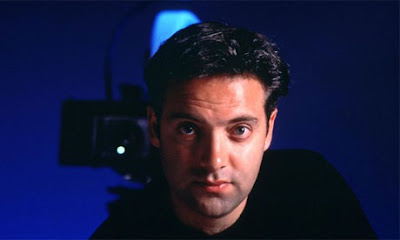
Gabriel Byrne: The Hollywood Flashback Interview

I interviewed actor Gabriel Byrne by phone in 2009, my final interview for Venice Magazine. It was simultaneously one of the easiest and most difficult conversations I've ever had. Easy because Byrne and I had that very rare thing: an instant rapport. Difficult because the phone he was using at a resort in the South Pacific kept cutting out, requiring dozens of call-backs between us. It got so bad that I even went online and found a help desk for how to deal with bad overseas phone connections in the 21st century. I tried to feed Byrne instructions over what felt like an ocean's worth of static. At one point he laughed, saying "Alex, is this most miserable interview you've ever done?" Well, hardly.
GABRIEL BYRNE: TALK TO ME
By Alex Simon
Gabriel Byrne was born in Dublin May 12, 1950, the eldest of six children. After schooling under the stern tutelage of The Christian Brothers and five years in Catholic seminary, Byrne attended University College in Dublin, where he studied linguistics and archeology, as well as honing his love of soccer, playing with the renowned Stella Maris Football Club.
Byrne discovered acting late compared to most of his peers, spending his 20s working in a variety of professions including schoolteacher, where his students inadvertently helped him discover his true calling (see below for more details). Since then, he has starred in over 45 films for some of cinema's finest contemporary directors both in the US and Europe (John Boorman, Costa Gavras, Michael Mann, Ken Loach, David Cronenberg, and the Coen Brothers, to name a few). Byrne produced the controversial and Oscar-nominated drama In the Name of the Father, as well as the fantasy Into the West, in which he also starred. On Broadway, Byrne was nominated for a Tony Award for his portrayal of James Tyrone in the acclaimed revival of Eugene O'Neill's A Moon for the Misbegotten. Also on Broadway in 2007, Byrne won the Outer Critics Cirlce Award for Best Actor for his work in A Touch of the Poet by O'Neill, and was awarded this year's Golden Globe for Best Actor in a Television Series, Drama for his work on HBO's In Treatment, where Gabriel Byrne takes on what he calls his most challenging role, as Paul Weston, a psychotherapist whose weekly sessions with a disparate group of patients provide the drama for the series. In Treatment has its second season premiere Sunday, April 5 on the venerable cable network.
I was originally scheduled to speak with Gabriel Byrne by phone from his home in New York on March 16, the day his close friend Natasha Richardson was fatally injured while skiing in Canada. Understandably not feeling up to chatting with a journalist, he rescheduled our talk for the following week. What followed were three different conversations over a period of three days. Gabriel Byrne proved himself to be a true man of letters and great intellectual curiosity during our talks, covering topics ranging from history, to religion, to politics, to film, and much more. In this case, words speak louder than action. And so…
I was thinking while watching In Treatment that it must be an interesting exercise for an actor to play a therapist since, as an actor, you have to be both a good listener and introspective.
Gabriel Byrne: That’s true. I think one of the challenges in the role for me is trying to find ways to deal with the different energies of the different characters that I work with. For example, it’s very difficult to let the audience know what you’re thinking, but not let the “patient” know what you’re thinking. You have to be constantly aware of that delicate balance between being a therapist and an actor. A lot of therapists have to act in a way, as do we all, in whatever job we do, we have to adopt a certain persona, even someone who checks you into a hotel. I’d say this is the most difficult role I’ve ever played since I did A Touch of the Poet and A Moon for the Misbegotten. It requires the same kind of stamina. It’s a very complex role, and is really much more a theater actor’s piece than it is a film. Essentially, it’s a one hour play every night.
That’s one thing I love about it. I find it very Bergmanesque.
It’s interesting that you should say that, because I remember years ago seeing Scenes from a Marriage, and he was really the one that starting the whole technique that blurred the line between reality and fiction.
And it’s such a refreshing experience to have that to watch nightly instead of things blowing up every five minutes or stories about horny teenagers trying to get laid.
Yeah, that’s very true. (laughs) I think we’re so used to action now and the language of plot that we’ve forgotten how to really listen. I think the challenge and the achievement of this program is that it makes people listen and watch a little closer, which allows you to get caught up in the complexity of human behavior. There’s nowhere to escape for these characters. There’s no liquor cabinet, no cigarettes you can light, no car you can escape in. You have to depend completely on the emotional connection between the characters.
I never thought of it that way, but you’re absolutely correct: you’re literally a captive audience with Paul and his patient.
In fact, you’re in the room with those patients; therefore you have the notion of eavesdropping on something that’s very private. But what’s deceptive about it is, that if you were to film a real therapy session, for it to be compelling to eavesdrop on, it would have to be dramatic, but it would have to be acted in such a way to seem like a real therapy session, and most therapy sessions aren’t very dramatic in real life. They’re a bit more subdued and unstructured, and they’re certainly not framed with any sort of dramatic plotting.
Well, when we reach an emotional catharsis, we don’t explode, we implode, and this show captures that beautifully. It’s a show about implosion.
I think that’s very well-put. There are constant moments of revelation, both with the audience and the characters themselves. I think the role of the viewer is complicated in a good way, in that you can empathize with these people, but you can also judge them. You can say ‘Well, they should do this, and they should do that.’ But you can also say ‘Well, I’ve done this, and I’ve done that.’ To see all those experiences of the patients, we might not be able to relate to them all directly, but we still empathize with the feelings behind them.
It’s been interesting you mention judging the patients, because at first I found myself really judging them, and the things they did, for example the Hope Davis character. My gut reaction to her straight off was “This woman is nuts!”
(laughs) Yeah.
But then I tried to put myself in Paul’s shoes by listening to her without judgment, which was a very challenging exercise in trying to be empathetic with another human being, which we probably don’t do enough of.
One of the challenges that I like in playing this part, I never ask for the script before the day that we shoot, because I don’t want to know where the other character is going. I don’t want to know what the arc of the other character is. So there’s a part of me that wants to find out, meeting-by-meeting, what’s going on with this person. That’s deliberate on my part to keep removed, and to keep from knowing what’s going to happen, and that keeps me from judging the characters before we shoot the scene.
I also find it fascinating that your character uses his position to avoid any real intimacy with the people close to him in his life.
I think we have an expectation of people who are in the healing profession, a higher expectation of their behavior than we do our own. No therapist would deny that they’re not human beings, or that they’re a saint outside that room. I think what’s interesting about that character is that he is a human being and he is gullible to an extent in his own life so that when it comes to relating to his patients, he has an objectivity and an empathy and compassion, but doesn’t necessarily feel compassion for himself. He’s very hard on himself.
And given his back-story, that’s understandable.
Yeah, we really lay out the emotional roadmap of his life this season, where Paul asks himself “Am I a rescuer because I’m trying to repair something in my past because of my mother’s death, therefore I go through life now with a job where I attempt to rescue everybody, because I couldn’t rescue my mother?” A lot of his private world is tortured, whereas when he’s in that chair in front of people, I think he has a more defined existence.
There’s an amazing supporting cast on the series, most of whom have strong stage backgrounds: John Mahoney, Dianne Wiest, Hope Davis, Laila Robins.
Yeah, they’re terrific, aren’t they? Most of the writers and directors have strong stage backgrounds, as well, which is what I think the producers of the show really wanted because again, we’re really doing a series of short plays each week, as opposed to something more cinematic.
 Byrne and Dianne Wiest in HBO's In Treatment.
The segments that have affected me the most are the sessions between your character and Dianne Wiest, who plays Paul’s therapist.
Yeah, what a good psychotherapist can do is help you to revisit the nerve center of your own experiences, of your own childhood, and try to make sense of them, because we all tend to distort and reimagine our childhood and our formative experiences. And what my character is trying to do, ultimately, is figure out why he is the way he is. So the room of the other psychotherapist becomes a sacred place for him, where he can communicate in all honesty and come to terms with his past.
Ultimately, I think that’s something we all try to do if we choose to live our lives with some semblance of self-awareness.
Right, I mean can you ever move forward until you’ve come to terms with the past? I don’t think so. You can only dwell in the past for so long, but you can’t look back on it without looking at how it helped form you into the person you are today. If you choose not to engage in that, then it seems to me to be a pretty empty exercise. If you’re open to it, it’s quite a rewarding path to discovering why you are the way you are.
I think the key is to come to terms with your past without living there.
It’s an ironic contradiction, if you think about it. We can’t really live in the past again, but we still have a need to make sense of it. So Paul’s journey into his emotional past is a brave one.
Let’s talk about your background a bit. You were born and raised in Dublin, the eldest of six children. What was life like for you as a child?
Both my parents worked. My father was a laborer and my mother was a hospital worker. We were a solidly working class family that was pretty typical of Dublin in the ‘50s and ‘60s.
Who did you get the artistic side from?
I can’t say, really. There were never any actors in the family. Probably more from my mother.
 A pre-teen Gabriel Byrne, circa early 1960s.
You were educated by The Christian Brothers, who are known as the Marine Corps of the Catholic Church. What was that like?
They were pretty hardcore. They were a combination of Catholic Victorian morality, which believed in eternal damnation, and a spare the rod, spoil the child kind of philosophy. So we got beaten around quite a lot. The result was I do not believe in corporal punishment, because I’ve suffered it. Corporal punishment degrades and humiliates. It teaches fear and radically affects self esteem. I think anyone who has been a victim of corporal punishment would be in a difficult position to put up a proposal for it. To be hit for something that you don’t understand is one of the great humiliations of life. I didn’t understand most of what they were talking about in terms of mathematics and language or whatever they were lecturing about. There were 35 of us in a class, and they could pick on you at any time. They could ask any comprehensible question about any comprehensible topic, and if you didn’t know the answer, you got beaten. Sometimes you got beaten anyway, just for sitting there. And when I say ‘beaten,’ I mean hit, really hard. So to me, corporal punishment is not an effective form of education.
It sounds like you were in a constant state of fear.
Yes, I think that most kids who went through that kind of schooling were.
I know you spent five years in seminary, so you spent a good portion of your early life training to be a Church-ordained therapist in many ways.
That may work in some advantage to the role I’m playing now, but I’m really just acting and I doubt whatever I learned anywhere else, outside of theater and film, has a great deal of bearing toward what I do in that chair when I’m playing Paul.
 Byrne (second from right) graduates from college, circa 1973.
Still, the fact that you were so in touch with your humanistic side at an early age, I’m wondering if this quality led you to discover that you were an actor, rather than a priest.
I don’t think they were related. I didn’t become an actor until I was nearly 30 years old. I was a school teacher during most of my 20s, teaching Gaelic and Spanish literature, and I was always going to the theater, but I didn’t know that you could make a living at it. The students came to me one day and asked if we could start a drama club, and that’s how I got interesting in acting as a form of expression.
After that you got involved in the Abbey Theater.
Yeah, I got involved with the Abbey and Focus Theaters for a few years, did some theater in Dublin, and then I left and went to England.
 Byrne as Uther Pendragon in John Boorman's Excalibur, his feature debut.
The first film I remember seeing you in is one of my favorites: John Boorman’s Excalibur. That was your big break, just as it was for people like Liam Neeson, Patrick Stewart, and many others.
There had been very few films made in Ireland of international standing up until then. None of us had any experience in making films. John Boorman found a bunch of us at the Focus Theater that he put into the film, along with a group of amazing actors from England like Helen Mirren, Nicol Williamson, Patrick Stewart, all these great Shakespearian actors. We had no idea what we were doing. It was a really bewildering experience for an actor from the theater. It was a very different technique and it took forever to get used to it. I couldn’t wait to get back to the theater, to tell you the truth. (laughs) But there was very little work at the time, and to be put on a big, international film like that, was a very big deal. But ultimately it was the theater that took me to London, to The Royal Court and National Theaters.
What was John Boorman like to work with?
John was an exotic ward of filmage as far as we were concerned. (laughs) He was really generous and kind to first-time actors, and knew what he wanted. But what he wanted and what we saw at the time we were shooting it was totally different. It was only after we saw the finished film that we realized what an amazing vision he had. Moment-to-moment, day-to-day we became more aware of how complex his vision really was. I think he wanted to capture some of the brutality and the primitive quality of myth in that film. So the combination of myth and magic that he infused the film with are really timeless things, and Boorman is someone who is obsessed with mythology and really understands the very close relationship between mythology and cinema.
 Byrne in Defense of the Realm.
The next film I saw you in was Ken Russell’s Gothic, which was Natasha Richardson’s film debut. If you’re not comfortable talking about Natasha yet, let’s address Mr. Russell, who I understand is a force of nature.
Yeah, working with Ken was another huge break for me. I’d done a film in England just before that one called Defense of the Realm, which I think was one of the best films to come out of Britain in the ‘80s. Based on that film, I was offered Gothic. Ken was still, even at that time, the enfant terrible of British cinema. He was so controversial, that people would protest outside cinemas when Ken Russell films would show up during the ‘70s and ‘80s, that’s how incendiary some of his work was. He asked me to play Lord Byron and Natasha played Mary Shelley.
 Julian Sands, Byrne and Natasha Richardson in Ken Russell's Gothic.
Are you comfortable talking about Natasha, or should we leave that?
(pause) I think everyone who knew her is obviously very sad. My memory of her is very personal, to me. I don’t think there’s anything to be gained with me commenting in a general way about her. It was a privilege for me to work with her in her first film. Her magnetism was incontestable, both as a person and as an actress. When you’re working with somebody you see them in a very different light. I just knew she was special. I think we’d better leave it at that.
Fair enough. I know that you and Liam Neeson go back to your theater days in Dublin.
We go back to ’76 together in The Project Theater. It was basically a tiny theater in the center of Dublin. Stephen Rea, Colm Meany, Liam Neeson, myself, Jim Sheridan, Neil Jordan, Ciaran Hinds, we were all working there together for about forty dollars a week. There was also a band of spotty kids who would practice there who were trying to hustle gigs around town at pubs and things. That band was U2.
My God, all that zeitgeist under one roof!
Yeah, pretty amazing, isn’t it? (laughs) When I look back it’s all bit surreal to think how well we all did and how lucky we all were. Why things happen that way every so often, I have no way of explaining.
Back to Gothic. Was Ken Russell’s reputation justified?
Oh yeah, he was very much a moment-to-moment guy. Looking back on it now, he was about taking risks. His notion, which was quite ingenious, was that Byron and Shelley were the Keith Richards and Mick Jagger of their day. He wasn’t comparing them as artists, but was saying that the milieu in which they existed was very much like the ‘60s, and that Frankenstein and a lot of their poetry was written under the influence of drugs. A lot of the poets of that time wrote under the influence of opium. So the film had the feel of a modern-day video, and I don’t know if that dates it, or not, but the idea was that the so-called counterculture of the ‘60s was nothing new. That environment had been around for a very long time.
The next film we have to discuss is Miller’s Crossing, another favorite of mine. Tell us about the Coen brothers and their universe.
Well, there was pre-universe, during it, and post-universe. (laughs) When I read that script, I was just like anybody I think who read it, just really impressed by how visual and literate and how complex those relationships in the story actually were. When you unravel what that movie is about, it’s even more audacious that someone could base a storyline on that single conversation between Steve Buscemi’s character and mine at the bottom of the staircase. All the twists and turns, the betrayals…
 Byrne in the Coen Brothers' Miller's Crossing.
Everyone betrays everyone at the end of that film.
Yeah, they do. I think the film was really about the idea of who can you really trust.
And can you even trust yourself at the end of the day?
Exactly. Nobody ever really knows anybody.
I loved your character of Tom Reagan.
Yeah, he’s a watcher and a mover and shaker and really quite ruthless and deadly in the end.
I just finished college when the film came out, and had written a paper on Machiavelli, and it struck me that what the Coens did was to take Machiavelli, put him in a gangster picture in the 1930s, and make him an Irishman.
Well, yeah. (laughs) There were certainly Machiavellian traits in the character and as much as the film is about gangsters, it’s also a film about big business and about the nature of morality. I think when the film came out it was really underrated.
The other element that defines it, as with all the Coens’ films, is its incredible sense of humor. It’s a very satirical film.
Oh, its humor is terrific. There’s laugh out loud moments in that movie, whereas on paper, it didn’t necessarily read that way. When Albert Finney turns around says “They took his hair, Tommy. They took his hair!” (laughs) And of course, we’d just seen the kid run off with the guy’s rug in the earlier scene. I asked the Coens what their inspiration was to write the film, and I forget whether it was Joel or Ethan who said to me: “You always see gangsters in the street, but you never see them in a forest.” I just thought that was so brilliant. Plus, there’s so much amazing imagery: the hat floating by the camera through the forest, which is one of the most original images in film history.
They also pay homage to some of my favorite films, especially the ending, which is a nod to The Third Man.
Yeah, there’s The Third Man, there’s also The Glass Key in there, the original Scarface with Paul Muni. I remember looking at those old gangster films and thinking ‘What can I steal out of here that won’t be too obvious. And I think it’s in Scarface where Paul Muni lights the match off the policeman’s badge. It’s just a throwaway bit, but in order to set up that shot in Miller’s Crossing, it was this really complicated process, where we had to fix the cop’s badge with sulfur and all kinds of props for that bit to work. And it was this wonderful, Coen-esque cop character: “I’m just speculatin’ about a hypothesis, Tom!” (laughs) It looked like a throwaway moment, but it really helped establish Tom’s disrespect for the law, and everything, really.
You got to work with the great Albert Finney in that film.
Yeah, we shot that in and around New Orleans, and I think if they’d had an election for Mayor that year, Albert would’ve won it, hands-down. He led the St. Patrick’s Day parade and was up and down Bourbon Street every night. The last thing you’d think of Albert after talking with him was that he was an actor, which is the greatest compliment I can give him. You’d talk with Albert about race horses, football, politics, what was going on down the road. I never heard him talk about acting, and I’m not someone who likes talking about acting, either, or talking about the business. We had many great conversations. I remember after we shot that scene in the park, we were two hours from New Orleans, and myself and Albert came back together in the van. We didn’t have separate cars in that film, everyone just went in the van together. It was great. Coming back, I just sat with Albert for two hours and he told me all about where he was born, and where he was brought up, what working in England was like in the 1950s and ‘60s…he told me how he turned down the lead in Lawrence of Arabia. I said ‘Did you regret it?’ He said “No Gabe, I didn’t regret it, because the next year I won the Oscar for Tom Jones.” (laughs)
He was part of that first group of working class Brits that made it as actors and artists: Finney, Michael Caine, Joe Orton, The Beatles. They were all real renaissance men, because they had to be.
Yeah, when you grew up in the UK in the ‘60s, as I did, those were the guys you watched. Of course I saw American films, but to me British films had more of an accessibility. I could recognize the people, the buildings, the world they lived in. It wasn’t America, which seemed very far away. You could take the boat or the train from Dublin and be in a place like Manchester. So they were making films about people I knew, who didn’t speak in American or British “toff” accents of the ‘40s. They were actually speaking with their own accents, which to me, was remarkable. Albert Finney, Michael Caine, Tom Courtenay, Alan Bates, Richard Harris, all those guys didn’t let go of their working class credibility and they weren’t sort of precious actors, either. British films had been very staid and predictable, then suddenly people like Tony Richardson and Karel Reisz were making films about the people who I lived next door to. It was a revelation of sorts, hearing these people speak in their real accents, unashamed. And I don’t know that that’s happened with American actors yet, to tell you the truth. That would be a primary criticism I’d have of American cinema, actually: that it’s not representative of the diversity of American culture for the most part. It tends to still be a white man’s cinema, and with that a white man’s values and a white man’s perspective of the world.
Specifically a white, Anglo-Saxon, Protestant view.
Yeah, exactly. The truth about it is, until the leading actor in an American film happens to be a Korean simply because he’s a terrific actor and the best person for the part, and not because his last film made $800 million or that the part is specifically written for a Korean, American cinema will never be representative of how diverse the country really is. If you live outside of America, odds are that you will be inundated with American film and television. That’s just the way it is. And with that comes certain perceptions and viewpoints that will form as the result of being exposed to all this media from an early age. You ask people outside the U.S. what their perception of an American is, they’ll say things like “A cowboy,” or “One of the guys from Goodfellas.” (laughs) I think the reason certain societies thrive while others don’t is the society that is open to new ideas is going to thrive, while the ones that don’t, that oppose any outside or opposing cultural influences, those are in trouble, and I think America has done the latter over the past 20 or more years. The worse it is for America, the worse it is for the rest of us. That cultural isolation and political isolation that’s occurred over the last eight years has led to a separation from the rest of the world, not just culturally and politically. When American television and films don’t reflect complex ideas, and the theater scene is dying, where are the new ideas going to come from? I did a play by Eugene O’Neill called A Touch of the Poet on Broadway a few years ago. I remember looking out into the audience at one point, and the theater was packed with wealthy, white-haired people. After the curtain call I turned to one of the other actors and said ‘Theater is dead.’ He laughed and said “That’s a good one.” I said ‘No, seriously, theater as we’re doing it now is dead. There’s not audience. There’s no one under 60 out there. They’re all white. And they can all afford $300 for a night.
The point you raised earlier about accents and the homogenization of American media provides a perfect segueway to a question about In Treatment, which is that I found it a fascinating choice that you decided to play Paul with your own Irish brogue. Was his back-story that he emigrated in his early teens?
Yeah, the back-story I wanted to give him was that he emigrated to the States in his early teens and that he went back to Ireland to study at university. I find it interesting that there’s no reference to the fact that he’s Irish at all, but you still picked up on it, which is precisely why I did it that way. I wanted to make a point that you can be Irish and still have as valid an emotional viewpoint as someone with an American accent. At one point, a person who worked on the show asked me “Do you want to play this with a different accent?” I said ‘Why would I do that?’ He replied “Well, you might not be understood.” (laughs) I said ‘I don’t think so. And by the way, if you think I have an accent let me ask you: do you think you have an accent?’ He said “Well, no.” I said ‘You have what’s called an American accent.’ (laughs) I think nationalism can be a wonderful and instinctive thing but it can also be very isolating. As John Lennon said “Imagine there’s no countries.” The notion that nationalism is unequivocally and universally a good thing, I take to be something of a challenge. America is such a diversification of cultures; it can’t be defined as one particular thing. So that’s the point I’m trying to make, playing Paul that way.
 Kevin Pollack, Stephen Baldwin, Benicio del Toro, Byrne, Kevin Spacey: The Usual Suspects.
We have to talk about The Usual Suspects. I remember seeing it premiere at Sundance in 1995, and also having it confirm what I always felt about Bryan Singer, who was a classmate of mine in college, that he would be a major filmmaker.
It’s interesting working with people like Bryan and the Coen brothers. As you got to know them, you knew what a unique cinematic vision they had. They have such a command of the language of cinema. It’s interesting to me that Bryan was not interested in becoming the next Fellini or Antonioni. He was interested in becoming the next Spielberg. He could’ve continued making sophisticated independent films, but that was never his ambition. His ambition was always to join the mainstream. The Usual Suspects was only his second film, but his total command of the medium was really inspiring to be around. Sometimes when you work on a film, around the middle of the shoot, your worst suspicions get confirmed. But on The Usual Suspects, I think we all knew right away that, at the very least, this was going to be a very interesting and powerful small film, but nobody had any idea of the impact that it would have, even though we knew we were a part of something very special. 1995 was an amazing year at Sundance, actually. Lots of great films came out that year.
You got to work with Wim Wenders on The End of Violence. What was that experience like?
Well, that’s a funny story, actually. I was at The Viper Room, watching this great big band play. I was standing next to this guy and we started chatting. He said he was from Germany and we started talking about German cinema and people like Fassbinder. And I said ‘And I love this film Wings of Desire by a guy named Wim Wenders. Have you ever heard of him?’ And he sort of paused and said “I am Wim Wenders.” (laughs) I had no idea! I had never seen anyone with a jacket on like the one he was wearing. It had so many zippers on it, you could’ve made it into a tent, or something. (laughs) Then I started listing off all his films that I loved, and said ‘If you’re ever stuck for anybody to cast in one of your projects, please give me a call.’ And he said “There’s a part in my new film that I think you’d be perfect for.” And that was The End of Violence, so there you are. And I got to have a scene with another one of my favorite directors, Sam Fuller. And Sam had just had a stroke, and couldn’t speak. So we just improvised the scene and Wim filmed it, and there it was in the final product. I learned from Wim Wenders that sometimes you just have to go with the moment, whereas filmmakers like the Coen brothers have everything storyboarded and planned months beforehand. But Wim Wenders and Jim Jarmusch were both very much about being in the moment.
 Byrne in Jim Jarmusch's Dead Man.
Jarmusch is another favorite of mine. What was the experience of Dead Man like, with Johnny Depp and Robert Mitchum?
Working with Jim was a real pleasure. To be in a black & white western that was Robert Mitchum’s last film, there was something very cathartic about that for me, that took me back to my childhood watching Mitchum in black & white westerns, never imagining that I’d wind up acting in one with him. It was very sentimental for me, and also a really original take on the genre, and a very spiritual film, as well.
Did you get to know Mitchum at all?
A little bit. When we first met, he turned my head to the left, then to the right. Then he turned to Jim Jarmusch and said “He’ll do.” (laughs)
You worked with another original, David Cronenberg, on Spider.
Yeah, that was a very interesting film. 9/11 happened while we were shooting it. I remember walking onto the set and seeing people gathered around a TV, watching what I thought was a clip from the film, then what appeared to be a plane crash that just happened. Then we got the news of what had really happened. David arrived, took it all in, then said “Okay, let’s get to work.” I thought later about that mixture of not comprehending what was going on and his auto-practicality—it wasn’t callousness on his part, he just knew that we had to move on—and then the pain of what had just happened, we found the key to making the film. He’s absolutely fascinating, Cronenberg. There was one point where I was having some questions about my character, and I spoke with David about it. The first A.D. came up and said “We’re ready to go, Mr. Cronenberg,” to which David replied “Hold on, this is more important.” The A.D. gave him a rather quizzical look and David said “You’re fighting for the light, he’s fighting for his character.” He made the decision for my character, rather than the light. I’ll always remember that moment. Not every director will wait for the actor to be ready to go.
 Byrne and Miranda Richardson in David Cronenberg's Spider.
You’ve just made an important distinction between the two types of directors working today: you have filmmakers, who are more geared toward the actors and the story, and you have shooters, who are all about the look and staying on-schedule.
Yeah, exactly. There are some directors who can never understand the acting process. You’re at an immediate disadvantage as a director if you don’t understand what it is an actor does. You’ve got to know more than the technical language of film to be an effective filmmaker, in my opinion. I think all directors should have the experience of being on stage or being in front of a camera, just take a scene study class or something similar. Cronenberg said to me once “Without a performance there is no film, and without the script, there is no performance.” They’re all interdependent, and it’s the job of the director to be like a great orchestra leader, and bring out the music that the writer wrote, through the instruments, which are the actors.
But as we spoke about earlier, studios aren’t making those kinds of films anymore. It’s not about story, it’s about product, which more often than not involves blowing things up and making action figures of the characters that do the blowing up.
Yes, and the question is, is it the chicken or the egg? Are the studios actually giving people what they want, or are people going to see these movies en masse because that’s all that’s being offered?
It’s like the film Soylent Green: if all you give the people to eat is Soylent Green, then that’s all they’ll demand. What else do they know?
And that raises a bigger question: if movies still have as big a power to influence as they do, what is the ultimate effect of redundant and unimaginative cinema on the public? That’s a question that probably can’t be answered in one sentence, but it’s certainly something I sometimes think about, because what we’ve become addicted to as an audience and what we’ve been given, is an addiction to action, an addiction to sensation. It’s also true of television, where something like Celebrity Big Brother and American Idol have been built to supply sensation after sensation after sensation. There’s nothing in between. There’s only people getting rejected or winning. When you’re addicted to action, there’s no room for any kind of subtlety. Action has affected the pacing of everything. I showed Dog Day Afternoon, which was made in 1975, to a group of 15 year-old kids, who said it felt dated to them. They said it dragged. I asked them why they felt that way and they said “Because everything happens too slow.” When I dug a little deeper, I realized what they were talking about was the way the film was edited: the takes, for their sensibilities, lasted too long before they cut to another shot. Editing and action go hand-in-hand. If you cut for emotion, which is something I always talk about during In Treatment, you’re cutting a different film than when you’re cutting for action, because when you’re cutting for action, you’re not asking the audience to feel and think for the most part, you’re asking them to react to a sensation.
I wonder if you showed that same group of 15 year-olds The Wild Bunch, which was made in ’69 and is cut for both action and emotion, with some of the greatest action set pieces ever filmed, that they’d feel the same way?
Good question, and again, it raises a bigger one: what is the modern language of film? What worked in 1969 for The Wild Bunch, which was made by Sam Peckinpah and single-handedly redefined movie violence as we know it, and what worked for Sidney Lumet in ’75 for Dog Day, can that still work today? I remember seeing Lawrence of Arabia on the big screen during its first run in 1962 and remember thinking to myself ‘Wow, 70mm is amazing!’ I remember seeing Omar Sharif appear for the first time, riding across the desert. I remember experiencing that in a crowded cinema, that experience of being in awe of what you were seeing with a group of total strangers, and I don’t know that cinema means that to an audience anymore.
Movies like Watchmen give me hope that that isn’t the case. To me, it encompasses some of the best revisionist sensibilities that were present in films of the ‘60s and ‘70s and marries it with 21st century technology. Have you seen it yet?
No, I haven’t, but I want to, because the idea of a revisionist super hero movie really appeals to me. The idea of a super hero is something that’s been around in primitive literature since the world began. The idea that we’re now questioning the idea of a super being that’s indestructible, which is a very American idea and ideal about itself, maybe the fact that we’re questioning that shows that America is questioning itself as a “super hero” power.
I think that’s correct, but there’s a big dichotomy that still exists: we’re the country that elected Barack Obama, but in the state of California, we also voted yes on Proposition 8. So we still have a long way to go in my view in terms of what we perceive to be the righteousness of our moral fabric.
Yes, absolutely. The problem is that when a small group of people decide what other people do or see, you have to question that. Whose ideals and values do they reflect? Whose politics do they really reflect? So it’s hard to know if cinema as we know it now will be around in another 50 years. The notion that people will queue around the cinema for a week to see a picture, I just don’t know that in the age of immediate gratification that will exist or does exist anymore.
I’d argue that it will simply because there are so few communal experiences left in our society: Church attendance is dropping off. We’re increasingly isolated by technology that we have in our homes. What other communal experience is left to us, but going to the movies?
That may be true, but one thing I’ve been noticing lately is that everything I took for granted for so long has now been challenged.
Like what?
I never thought when I was growing up there would be such a thing as the abolition of albums and CDs, and that downloading music would be the new way people would listen to music. People can communicate directly and immediately across the Internet. But the big question, again, is where do we go to get our stories from? I hope that some version of sitting around the fireside telling a story, which is what the movie house is: a dark room with everyone sitting around watching their imaginations projected onto a screen by a storyteller. That’s very similar to what we did in the caves. We need that kind of rest for ourselves as human beings, and we’re not going to get it over the Internet. We need, as you say, to get it communally. I think we’re living in a real revolution now: a political, cultural, social and economic revolution. And the difference is, in the past during a revolution we attacked the castle with our spears and went after the lord of the manor. Now, we have a really profound, hopefully non-violent, revolution happening, which is affecting how we communicate and tell our stories. It’s a very exciting time, and I don’t know where it’s all going to end, but I do know that it’s a great time to ask questions.