Showing posts with label melinda spencer. Show all posts

PSE Investigates Electrical Load of Olympia Marijuana Operation


By Janine Unsoeld

Puget Sound Energy has completed its investigation into electrical loading issues at a home in a northeast neighborhood in Olympia. The home is alleged by a neighbor to be used for a commercial marijuana grow operation, and not a collective garden as the resident says. 

The Thurston County Narcotics Task Force made an unannounced visit to the home on July 7 and found the marijuana operation in compliance with that of a state licensed collective garden.

The neighbor, Melinda Spencer, believes that recent utility line fires were caused by the operation next door to her home. Through telephone calls and emails since June, she requested information and assistance from city code enforcement, law enforcement, and Puget Sound Energy. Finally, she addressed the Olympia city council on August 18.

Amy Tousley, Puget Sound Energy's (PSE) municipal liaison manager and Bryan McConaughy, PSE senior local government representative, wrote a letter today to Olympia city manager Steve Hall and council members explaining their investigation and recommendations. The letter does not delve into the possible reason for the electrical loading issues.

In late August, PSE installed a volt recorder meter to conduct readings at Spencer’s home and that of her neighbor’s. 
 
The letter states that Spencer’s home readings were determined to be well within normal swing limits for electrical usage. 

The readings at the neighbor’s house,  “…indicated a steady state of electrical load with high fluctuations well above electrical tolerances. This type of usage demand does not allow the equipment to cool. Our investigation also determined that the existing 100 amp circuit panel for (the address) is not sufficient to...meet the load being placed upon the equipment. To meet the existing load, PSE recommends that the circuit panel be increased to a 300 amp meter base. It is PSE’s assessment that without improvements to the service line and circuit panel, existing and additional increases in electrical load will continue to affect the service….”

To address the load, PSE recommends the installation of a larger wire for the service, replacement of the mast-head and anchoring for the new service wire, and an upgrade of the circuit panel.

The customer is required to contact PSE Customer Construction Services to submit an application for a service upgrade. 

“If PSE were to make improvements to the service line without the masthead and circuit panel being upgraded, there will more than likely be continued service issues at this location including the potential for a structural fire.”

PSE has contacted the property owner to explain the issues associated with the service to the property, and has sent the customer living at the rental home a letter informing him of his options.  Those options are to obtain the services of an electrician and submit an application to PSE for improvements, curtail the additional load being placed onto the system, or disconnect the electrical service due to ongoing safety concerns.

The letter places the burden on the city to address the underlying issue or what may or may not be going on at the property in question, and suggests that the city request access to the home in order to ensure that any alterations to the existing circuit panel are compliant with code.

“We are also concerned about rumors of an expansion of the ancillary use to the detached structure on the parcel….We greatly appreciate our partnership with the City to ensure proper permits are obtained prior to any expansion occurring.” 

After city manager Steve Hall briefly reviewed the PSE letter with councilmembers, Councilmember Julie Hankins asked a couple of follow up questions about grow operations in a residential area, which prompted a longer conversation about referring the issue to the city's Land Use committee and the city’s Planning Commission for further review.

For more information about this case, go to Little Hollywood at www.janineslittlehollywood.blogspot.com, and use the search engine to type in key words. Three previous articles are dated August 18 and August 23, 2015.

Editor’s Note: Although Puget Sound Energy’s letter to the city manager and councilmembers mentions the address of the home in question, Little Hollywood is choosing not to print it. Little Hollywood initially printed it the evening of August 18, but chose to retract the address the next day. Little Hollywood does not believe the address is relevant, as the issue is one that is widespread throughout the city, and one that will need to be addressed.


Electrical Needs For a Marijuana Grow Operation


Above: Electrical lines at sunset in a northeast Olympia neighborhood off of Puget Street. 

By Janine Unsoeld
www.janineslittlehollywood.blogspot.com

On Friday, August 21, Little Hollywood sat down with representatives of Puget Sound Energy to discuss the Olympia case involving a marijuana grow operation in an Olympia northeast neighborhood. PSE has been in contact with both customers involved in the dispute.

Puget Sound Energy is responsible for the utility connections to homes and businesses.
 
Amy Tousley, municipal liaison manager for Thurston County, and Bryan McConaughy, senior local government affairs representative, discussed what they knew about the case, answered questions, and explained their next steps.

Puget Sound Energy has told the City of Olympia that the repair work done on a line after three utility line fires was safe, and that PSE was continuing to monitor the condition of the line. PSE concluded that the line fire cause was due to the age of, or damage to, the line.

Tousley said she will give the Olympia city council an update on the situation at their September 1 meeting.

“Our business is having a safe system…and to work closely with cities and counties to see what we can do to help them,” said Tousley. 

Above: The transformer in question in a northeast Olympia neighborhood.

According to PSE, a PSE employee made a service call to Melinda Spencer’s house and her neighbor’s several months ago because Spencer’s neighbor asked if he could pay PSE to upgrade the transformer. The tenant indicated that he didn’t think the service line or transformer serving the home could support the equipment used in his marijuana grow operation.

That PSE employee reported seeing a large number of marijuana plants, much more than what would be considered as a collective grow. The tenant also said to the employee that he intended to expand his operation to a detached garage.

The tenant never followed through with paying to have a larger transformer installed, so the original transformer, which serves six homes on the street, is still in place. In addition, the service line, which is sized for residential electrical loads, continues to serve that property.

On August 15, a volt recording meter was installed on the Spencer’s house. It measures voltage and amperage. The levels were normal at the Spencer’s house, and well within what is called a “voltage swing,” determined to be 114 - 126 volts.

On Thursday, August 20, a volt meter was installed on the neighbor’s house in question. The results will be available next Wednesday, August 26. The volt meter is put on the transformer right on the live line to get the best data available to see if that transformer is overheating. The volt meter data will measure whether or not too much load is being pulled through the wire, and whether or not the wire is too small.

“The transformer is large enough but the wire may not be because of what may be pulled through,” said Tousley.

If an upgrade is needed and if the wire needs to be changed out, then it is the customer’s responsibility. If the customer is a renter and the renter leaves, the property owner would bear that cost.

“Our lineman was taken to a detached garage and was told there might be an expansion into that structure. Whether or not that has already occurred, they have already disclosed their intention, and that would very much require more electricity,” said Tousley. 

“PSE is taking action on this. We are doing the monitoring and testing to make sure we provide ourselves the best information so we can find out what the next step is, otherwise, we’re just going to be making a lot of speculation based on what we think might be occurring….This is an issue we’ll be seeing more of throughout our region. It’s probably something we need to put together a team and say, ok, this is going to be happening…how are we going to address this? Do we encourage cities to add some code component, or request that they do, or defer to the cities and say it’s the cities’ responsibility? We need to figure that out….” said McConaughy.

Tousley said that the repair work that was done after the line fires may look a little like undone shoestrings, but its appearance is a standard method of splicing and repairing of the line.

Marijuana operations aren’t the only type of business that may draw more electricity. Beauty shops, automotive shops, small internet service providers, and radio stations are other examples commonly seen within a residential area. PSE has different customer classifications based on usage, but it is up the city to determine if a business is taking place within a home.

Asked how often PSE is responding to cases similar to this one, Tousley said it is happening more and more because they are wondering more often why their equipment is giving way.

“We’re becoming very familiar with this on the industrial side of the pot growing operations. Because they have to go through proper permitting to become an actual facility, we are usually brought into the loop earlier because some of these larger operations are 200,000 square feet, like the one in Lacey. There’s going to be a need for a couple megawatts of power. We actually have a special person inside PSE that works with these official businesses to help them through the process and make sure the load in our system is prepared to handle that...,said McConaughy.

As for the non-industrial side of the operation, McConaughy said, We’re having to address a whole new scenario…(it’s) new case law, a brand new legal arena.” 

Above: Of course, fire was the first source of light, as the Olympic Mountain Family Fire Dancers demonstrated Sunday night at the Love our Local Fest event in Olympia's northeast neighborhood.

For more information about this case, go to Little Hollywood, www.janineslittlehollywood.blogspot.com and type key words into the search engine.

Olympia Dispute over Marijuana Operation Raises Questions

 
Above: Medical Marijuana

By Janine Unsoeld

Questions are being raised in a community issue involving medical marijuana, code and law enforcement, he-said-she-said neighbor disputes, and three utility line fires that involve Puget Sound Energy. Throw in a breakdown in communication and you have a messy situation.

Little Hollywood has learned that the Thurston County Narcotics Task Force did what is called a “knock and talk” at a marijuana operation in an Olympia northeast neighborhood on July 7. 

The unannounced visit to the home was in response to a neighbor complaint by Melinda Spencer, who alleges that her neighbor is operating a commercial marijuana grow operation.

In a telephone interview on Wednesday with narcotics task force captain Dave Johnson and the detective who actually visited the home, both said that the tenants were cooperative and invited law enforcement inside. The tenants showed the proper paperwork for a collective grow. Captain Johnson said that the residents gave the detectives a tour of the entire property and it was found to be in compliance with current medical marijuana law.

Captain Johnson said that in the last three years since the passage of state legislation, they have dealt with a lot of complaints about grow operations.

“The law is going to change next July, and it’s going to get cleaned up a little bit, but until then, it’s a Catch-22 law, and not easy to deal with,” said Johnson.

Collective grows are not required to register with the state or local authorities, so police have no idea how many are in operation, and neighbors and concerned neighbors wonder where to turn to for information and assistance.

Utility Line Fires and Communication Timeline

The information about the narcotic task force’s “knock and talk” was never provided to Melinda Spencer, who complained about her neighbor’s operation at Tuesday night’s Olympia city council meeting in public testimony.

City manager Steve Hall mentioned it during council comments and regretted the lack of communication with Spencer.

Spencer said that she believes that three recent utility line fires, one occurring as recently as July 30 near her home, were caused by the grow operation in her northeast neighborhood. She says that her neighbor in question has repeatedly and openly referred to his operation as a wholesale grow for sale to medical dispensaries.

Spencer began communicating her concerns with the city and other authorities in the third week of June, before the fires.

In a June 29 email, the date of the first utility line fire, Chris Grabowski, lead city code enforcement officer, told Spencer and her husband that their concern had been forwarded to the Thurston County Narcotics Task Force, saying this was not a city zoning or code enforcement issue, but a law enforcement issue.

That same day, a sergeant at the Olympia Police Department said that the task force will make contact with the residents when time permits and determine if there are any law violations. Spencer responded to Grabowski, and thanked him for getting her concern pointed in the right direction. 

Another utility line fire occurred in early July.

Spencer continued to do research and contacted Puget Sound Energy. She also wrote the city attorney on July 8, specifically detailing her concerns and to ask if the operation has the proper permits. Spencer says she never got a response from the city attorney.

A third utility line fire occurred July 30.

Spencer and several other neighbors co-wrote a letter on August 1 to the property owner informing him that they have authorized their insurance agents to pursue damages against him if any activities occurring at his property harm persons or property in the vicinity. She sent copies to several city officials, including the fire chief, the police chief, and city attorney.

Spencer wrote an email to Olympia city council on August 13. She says she did not receive a response from any councilmembers. That same day, she contacted Puget Sound Energy to provide details about the grow operation so it could better evaluate if those activities contributed to the service line fires.

On Tuesday, August 18, Spencer felt compelled to speak publicly about the situation.

Communication from Code Enforcement

On Wednesday, the day after she spoke at city council, Chris Grabowski, the city’s lead code enforcement officer, sent Spencer an email providing details about the Thurston County Narcotics Task Force visit, but did not provide her the date. That information was provided to her by Little Hollywood.

Grabowski said in the email that detectives counted 50 plants on site.
 
“At the time of the inspection, that was slightly above the maximum 45 allowed, but under the new laws now in effect, the amount has gone up to 60 plants.  (The detective) told me that the grow was a legal one, and that (the task force) had no plans to go back and re-inspect as there was no indication of any illegal activity,” wrote Grabowski.

In an interview, Spencer says she appreciated the email, but it came a little too late.

“No one ever closed the loop with us,” Spencer said.

“This really is such a gray area and I feel pretty whipped and overexposed by this whole situation. I did get some staff to focus on this issue and follow up with me -- with prodding. I asked a lot of questions that were never definitively answered…but what makes me bitter is the big lapse by whoever should have let us know that the task force had done its job and made its conclusions. My emails after the inspection on July 7 should have reminded someone at city hall that crucial information had never been sent to me....” said Spencer to Little Hollywoodlate this week.

Spencer says she would have preferred to not have spoken publicly, nor ask for media attention, but felt she had no choice. Spencer still has concerns regarding the electrical safety of her home, and other homes on her street.

The Other Side of the Story

Little Hollywood has spoken several times with the resident at the address in question to get his side of this story.

The resident, who does not want to be named, says he is a medical marijuana user. He says he is a retired engineer on Social Security and disability. He says he has had brain surgery and uses the medicine to prevent seizures. He says he has been very up front with his neighbors about his collective garden, and gets along well with many of them. He is upset with his neighbor, Melinda Spencer, who he feels has been harassing him. He says the Thurston County Narcotics Task Force has come to his home twice and he has showed them the proper paperwork.  He admits he put about 50 plants outside during a recent heatwave. The air conditioning runs fulltime because he says marijuana is a fickle plant and needs to stay at a cool temperature. He says his crop is grown organically and he does not use chemicals. He did some work on the home for the owners late last year and says they are aware of his collective garden. He says the house used to be the worst looking one on the block.

“.…I’ve only been doing this since November. This is an expensive thing to do if you’re going to do it right. I’ve got nothing to hide. There’s no 100 plants. This hurts…it’s life changing stuff….” he said.

He currently has an option to buy the home, but now feels like he needs to break his contract and leave the neighborhood. He says he has retained an attorney.

The tenant says he knows of at least seven grow operations within four blocks of his house.

Collective and Cooperative Marijuana Garden Law

A collective grow is not a business, since the intent of the marijuana grow, under current Washington State law, is for the members of the collective to pool their resources to grow medicinal plants for their own consumption. 

According to the Washington State Liquor and Cannabis Board (WSLCB), a “collective garden” means qualifying patients share the responsibility for acquiring and supplying the resources required to produce and process cannabis for medical use such as, for example, a location for a collective garden; equipment, supplies, and labor necessary to plant, grow, and harvest cannabis; cannabis plants, seeds, and cuttings; and equipment, supplies, and labor necessary for proper construction, plumbing, wiring, and ventilation of a garden of cannabis plants.

Starting on July 1, 2016, collective gardens will be eliminated, but will allow for the creation of medical marijuana “cooperatives” that may be formed by up to four qualifying patients or designated providers.

Washington State Governor Jay Inslee signed new legislation in July that will make marijuana laws more restrictive. The new law repeals RCW 69.51A.140, which granted cities and counties the authority to adopt and enforce requirements related to medical marijuana, including zoning.

Rules regarding marijuana cooperatives state that they cannot be located within one mile of marijuana retailers; the location must be registered with the WSLCB; they must be located in a domicile of one of the participants; are limited to one cooperative per tax parcel; and may grow up to the total number of plants authorized for each patient, a maximum of 60 plants. Qualifying patients or designated providers may only participate in one cooperative, and are subject to inspection by the WSLCB and law enforcement. The WSLCB may adopt rules relating to security and traceability requirements for cooperatives.

Above: The northeast Olympia neighborhood rocked tonight at the Love our Local Fest on Bethel and San Francisco Avenue. DBST played funkadelic rock.

For more information about this case, go to Little Hollywood, www.janineslittlehollywood.blogspot.com and type key words into the search engine.

Code Enforcement Leaves Olympia Resident Frustrated


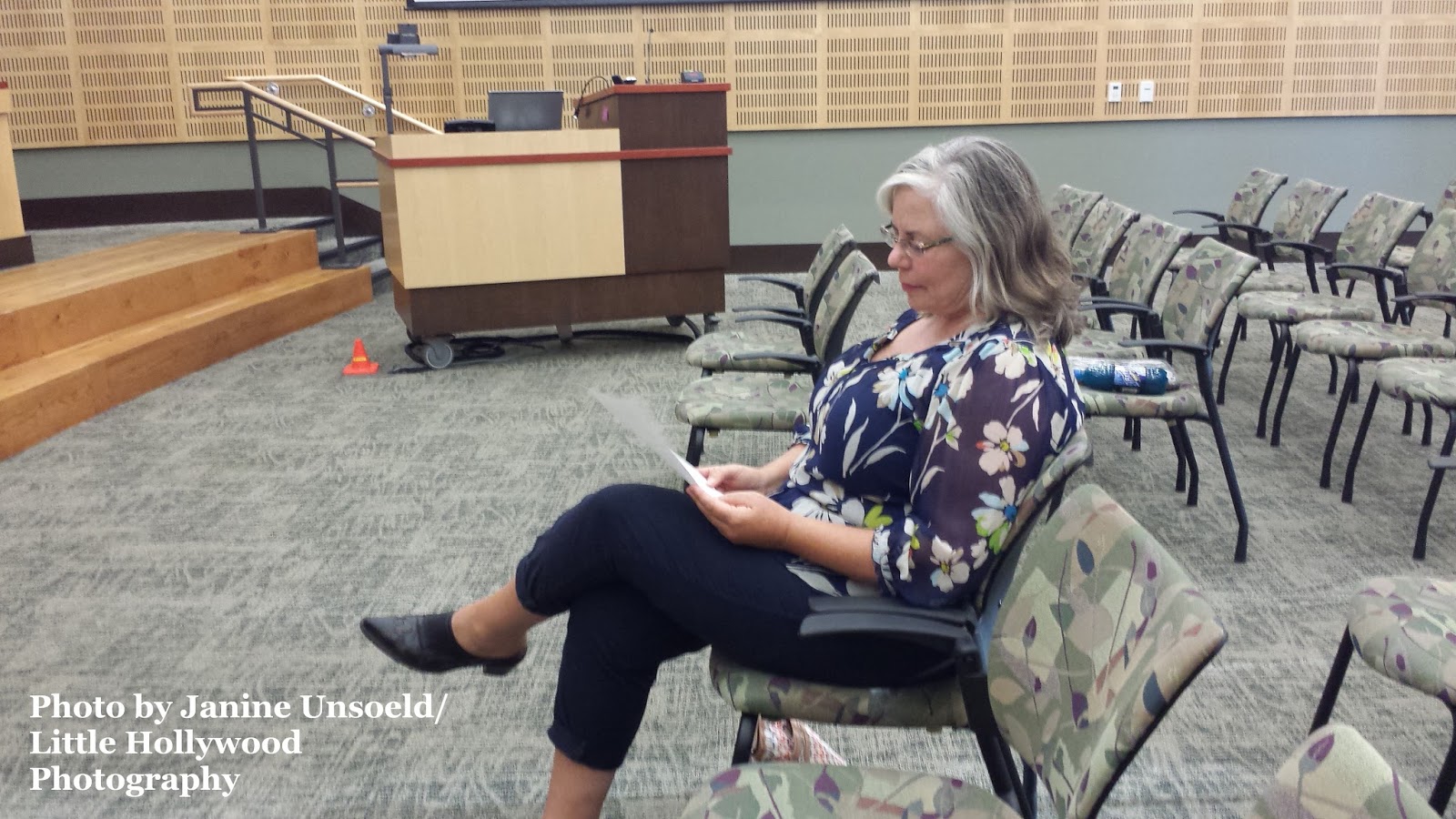
Above: Melinda Spencer arrived early at tonight's Olympia city council meeting to give public comment about an alleged commercial marijuana grow operation in her northeast neighborhood. Spencer believes that three recent utility line fires near her home were caused by the operation. 

By Janine Unsoeld

Code enforcement for residents of the City of Olympia is an issue fraught with emotions. Law abiding citizens turn to the City of Olympia for help and information regarding sidewalks blocked with vegetation, abandoned or dilapidated houses used by the homeless, abandoned vehicles, busy drug houses operating in established neighborhoods, and nuisance dogs.

Commercial businesses like the Grande Terrace on Capitol Lake, a wedding and event venue on Deschutes Parkway, also test neighbor's nerves, when they are blatantly allowed to skirt the law, operating in a residential neighborhood and violating the terms of temporary use permits, as well as known federal and state law and city ordinances.

With the help of a concerned group of neighborhood volunteers between 2010 and 2014, the city did pass a repeat violator ordinance and developed an action plan to improve code enforcement but a functional online system that would allow citizens to track the status of code enforcement complaints has yet to be implemented.

Not surprisingly, a 2014 opinion survey of Olympia’s city government services by Elway Research published last November indicates that code enforcement is lagging.

Out of thousands contacted, the poll surveyed 952 residents drawn from a list of residential utility customers provided by the city.  Survey respondents were asked about the quality of life in Olympia and their assessment of city government programs and services.

Performance lagged behind expectations for six services: neighborhood planning, permits and code enforcement, sidewalks, land use, street maintenance and police patrols.

Neighbor Concerned About Alleged Marijuana Grow Operation

Tonight, northeast neighborhood resident Melinda Spencer addressed the Olympia city council about an alleged unpermitted, commercial marijuana growing operation. The home is 200 feet from Roosevelt Elementary School.

Earlier this month, Spencer reached out to Little Hollywood for assistance and granted an interview to explain her plight.

Spencer said that she believes this operation has caused three fires on the power line outside her home since June 29, causing a transformer fire, lit the lawn on fire, and closed the street. She is concerned about the electrical safety of her home, and other homes in her neighborhood, as well as other issues.

In her comments to city council tonight, Spencer said, “Because this business continues to operate unchecked, we are bracing for the next power surge and fire. The city better hope that the melted service line doesn't fall on a school bus, Intercity Transit bus, U.S. Postal Service mail carrier, or anyone else who lives or travels on our street. We need city staff to investigate this situation and take the appropriate actions. And I shouldn't have to lobby City Council to get our staff to do their job.” 

Spencer mentioned that a group of volunteers worked for four years with city staff from 2010 until 2014 to develop workable solutions, but which city managers have largely ignored.

“You should be very concerned about the lack of accountability that has been allowed to take root among our city staff. Volunteers work for years to cultivate strong neighborhoods, but city staff demolish those gains when they ignore clear code violations and allow unsafe and illegal commercial operations to flourish in our communities,” said Spencer. 
 
“I’m sure the individual code enforcement officers took their positions with the city with every intention of doing a good job for the citizens of Olympia. But something is broken at top levels of city management, and this breakdown has cultivated a culture of inaction among key city staff. Olympia will never grow into its potential if residents' efforts to build strong neighborhoods are obliterated by the lack of accountability among management at City Hall,” she said.

Little Progress and the Run-Around

In her interview with Little Hollywood, Melinda Spencer said she works fulltime and researching city codes has been exhausting.

“This is not what I do for living, and I might have missed something, but I want to know what universe I am in that it takes all this work to get city staff to help us with this situation. I’ve lived here 18 years and I’ve never needed code enforcement. Now that I do, I need them to help me,” said Spencer.

Spencer brought her concern to the attention of the city code enforcement staff in June. She also informed Puget Sound Energy (PSE). As her research increased, so did her email communications to the city. Most recently, on August 13, she informed the city council of her concerns, and received no reply. 

In an email to Spencer on August 7, the city's code enforcement manager, Todd Cunningham, said that the service line from the pole to the home is regulated by PSE – the city has no jurisdiction over this part of the electrical system. He referred the situation to Chris Grabowski, the city’s lead code enforcement officer in charge of complaints for the Eastside.

On August 11, Grabowski referred Spencer to Jeff Payne at PSE, who informed Grabowski that PSE was looking into the line failure but they had not made a determination yet on the cause of the fire. According to Spencer, PSE has had to repair the service line to the property three times since late June.

Grabowski also told Spencer that her issue was not a code enforcement issue, but a law enforcement issue. Grabowski forwarded her concern to the Olympia police, who then forwarded it to the Thurston County Narcotics Task Force.

The business is not listed as licensed on a list of marijuana license applicants by the Washington State Liquor and Cannabis Board (WSLCB). The WSLCB does not issue licenses for locations that are personal residences.

The residence is a small home on a 0.17 acre residential lot owned by Michael Saulino of Ocean Shores, according to Thurston County Assessor’s Office information.

Attempts by neighbors to reach Saulino in early August were unsuccessful. The homeowners sent Saulino a certified letter, but have seen no changes at the home.

“The pot-growing operation continues as usual and it does not look like the tenants are being evicted. We continue to be concerned about fires resulting from these activities,” said Spencer.

Spencer showed Little Hollywood two photos that show how the service line to that property was taped and clamped after the most recent power surge and line fire on July 30.

According to Spencer, a PSE employee who was at her home to determine if her power supply has been affected by the surges said that the fixes to the melted service wire may not appear to be safe, especially if the pot-growing equipment continues to draw extraordinary amounts of energy.

Spencer’s husband, Keith, and PSE staff were given tours by the tenants of the marijuana operation inside the home as well as two attached and detached garages, and confirmed that air conditioners have been running around the clock since they moved into the rental home in January.

In response to Little Hollywood's question about odors, Spencer said, “Yes, there are uncontrolled odors, and the pesticide and fertilizer use goes down into our water system, but the pot operation isn’t even the issue for me. It’s an unpermitted commercial operation that is exceeding the capacity of the system in a residential area….The city is on the hook for this,” said Spencer, as she concluded our interview.

City Response 

As is customary at city council meetings, council members listen to all speakers at public comment time and at their discretion, choose to respond to specific speakers and issues.

In response to Spencer’s comments, Olympia city manager Steve Hall said that city staff has been very responsive to Spencer’s concerns, and detailed the city communications with PSE and staff, information that was already known to Spencer. Hall said PSE has assured the city that the power lines are safe.

Hall also said that he just received information that he had not shared with Spencer.

Hall said that city staff contacted the Thurston County Narcotics Task Force, who investigated and determined that the location is a collective garden operation, which would be allowed under state law, and as such, would not be regulated by the city, nor is a business license required. 

Councilmember Nathaniel Jones commented that he remains concerned about the city’s role in the situation and was concerned about the three recent fires within a short period of time.

“It seems to me we have some responsibility to follow up with PSE in our role….to ensure there are no remaining concerns about fire risk or electrical failure.” He thanked staff for what has been done but said the report did not give him confidence on continuing risk.

Councilmember Jeannine Roe also thanked Spencer for coming, and said she sensed that the city needed the improve communications with constituents.

As the council turned to other business, speakers left the council chambers en masse. Hall quickly gave Spencer his business card as she left.

Outside city hall, Spencer was incensed with Hall’s comments.

“….I was last in contact with the city on Thursday and I never heard anything else after that…. He could have had the courtesy to call or email me…To undercut what I said in public! That’s mean! I’ve waited the last three business days for communication from the city because I’ve been giving them the benefit of the doubt. All along I’ve been thinking, ‘prove me wrong!’ You just don’t do that!”

Spencer complimented the councilmembers who expressed concern about the issue.

“It is not a collective grow operation. They have several hundred plants in there. The city is trying to tie it up in a tiny little bow because code enforcement minimized the problem,” said Spencer.

Above: City of Olympia's Strategic Communications Director Kellie Purce Braseth, who began her new position with the city on July 13, checks the public comment sign-in sheets at 6:50 p.m. City council meetings usually start at 7:00 p.m. At the beginning of the meeting, Braseth takes the sheets to the mayor, who usually calls speakers up to the podium in the order in which they signed up.

Tonight, ten speakers spoke on issues related to code enforcement, public support for the city's possible purchase of 75 acres off Kaiser Road as open park space, support for a $15 minimum wage, support for the the city's possible purchase of LBA Woods, and Black nationalism.


Labels