Showing posts with label narcotics. Show all posts

Code Enforcement Leaves Olympia Resident Frustrated
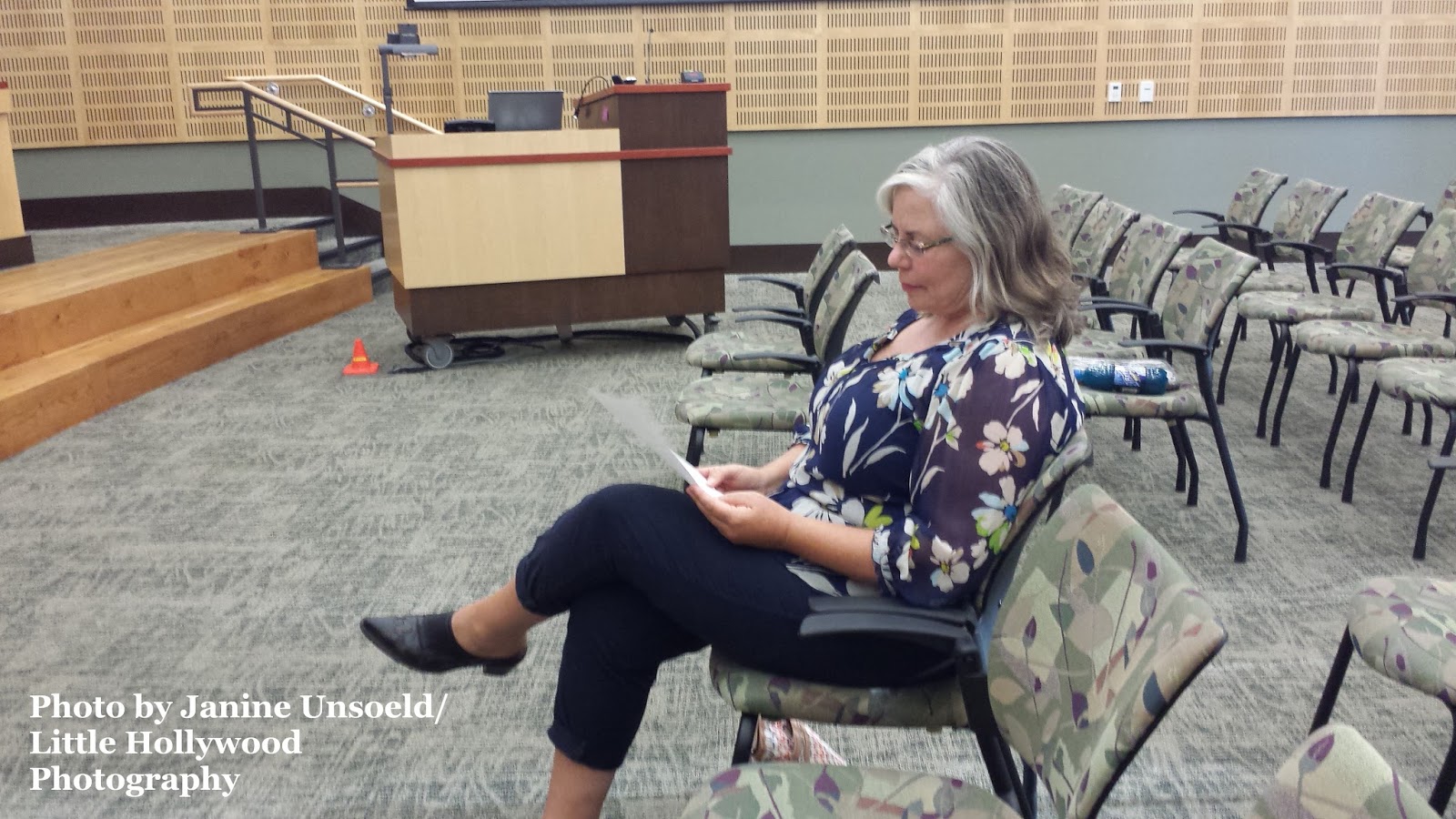

Above: Melinda Spencer arrived early at tonight's Olympia city council meeting to give public comment about an alleged commercial marijuana grow operation in her northeast neighborhood. Spencer believes that three recent utility line fires near her home were caused by the operation. 

By Janine Unsoeld

Code enforcement for residents of the City of Olympia is an issue fraught with emotions. Law abiding citizens turn to the City of Olympia for help and information regarding sidewalks blocked with vegetation, abandoned or dilapidated houses used by the homeless, abandoned vehicles, busy drug houses operating in established neighborhoods, and nuisance dogs.

Commercial businesses like the Grande Terrace on Capitol Lake, a wedding and event venue on Deschutes Parkway, also test neighbor's nerves, when they are blatantly allowed to skirt the law, operating in a residential neighborhood and violating the terms of temporary use permits, as well as known federal and state law and city ordinances.

With the help of a concerned group of neighborhood volunteers between 2010 and 2014, the city did pass a repeat violator ordinance and developed an action plan to improve code enforcement but a functional online system that would allow citizens to track the status of code enforcement complaints has yet to be implemented.

Not surprisingly, a 2014 opinion survey of Olympia’s city government services by Elway Research published last November indicates that code enforcement is lagging.

Out of thousands contacted, the poll surveyed 952 residents drawn from a list of residential utility customers provided by the city.  Survey respondents were asked about the quality of life in Olympia and their assessment of city government programs and services.

Performance lagged behind expectations for six services: neighborhood planning, permits and code enforcement, sidewalks, land use, street maintenance and police patrols.

Neighbor Concerned About Alleged Marijuana Grow Operation

Tonight, northeast neighborhood resident Melinda Spencer addressed the Olympia city council about an alleged unpermitted, commercial marijuana growing operation. The home is 200 feet from Roosevelt Elementary School.

Earlier this month, Spencer reached out to Little Hollywood for assistance and granted an interview to explain her plight.

Spencer said that she believes this operation has caused three fires on the power line outside her home since June 29, causing a transformer fire, lit the lawn on fire, and closed the street. She is concerned about the electrical safety of her home, and other homes in her neighborhood, as well as other issues.

In her comments to city council tonight, Spencer said, “Because this business continues to operate unchecked, we are bracing for the next power surge and fire. The city better hope that the melted service line doesn't fall on a school bus, Intercity Transit bus, U.S. Postal Service mail carrier, or anyone else who lives or travels on our street. We need city staff to investigate this situation and take the appropriate actions. And I shouldn't have to lobby City Council to get our staff to do their job.” 

Spencer mentioned that a group of volunteers worked for four years with city staff from 2010 until 2014 to develop workable solutions, but which city managers have largely ignored.

“You should be very concerned about the lack of accountability that has been allowed to take root among our city staff. Volunteers work for years to cultivate strong neighborhoods, but city staff demolish those gains when they ignore clear code violations and allow unsafe and illegal commercial operations to flourish in our communities,” said Spencer. 
 
“I’m sure the individual code enforcement officers took their positions with the city with every intention of doing a good job for the citizens of Olympia. But something is broken at top levels of city management, and this breakdown has cultivated a culture of inaction among key city staff. Olympia will never grow into its potential if residents' efforts to build strong neighborhoods are obliterated by the lack of accountability among management at City Hall,” she said.

Little Progress and the Run-Around

In her interview with Little Hollywood, Melinda Spencer said she works fulltime and researching city codes has been exhausting.

“This is not what I do for living, and I might have missed something, but I want to know what universe I am in that it takes all this work to get city staff to help us with this situation. I’ve lived here 18 years and I’ve never needed code enforcement. Now that I do, I need them to help me,” said Spencer.

Spencer brought her concern to the attention of the city code enforcement staff in June. She also informed Puget Sound Energy (PSE). As her research increased, so did her email communications to the city. Most recently, on August 13, she informed the city council of her concerns, and received no reply. 

In an email to Spencer on August 7, the city's code enforcement manager, Todd Cunningham, said that the service line from the pole to the home is regulated by PSE – the city has no jurisdiction over this part of the electrical system. He referred the situation to Chris Grabowski, the city’s lead code enforcement officer in charge of complaints for the Eastside.

On August 11, Grabowski referred Spencer to Jeff Payne at PSE, who informed Grabowski that PSE was looking into the line failure but they had not made a determination yet on the cause of the fire. According to Spencer, PSE has had to repair the service line to the property three times since late June.

Grabowski also told Spencer that her issue was not a code enforcement issue, but a law enforcement issue. Grabowski forwarded her concern to the Olympia police, who then forwarded it to the Thurston County Narcotics Task Force.

The business is not listed as licensed on a list of marijuana license applicants by the Washington State Liquor and Cannabis Board (WSLCB). The WSLCB does not issue licenses for locations that are personal residences.

The residence is a small home on a 0.17 acre residential lot owned by Michael Saulino of Ocean Shores, according to Thurston County Assessor’s Office information.

Attempts by neighbors to reach Saulino in early August were unsuccessful. The homeowners sent Saulino a certified letter, but have seen no changes at the home.

“The pot-growing operation continues as usual and it does not look like the tenants are being evicted. We continue to be concerned about fires resulting from these activities,” said Spencer.

Spencer showed Little Hollywood two photos that show how the service line to that property was taped and clamped after the most recent power surge and line fire on July 30.

According to Spencer, a PSE employee who was at her home to determine if her power supply has been affected by the surges said that the fixes to the melted service wire may not appear to be safe, especially if the pot-growing equipment continues to draw extraordinary amounts of energy.

Spencer’s husband, Keith, and PSE staff were given tours by the tenants of the marijuana operation inside the home as well as two attached and detached garages, and confirmed that air conditioners have been running around the clock since they moved into the rental home in January.

In response to Little Hollywood's question about odors, Spencer said, “Yes, there are uncontrolled odors, and the pesticide and fertilizer use goes down into our water system, but the pot operation isn’t even the issue for me. It’s an unpermitted commercial operation that is exceeding the capacity of the system in a residential area….The city is on the hook for this,” said Spencer, as she concluded our interview.

City Response 

As is customary at city council meetings, council members listen to all speakers at public comment time and at their discretion, choose to respond to specific speakers and issues.

In response to Spencer’s comments, Olympia city manager Steve Hall said that city staff has been very responsive to Spencer’s concerns, and detailed the city communications with PSE and staff, information that was already known to Spencer. Hall said PSE has assured the city that the power lines are safe.

Hall also said that he just received information that he had not shared with Spencer.

Hall said that city staff contacted the Thurston County Narcotics Task Force, who investigated and determined that the location is a collective garden operation, which would be allowed under state law, and as such, would not be regulated by the city, nor is a business license required. 

Councilmember Nathaniel Jones commented that he remains concerned about the city’s role in the situation and was concerned about the three recent fires within a short period of time.

“It seems to me we have some responsibility to follow up with PSE in our role….to ensure there are no remaining concerns about fire risk or electrical failure.” He thanked staff for what has been done but said the report did not give him confidence on continuing risk.

Councilmember Jeannine Roe also thanked Spencer for coming, and said she sensed that the city needed the improve communications with constituents.

As the council turned to other business, speakers left the council chambers en masse. Hall quickly gave Spencer his business card as she left.

Outside city hall, Spencer was incensed with Hall’s comments.

“….I was last in contact with the city on Thursday and I never heard anything else after that…. He could have had the courtesy to call or email me…To undercut what I said in public! That’s mean! I’ve waited the last three business days for communication from the city because I’ve been giving them the benefit of the doubt. All along I’ve been thinking, ‘prove me wrong!’ You just don’t do that!”

Spencer complimented the councilmembers who expressed concern about the issue.

“It is not a collective grow operation. They have several hundred plants in there. The city is trying to tie it up in a tiny little bow because code enforcement minimized the problem,” said Spencer.

Above: City of Olympia's Strategic Communications Director Kellie Purce Braseth, who began her new position with the city on July 13, checks the public comment sign-in sheets at 6:50 p.m. City council meetings usually start at 7:00 p.m. At the beginning of the meeting, Braseth takes the sheets to the mayor, who usually calls speakers up to the podium in the order in which they signed up.

Tonight, ten speakers spoke on issues related to code enforcement, public support for the city's possible purchase of 75 acres off Kaiser Road as open park space, support for a $15 minimum wage, support for the the city's possible purchase of LBA Woods, and Black nationalism.


Proposed Downtown Olympia Drug-Free Zone Ordinance Passes Committee


By Janine Unsoeld
To potentially thwart the activity of drug dealers in downtown Olympia, a proposed drug-free zone ordinance passed the city’s Land Use and Environment committee on February 20 and will now go to the full council.
It has not yet been scheduled to be heard by the city council as of this week.
The draft ordinance designates five civic centers located in downtown Olympia and the area within 1000 feet of the perimeter of each civic center as drug-free zones.
These civic centers include the Hands-On Children’s Museum on Adams Street, the Washington Center on Washington Street, the Olympia Center on Columbia Street, Olympia City Hall on Fourth Avenue, and the Olympia Timberland Library on Eighth Avenue. A map indicating the areas shows that the downtown core of Olympia is covered.
The draft ordinance, states, “…there is an increase in the consumption of illegal felony drugs, including methamphetamine and heroin….Drug-free zones will permit a potential enhanced sentence if a person is convicted of a felony drug offense in violation of 59.50.401, 69.50.410, and 69.50.204, excluding marijuana leaves and flowering tops….”
The creation of the draft ordinance was a joint decision made between multiple agencies and departments within the city. 
The police department worked with the city prosecutor, the Thurston County prosecutor, the Thurston County Sheriff, the city manager’s office, the Community Planning & Development department, the Parks department, and the Public Works department.
The top five reasons for arrests downtown in 2013 in descending order, are outstanding warrants, drinking in public, trespassing, assault, and narcotics, says Amy Stull, senior program specialist for police community programs at the Olympia Police Department.
Roberts and Tunheim Address Proposed Ordinance
Olympia Police Chief Ronnie Roberts and Thurston County Prosecutor Jon Tunheim explained the proposed ordinance in a brief presentation to the committee.
“State law allows this designation….It certainly is not the solution. We can’t arrest our way out…but it does allow us to identify those repeat offenders and refer those cases….All these areas are where we’ve had a considerable number of calls,” said Chief Roberts.
The proposed ordinance uses current statute language and does not take the passage of I-522 into consideration. “The marijuana discussion is different,” said Tunheim.
Tunheim said his office would use the designation as a strategy, and is a collaborative effort with other agencies. “It has a valuable role, and is really consistent with the ongoing efforts of the Olympia Police Department and all law enforcement leaders of the community with a more regional approach….I want to stress it’s not our intention to go on an all-out enforcement effort and jail everyone we can….It’s about the prosecution of drug dealers and the ability to address the chronic offenders with some enhanced sentence.”
Tunheim said that with an arrest for a felony drug case, the offender could go to the state prison system if the sentence exceeds one year, or it could get handled on a county level. “The enhanced sentence automatically kicks us into that conversation for treatment options, through the Drug Offender Sentencing Alternative (DOSA) or Drug Court.”
The Thurston County Superior Court Drug Court is a 12 – 18 month treatment program, but not everyone is eligible to participant.
Tunheim said, “Coerced drug treatment can be as effective as voluntary treatment, and that’s a shift of what we’ve known before….The more leverage you put on the table, the greater chance they can get treatment.  Make no mistake - dealers are in it for the money. That’s what they’re motivated by.”
Roberts and Tunheim would like a map of the ordinance area to be part of the ordinance. “Admitting it into evidence makes it easier for us, so we can say, ‘here’s the zone, here’s where the deal happened.’”
Tunheim added that the prosecution doesn’t have to prove that the offender knew it was a drug-free zone and says a dealer is defined as someone who possesses drugs and paraphernalia with intent to deliver. Evidence could include packaging, materials for the purpose of redistribution, scales, notes, records, multiple packages of all the same weight, and the presence of drugs.
“There is no automatic threshold – it’s just the totality of evidence,” said Tunheim.
Tunheim said he plans to ask the court to restrict the offender’s ability to come into downtown. “If the court puts that in place and a law enforcement officer knows they have that order, then they will be in violation of a court order, and the officer can engage that person and make an arrest.”
The specifics of an exclusion order will be addressed at the time the order is issued by the court, said Chief Roberts, when asked later by Little Hollywood.
Asked if there is capacity to hold additional offenders, Tunheim said yes. “Yes, we have capacity. We have for quite awhile. We face this challenge of people not looking at a lengthy sentence for a felony…they serve time, get out, and do it again. It’s tougher for us to push people into treatment….The Drug Court has their own treatment staff. There is capacity. In the county overall, outside the criminal justice system, for detox and drugs, there is a lack of capacity.”
Felony offenses are already illegal in parks so drug-free zone signs will not need to be placed in parks such as Heritage Park or Sylvester Park, which are governed by the state. It is expected one sign per city facility would be sufficient notice.
“The signs will send a message to the community that we’re taking this serious, that we’re cracking down,” said Councilmember Jeannine Roe.
Councilmember Langer said he would like to get the word out to the Tacoma community that dealers are not welcome in Olympia. Roberts and Tunheim said there are already collaborative efforts underway with the City of Tacoma Narcotics Task Force.
Connie Lorenz, executive director of the Olympia Downtown Association, asked about the Olympia Farmer’s Market. Roberts admitted that the market is not included in the zone and is a point of contention in discussions. “I was concerned with going too far. It is city property….the city attorney will have to weigh in.”
Councilmember Steve Langer invited public comment during the meeting, and community member Monica Hoover said that the proposed ordinance criminalizes poverty.
She followed up her comments with a letter to the council, saying in part, “I have no faith that the prison system contains solutions for the vast majority of the problems we are facing in society.  They are mostly part of the problem that drains resources away from what people really need.

“The United States has the highest incarceration rates in the world; many times greater than countries that we might consider our peers.  Longer sentences for drug related crimes are a significant part of this problem.  Please reject this ordinance and work for solutions that don't exacerbate the prison problem.”
Tunheim responded, saying that in the last 25 years, there has been a dramatic shift away from incarceration to treatment. “….Evidence is showing us that criminal justice gets people into treatment and use the system as a way to get into treatment.”

Roberts said that when people complete Drug Court, the charges are dismissed.

Roe said she views the proposed ordinance as a deterrent for hardcore dealers. “It may save some lives, and targets individuals making a business of this.” Langer agreed. “I support this. It deals with drug dealers and not users.”
Exclusion From Downtown Olympia
Later, Tunheim clarified for Little Hollywood that whether a certain offender is excluded from the downtown or not is ultimately a judge's decision and will likely be made on a case by case basis, depending on the circumstances of that case and the offender. 
“Both the state (through the prosecutor) and the defense are allowed opportunities to make recommendations to the court before a judge makes the decision.  My deputy prosecutors will generally recommend a condition like this if they believe the person continues to present a risk of further criminal behavior downtown.  A judge can potentially order someone excluded from downtown at any point in time after they are arrested and charged and, once imposed, a condition like this would likely last until the case is concluded. However, if the defendant is convicted, the same order can also be part of the court's sentence extending the condition up to a couple of years.”
To clarify questions regarding the Drug Court program, Tunheim also said later:
“In almost all cases involving drug related charges, participants who graduate have their charges dismissed.  That is part of the reward for successfully completing the treatment program.  Their “record” (because it does not involve a conviction it is generally only available to law enforcement) shows only that they were arrested and charged, but that the charge was dismissed.  If someone enters drug court but is terminated before they graduate, then the judge decides their guilt or innocence for the original crime based only on the information contained in the police report.  If convicted, then they will have that conviction on their record.”
Upcoming:
A conference, Substance Abuse: A Community Response, will be held Wednesday, April 30, 2014, from 9:00 a.m. to 4:00 p.m. at Great Wolf Lodge Conference Center, 20500 Old Highway 99 SW, Centralia, WA 98531.
Sponsored by the Thurston County Drug Action Team, the conference will provide educational breakout sessions, opportunity for discussion and collaboration, and informative professional keynote speakers.

Prevention leaders, treatment professionals, law enforcement professionals, educators, health professionals, government officials and community members are invited to attend. 

The conference is designed to cover all community sectors and focus on current and emerging issues, latest research findings, best practices, successes, lessons learned, and problems solved. The conference is designed for all levels of experience. 
 
Early-bird registration, on or before March 31, is $35 and includes lunch. Regular price registration, April 1 and later, is $45. Payment for registration must be received on or before March 31 to qualify for the early-bird price.
For more information, contact Tamara Clark, Events Coordinator, TOGETHER!, at tclark@thurstontogether.orgor 360-493-2230 ext. 10.

For more information about the proposed ordinance, go to the February 19, 2014 story, “Draft Drug Ordinance Covers All of Downtown Olympia,” at www.janineslittlehollywood.blogspot.com.
The City of Olympia website is www.olympiawa.gov

Labels